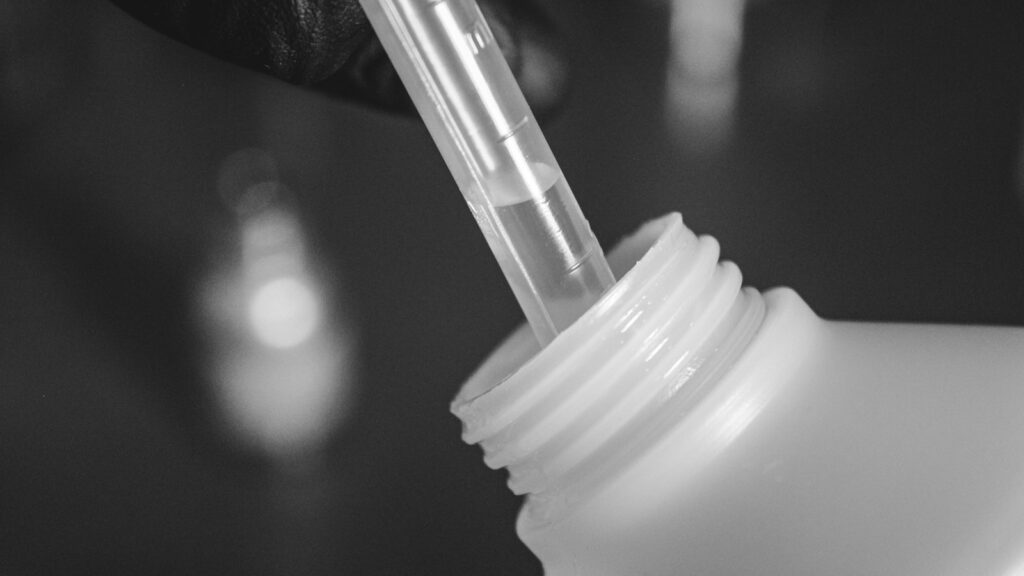
A micropipette is a hand-held piston instrument that measures and transfers liquid volumes from about 1 µL to 1000 µL, and in most laboratory work it is the last thing between a planned volume and the volume that reaches the well. Small transfer errors carry through every dilution step and show up as shifted curves and poor replicates. Knowing the parts, the two techniques and how accuracy is measured separates a reliable plate from a noisy one.
This guide covers the parts of a micropipette, how to use one, forward and reverse pipetting, the ISO 8655 limits and gravimetric checks behind pipette calibration, and why peptide work adds adsorption to plastic. “How to use” here refers only to the instrument, with a generic aqueous buffer as the example liquid.
The short answer
- What it is. A micropipette moves a piston to draw liquid into a disposable tip, usually with a cushion of air between the piston and the sample.
- The core parts. Plunger with two stops, volume adjuster and display, tip ejector, shaft and tip cone, plus the disposable tip.
- Two techniques. Forward pipetting is the default for aqueous liquids; reverse pipetting is a workaround for viscous, foaming or low-surface-tension samples.
- Accuracy is measured by weight. ISO 8655 allows ±0.8% systematic error and 0.3% random error at nominal volume on a 200 µL pipette, checked gravimetrically.
- Size matters. ISO limits are fixed in µL across a pipette’s range, so a 100 µL transfer on a P1000 may legitimately be off by 8%.
Micropipette at a glance
Also called: pipettor, piston-operated pipette, air-displacement pipette
- Governing standard
- ISO 8655 (Part 2 covers pipettes; 2022 edition)
- Common models
- P10, P20, P100, P200, P1000
- Main designs
- Air-displacement and positive-displacement; single and multichannel
- Reference check
- Gravimetric: 10 measurements at 100%, 50% and 10% of nominal
- Reference limits, P200
- ±1.6 µL systematic, 0.6 µL random
Where the evidence stands
- Standardized method
- Routine in labs
- Technique effects measured
- Peptide loss in tips measured
Instrument limits and gravimetric checks are well defined. Peptide adsorption has been measured mainly on containers, not tips.
Parts of a micropipette
- Plunger. The thumb button that drives the piston. It has a rest position and two stops you can feel: the first sets the measured stroke and the second, the blow-out, travels further to clear the tip.
- Volume adjuster and display. A thumbwheel or the plunger itself turns to set the volume. When increasing, go one-third of a turn past the setting and come back down, and read the display at eye level [14].
- Tip ejector. Pushes the used tip off without touching it.
- Shaft and tip cone. The lower barrel, ending in the cone where the tip seals. A poor seal here can ruin a measurement.
- Disposable tip. The only part that touches liquid in an air-displacement pipette, and part of the measuring system: ISO 8655-2 covers tips in its scope [3], and Gilson ties its stated limits to its recommended tips [5].
The design dates from March 1957, when Heinrich Schnitger, a physician at the University of Marburg, built a prototype to spare himself hand-pipetting many small chromatography fractions [1]. Eppendorf launched the first industrially manufactured version in 1961 [2].
How a micropipette works: air versus positive displacement
In an air-displacement pipette, a cushion of air sits between the piston and the sample. When the piston rises, the air expands and atmospheric pressure pushes liquid up into the tip. Anything that changes the air, such as temperature or vapour pressure, can change the volume delivered. These pipettes are calibrated to water under defined conditions [11], and they give high accuracy and precision on aqueous, non-viscous liquids [13].
In a positive-displacement pipette, the piston is built into a disposable capillary tip and touches the liquid directly. Gilson recommends this design for viscous, dense, volatile, foaming, hot or cold liquids [13].
A multichannel pipette runs several channels at once to load plates quickly. ISO limits are doubled for these models [4], so the time saved comes with a wider tolerance.
How to use a micropipette: forward pipetting step by step
Forward pipetting is the standard technique for aqueous samples. These steps follow manufacturer guidance [14].
- Choose the smallest pipette that covers the volume.
- Equalize temperature. Let pipette, tips and buffer sit in the room together first.
- Set the volume and seat the tip. Use a slight twist; do not hammer it on.
- Pre-wet when conditions allow. Draw up and expel the set volume about three times with each new tip [4], unless temperatures differ (see below).
- Press smoothly to the first stop, pipette vertical, tip out of the liquid.
- Aspirate. Immerse the tip, let the plunger return smoothly, and wait about one second before lifting out [9].
- Dispense. Touch the tip to the inside wall; press to the first stop.
- Blow out. Pause for a second, press to the second stop, and slide the tip up the wall as you withdraw it.
- Eject the tip and take a fresh one for the next sample.
Planning in-vitro receptor or signalling work? See the growth and signalling range, priced in CAD.
Browse growth and signalling reagentsReverse pipetting and when it helps
Reverse pipetting draws up more liquid than the set volume, dispenses the set volume at the first stop, and leaves the remainder in the tip [12]. It is recommended for viscous, foaming, high-vapour-pressure and low-surface-tension liquids [11] [12], including buffers with enough surfactant to foam at blow-out.
The reported benefit is mostly in repeatability. In a Thermo Fisher application study, 1 µL and 10 µL transfers of 1% bovine serum albumin were repeated five times each with the pipette adjusted for each technique, and reverse pipetting cut imprecision by over 50% [15]. That is a manufacturer study with few repeats, not an independent trial.
It is not a universal upgrade. METTLER TOLEDO warns it can reduce accuracy and that precision depends on the user [12], another note cautions that it can over-deliver [22], and a 1996 article found it gave poorer inaccuracy than forward pipetting with methanol [16].
| Factor | Forward pipetting | Reverse pipetting |
|---|---|---|
| Press before aspirating | First stop | Second stop |
| Dispense | First, then second stop | First stop only |
| Liquid left in tip | None intended | Residue, sent to waste |
| Suits | Aqueous samples, small amounts of protein or detergent | Viscous, foaming, low-surface-tension liquids |
| Main risk | Film left on tip; foam at blow-out | Over-delivery; user-dependent |
Accuracy limits under ISO 8655
ISO 8655 is the international standard for piston-operated volumetric apparatus. Part 2 sets maximum permissible errors for single and multichannel pipettes, and the Standards Council of Canada lists its 2022 edition [3]. It separates two kinds of error:
- Systematic error (inaccuracy) is how far the mean of repeated deliveries sits from the set volume.
- Random error (imprecision) is the scatter of deliveries around their own mean.
These limits at nominal volume are as reproduced in manufacturer documents [4] [5].
| Nominal volume | Systematic limit | Random limit |
|---|---|---|
| 10 µL (P10) | ±0.12 µL (±1.2%) | 0.08 µL (0.8%) |
| 20 µL (P20) | ±0.20 µL (±1.0%) | 0.10 µL (0.5%) |
| 100 µL (P100) | ±0.80 µL (±0.8%) | 0.30 µL (0.3%) |
| 200 µL (P200) | ±1.6 µL (±0.8%) | 0.60 µL (0.3%) |
| 1000 µL (P1000) | ±8.0 µL (±0.8%) | 3.0 µL (0.3%) |
The limits stay fixed in microlitres across a pipette’s range [5] [6]. A 1000 µL pipette may be off by ±8 µL at any setting: ±0.8% at 1000 µL but ±8% at 100 µL [6]. The same 100 µL transfer carries a limit of ±1.6 µL on a P200 and ±0.8 µL on a P100. These figures describe the instrument under test conditions, not errors added at the bench. Sources differ at the smallest volumes (a 2 µL pipette appears at ±4.0% [4] and at ±2.5% [5]), so check the manufacturer’s specification there.
Pipette calibration and gravimetric checks
Gravimetric checking weighs what the pipette delivers and converts the mass to volume.
- Conditions. A draft-free room held within ±0.5 °C, between 15 and 30 °C, at about 50% relative humidity or above. Pipette, tips and water stand in the room for at least 2 hours first [7] [8].
- Test liquid and balance. Distilled or ion-free water, a balance whose resolution gets finer as volume falls, and evaporation control below 50 µL [7] [8].
- Replicates. Ten measurements at each of 100%, 50% and 10% of nominal volume [4] [7].
- Z factor. Each mass is multiplied by a temperature-specific factor in µL per milligram. For distilled water at 1 atmosphere, Z is 1.0029 at 20.0 °C, 1.0033 at 22.0 °C and 1.0040 at 25.0 °C [4].
A worked example, with invented numbers for illustration. A P200 set to 200 µL gives ten deliveries with a Z-corrected mean of 198.9 µL and a standard deviation of 0.5 µL. Systematic error is (198.9 − 200) ÷ 200 = −0.55%, inside the ±0.8% limit. Random error is 0.5 ÷ 198.9 = 0.25%, inside the 0.3% limit. It passes at this volume.
Between calibrations, METTLER TOLEDO’s quick check uses four replicates at 100% and 10% of nominal volume [4]. If a pipette fails, Eppendorf advises checking tip type, leaks and temperatures first; readjustment is a last resort, with all three points retested afterwards [7].
How often to calibrate
Guidance differs. Eppendorf says at least once a year, sooner with heavy use, many users or aggressive liquids [7]. Gilson suggests three to four checks a year for frequently used pipettes [14]. METTLER TOLEDO suggests monthly quick checks for pipettes used every working day and quarterly for occasional ones [4]. A reasonable approach is to set the interval by the cost of an undetected error: a pipette that defines a calibration series deserves more checks than one used for rough buffer top-ups.
In Canada, the Standards Council of Canada publishes accreditation scopes for calibration laboratories. One example, the ISO/IEC 17025 scope of Techmétrique Inc. in Saint-Lambert, Quebec, lists single and multichannel pipettes by ISO 8655 from above 20 µL up to 10 000 µL [21].
Where the errors come from
Eppendorf publishes reference values for common influences as a percentage of nominal volume [7].
| Influence | Reference effect | Practical fix |
|---|---|---|
| Leaky or poorly fitting tip | 0.5% up to 50% | Use recommended tips; check the seal |
| Not wiping the tip when required | Up to 3.0% | Touch off against the vessel wall consistently |
| No pre-wetting | Up to 2% | Pre-wet when temperatures match |
| Uneven rhythm | Up to 1.5% | Keep timing the same across a plate |
| Immersion depth and handling angle | Up to 1.0% | Hold vertically; keep depth consistent |
| Uneven piston movement | Up to 0.5% | Smooth thumb action, no snapping |
Temperature and pre-wetting interact
A technical analysis co-authored with the Fraunhofer Institute for Silicate Research names the liquid-to-pipette temperature difference as the largest error source, at roughly 0.3% per kelvin at nominal volume, while the shared temperature level matters far less [9]. Skipping the pre-rinse cut that effect to about one-third to one-sixth, and hand warmth can also shift volume [9]. A German calibration service report covers these factors [10].
So pre-wetting is not automatically good. When temperatures match, it avoids a low first delivery. When they differ and cannot be equalized, BRAND advises against pre-wetting and for changing the tip after each step [11]. Eppendorf also notes systematic deviations with forward pipetting when liquid is not at 22 °C [20]. Buffer straight from the fridge is the everyday example; our peptide storage guide covers cold-stored reagents.
Angle, depth and thumb
Tilting a 1000 µL pipette by 45° during aspiration raises the volume by about 0.28% at nominal [9]. Depth is more nuanced: one note recommends about 1 cm [22], while the Fraunhofer-BRAND analysis found no direct effect and only a small indirect one, below 0.02% per millimetre on large pipettes [9]. In practice, immerse enough to avoid drawing air and stay consistent. Thumb control follows the same logic: the same smooth pressure and rhythm in every well.
Why small transfer errors matter in peptide work
A systematic error in the transfer volume compounds along a dilution series. Take a 1-in-10 series made by moving 100 µL into 900 µL of buffer. If each transfer delivers 101 µL, every step’s ratio is 1.009 times the intended value, and after five steps the last point sits about 4.6% high (our arithmetic, for illustration). Random error partly averages out across replicates; systematic error moves the whole curve. Our peptide calculator handles the arithmetic but cannot correct what the pipette actually delivered.
Quantitative methods depend on accurate standards, which is one reason analytical method validation tests accuracy and precision rather than assuming them. An area-percent purity figure from HPLC is a ratio within one run, so it is less exposed to a small volume error than a concentration result.
Peptides stick to surfaces
A perfectly delivered volume can still contain less peptide than planned. Kristensen and colleagues studied three cationic peptides (mastoparan X, melittin and magainin 2) in 220 µL of 1 µM solution, and recovered only 10–20% after 1 hour in borosilicate glass or polypropylene. Losses were smaller in Protein LoBind tubes and at higher concentrations. Passing 250 µL of 5 µM solution through four glass or polypropylene containers left recovery close to 0% [17]. A study of eight radiolabelled endocrine peptides over 48 hours concluded that container choice prevents unpredictable loss [18].
Those results are specific to the peptides tested, and they measure containers rather than tips. Amphipathic sequences such as LL-37, a 37-residue helical peptide [19], are obvious candidates for a check. Low-retention tips are a reasonable extension, not a proven fix. Keep transfers few at low concentrations and run a recovery test with your own peptide. General handling is covered in our WHMIS lab safety guide.
What’s established and what isn’t
Reasonably well established
- ISO 8655 sets maximum permissible errors for pipettes, and gravimetric testing is the routine way to check them.
- Peptides can adsorb to glass and standard plastics, with low-binding surfaces losing less in the conditions tested.
Open questions
- How much low-retention tips reduce peptide loss for a given sequence and concentration.
- How reliable reverse pipetting is across liquids and users.
- The right calibration interval; European metrology institutes ran a multi-year project that included recalibration frequency [23].
Sourcing for Canadian labs
For labs sourcing research peptides in Canada, a few checks are worth making before an order:
- Know what you are reading. Our guide to reading a laboratory report explains what each section shows.
- Plan for stability. Review how peptides degrade before a long experiment, and see our notes on buying for a university lab.
- Compare suppliers on documents. See our research peptides in Canada overview.
 GHRP-2A six-residue peptide; comparing it across a concentration series depends on accurate transfers.View product
 GHRP-6The related hexapeptide; side-by-side in-vitro comparisons need matched small-volume transfers.View product
 LL-37A 37-residue amphipathic, helical peptide, so surface adsorption is worth testing in your own tubes.View product
Research use only. Pure Peptides Canada products are laboratory reagents for in-vitro research, not for human or veterinary use. This article explains published research for education; it is not medical, dietary or dosing guidance.
Frequently asked questions
What is a micropipette used for?
A micropipette is a hand-held laboratory instrument for measuring and transferring small liquid volumes, typically from about 1 µL to 1000 µL. Common jobs include loading assay plates and building dilution series.
How do you use a micropipette step by step?
Set the volume, seat a tip and hold the pipette vertically. Press to the first stop, immerse the tip, release slowly and wait about one second. Touch the tip to the vessel wall, press to the first stop, pause, press to the second stop, and slide the tip up the wall as you withdraw it.
What is the difference between the first and second stop on a pipette?
The first stop marks the piston travel that corresponds to the set volume. The second stop, or blow-out, travels further and clears the last film of liquid. Forward pipetting aspirates from the first stop and empties at the second; reverse pipetting does the opposite.
When should you use reverse pipetting?
Reverse pipetting is a workaround for viscous, foaming, high-vapour-pressure or low-surface-tension liquids on an air-displacement pipette. It can be more repeatable on these samples but can over-deliver, so check it on the actual liquid. A positive-displacement pipette is the more direct answer.
How often should a pipette be calibrated?
No single interval fits every laboratory, and manufacturers differ. Eppendorf says at least once a year, Gilson suggests three to four checks a year for frequently used pipettes, and a METTLER TOLEDO procedure suggests monthly quick checks for pipettes used every working day. Heavy use, many users and aggressive liquids all justify shorter intervals.
Reagents for your next in-vitro assay
Pure Peptides Canada is a Canadian-owned research supplier, established in 2023 and based in Toronto, selling online in CAD. You can pay by credit or debit card, Interac e-Transfer or cryptocurrency at checkout.
References
- Die Revolution kam aus Marburg. UniForum (Philipps-Universität Marburg). 2005. Source
- Eppendorf. 60-Year Anniversary of a Pipetting Masterstroke. Eppendorf Lab Academy. Source
- Standards Council of Canada. ISO 8655-2:2022, Piston-operated volumetric apparatus, Part 2: Pipettes (database listing). Source
- METTLER TOLEDO. SOP for Pipette Quick Checks (gravimetrically), Version 1.0. 2018. PDF
- Gilson. Pipette Specifications, LT380069-13. PDF
- Ruosaari S. Thermo Scientific Finnpipette Performance Specifications (application note). Thermo Fisher Scientific; 2012. PDF
- Eppendorf. Userguide 025: Pipettes, calibration and adjustment. PDF
- RADWAG. Gravimetric determination of pipette errors. PDF
- BRAND GMBH + CO KG, with Lochner KH (Fraunhofer Institute for Silicate Research). Influences on Volume in Piston-operated Air-displacement Pipettes (technical note). PDF
- Lochner KH, Feldmann R. Analysis of influencing parameters on calibration of piston-operated pipettes with air cushions: Expert Report DKD-E 8-2. Physikalisch-Technische Bundesanstalt; 2013. DOI
- BRAND GMBH + CO KG. The challenges of pipetting (handout 994059). PDF
- METTLER TOLEDO. How to Reverse Pipette. Source
- Gilson. What Are the Benefits of Positive-Displacement Versus Air-Displacement Pipettes? Source
- Gilson. Helpful Tips for Ensuring Proper Pipetting Technique. Source
- Suominen, Koivisto. Increasing Precision When Pipetting Protein Samples: Assessing Reliability of the Reverse Pipetting Technique. American Laboratory. Source
- Ylätupa S. Choosing a pipetting technique affects the results of your analysis. European Clinical Laboratory. October 1996. PDF
- Kristensen K, Henriksen JR, Andresen TL. Adsorption of Cationic Peptides to Solid Surfaces of Glass and Plastic. PLoS One. 2015;10(5):e0122419. DOI
- Goebel-Stengel M, Stengel A, Taché Y, Reeve JR Jr. The importance of using the optimal plasticware and glassware in studies involving peptides. Anal Biochem. 2011;414:38-46. DOI
- Dürr U, Sudheendra U, Ramamoorthy A. LL-37, the only human member of the cathelicidin family of antimicrobial peptides. Biochim Biophys Acta. 2006. DOI
- Eppendorf. Influence of Physical Parameters on the Dispensed Volume of Air-Cushion Pipette. 2016. Source
- Standards Council of Canada. Scope of accreditation, Techmétrique Inc. (ASB SOA 151356 v1). 2026. PDF
- SCION Instruments. Pipetting Best Practice Guide (Technical Note, V.1). 2025. PDF
- EURAMET. Guide on the calibration, operation and handling of micropipettes (project 1295). Source
For laboratory research use only. Not for human or veterinary use. This article summarizes published research for educational purposes and is not medical advice.