
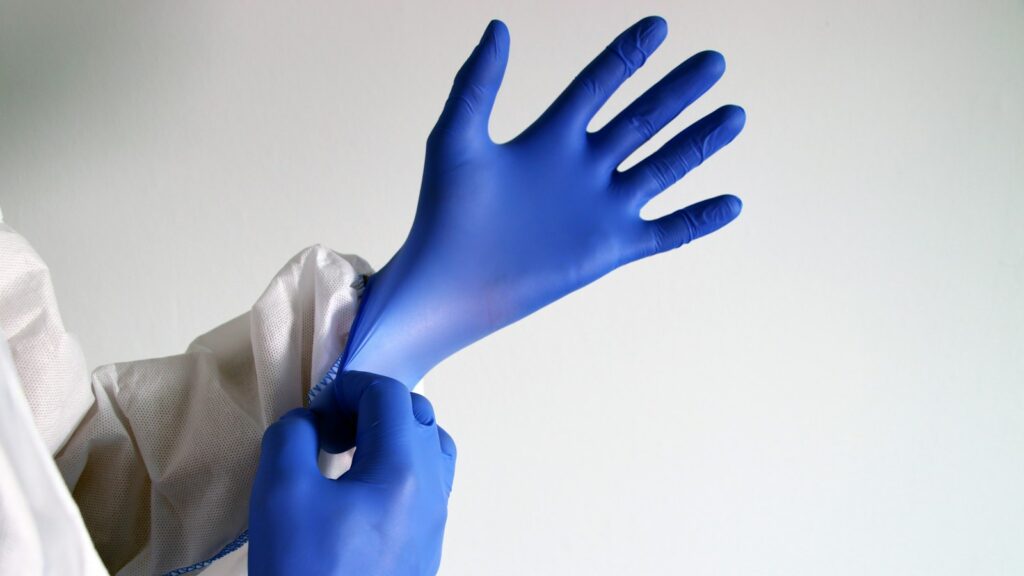
Storage advice for research peptides is about protecting the peptide. Peptide lab safety runs the other way: keeping a dry powder whose hazards may never have been studied off the person weighing it, off the bench and out of the drains. In Canada, the framework is WHMIS 2015, together with provincial and territorial occupational health and safety law and provincial waste rules.
This guide covers the practical side of handling peptide powders: hazard information, controls and PPE for weighing, static, spills, workplace labels, segregation and disposal. It stops at the balance: dissolving material for experiments is outside its scope.
The short answer
- Regard an uncharacterized powder as potentially hazardous. National Research Council guidance reproduced by OSHA says to assume that “all substances of unknown toxicity are toxic”, and NIOSH notes that only a small fraction of chemicals in commercial use have occupational exposure limits.
- Engineering controls come before PPE. CCOHS ranks hazard controls from elimination through engineering and administrative controls to personal protective equipment, the least effective level.
- Weigh in a closed container. Emory University’s weighing procedure tares a lidded container, adds the powder inside a fume hood, closes the lid and re-weighs it, using anti-static tools to keep powder from becoming airborne.
- Never sweep a fine powder. CCOHS warns that sweeping makes fine powder airborne; wipe up wet where that is safe, following section 6 of the SDS and your institution’s spill procedure.
- Label what you decant. Ontario’s WHMIS guide says a hazardous product decanted into a portable container needs a workplace label unless it is all for immediate use, or is used only by the worker who filled it, only during that shift, with the contents clearly identified.
- Peptide waste goes to the chemical-waste program. Not the sink and not the regular garbage: institutional chemical-waste programs work under provincial rules such as Ontario’s Regulation 347, and your EHS office decides how a given waste is classed.
WHMIS in a research lab
Workplace Hazardous Materials Information System · WHMIS 2015 · workplace hazard communication
- What it is
- Hazard classification, labels, safety data sheets, and worker education and training
- Supplier side
- The federal Hazardous Products Act and Regulations
- Employer side
- Provincial or territorial health and safety law; the Canada Labour Code in federal workplaces
- What triggers it
- Meeting a hazard class’s criteria: a classification outcome, not a product category
- Decanted containers
- A workplace label: product name, safe handling precautions, SDS reference
- Laboratory samples
- Narrow label and SDS exemptions for samples under 10 kg intended solely to be tested; not material used to test other things
- Hazardous waste
- Any identification workers understand, such as colour coding or a sign, plus education; no label or SDS needed (Ontario)
- What it is not
- A safety assessment; an unclassified powder is not a proven-safe one
What WHMIS information can tell you about a research powder
- Its classified hazards, where data exist
- How to label, store, clean up and discard it at work
- Effects that nobody has studied
- A safe exposure level where no limit has been set
WHMIS carries what is known; for a sparsely studied compound, the gaps are part of the hazard information.
Why peptide lab safety starts with the powder
Research peptides are usually supplied as a freeze-dried solid, for reasons our explainer on why peptides ship as dry powder sets out, and a dry powder leaves its container easily. CCOHS warns that sweeping makes fine powder airborne, and a balance manufacturer describes dry powders as “very susceptible to static influences”.
The second reason is what is not known. A research compound may have no occupational exposure limit and little published toxicology on inhaling or touching it, and that gap is common. As NIOSH puts it, “Only a small fraction of the chemicals in commercial use have OELs.” Its occupational exposure banding process sorts chemicals without limits into five bands, A to E, by toxicological potency and health effects, each band with an exposure range, through tiers that run from a quick screen to expert judgment. The bench rule is simpler: National Research Council guidance, reproduced in an appendix to OSHA’s laboratory standard, says to assume that “all substances of unknown toxicity are toxic”.
Sensitization needs its own mention because it can develop through repeated exposure. Respiratory or skin sensitization is a WHMIS health hazard class, and it is documented in peptide chemistry: McKnelly, Sokol and Nowick published a case study of anaphylaxis induced by HATU, HBTU and HCTU, coupling reagents used to make peptides, after repeated exposure, and noted that another coupling reagent, DCC, is widely recognized as an immune sensitizer. That evidence concerns synthesis reagents, not finished peptides, and says nothing about any particular product.
Start with the label and the hazard information
A WHMIS supplier label carries a product identifier, the supplier’s identity, pictograms, a signal word, and hazard and precautionary statements, in English and French. On a container of 100 mL or less those statements may be left off the label, although they must still appear in section 2 of the SDS, so a small vial’s label may tell you less than the sheet.
For the detail, go to the SDS where one exists; our explainer on what a safety data sheet covers walks through all 16 sections. For powders, the useful ones are 2 (classification), 6 (accidental release), 7 (handling and incompatibilities), 8 (exposure limits, controls and PPE), 9 (particle characteristics) and 10, whose conditions to avoid include static discharge. Where a required item is unavailable, the regulations require the sheet to say so, and “no data available” should push your controls towards caution.
Lab provisions are narrow: the “laboratory sample” rules cover material under 10 kg intended solely to be tested in a laboratory, not material the lab uses to test other things, and even where a label or SDS is exempt, CCOHS notes that “employers must still provide education and training”. Employer duties are set provincially or territorially, or under the Canada Labour Code in federal workplaces; in Ontario, training must be reviewed at least once a year.
Storing vials as well as handling them? Our storage guide covers temperature, light and moisture.
Peptide storage guideWeighing peptide powders: controls before PPE
CCOHS ranks hazard controls “from the most effective level of protection to the least effective level of protection”: elimination, substitution, engineering controls, administrative controls and, last, PPE. A research compound can rarely be eliminated or substituted, because it is the point of the experiment, but quantities can be kept down. Emory’s procedure says: “Purchase the smallest quantity of hazardous powder required to complete the work.”
Engineering controls carry most of the load. The NRC guidance calls laboratory chemical hoods “the most important components” for protecting laboratory staff. Emory’s procedure weighs by closed container: place an empty, lidded container on the balance and tare it, take it to the fume hood, add the powder and close the lid, then re-weigh it at the balance. Where airflow or vibration rules that out, its alternatives include a HEPA-filtered ventilated balance enclosure, a glove bag or glove box, or an enclosed balance.
Administrative controls fill the gaps: Emory asks for a designated, clearly marked area for hazardous powders, away from high-traffic spots and never near desks or computers. PPE comes last. Emory’s minimum is closed-toe shoes, long trousers or skirts, a lab coat, eye protection and task-appropriate gloves, and section 8 of an SDS may ask for more. A respirator is a separate decision: CCOHS says respirators “should not be the first choice” and belong where other controls are not practical, within a written respiratory protection program that includes fit testing, in line with CSA Standard Z94.4.
| Task | How powder escapes | First control to reach for |
|---|---|---|
| Opening a vial | Air movement lifts loose powder; static makes it jump | Open it inside a fume hood or ventilated enclosure |
| Weighing | Powder handled at an open, unventilated bench | Fill a lidded container in the hood; weigh it closed |
| Transferring with a spatula | Charged particles scatter and cling | Anti-static vessels, bar or gun; disposable spatula and weigh paper |
| Cleaning up a spill | Sweeping or brushing lifts dust back into the air | Wet methods, SDS section 6 and the institution’s procedure |
| Setting a portion aside | An unlabelled container becomes an unknown | A WHMIS workplace label |
| Discarding wipes and gloves | Contaminated items reach the regular garbage | A solid chemical-waste container |
Static, transfers and containment
Static is one reason powder ends up on the pan, the bench and your sleeve instead of in the container. A Mettler Toledo white paper notes that a very dry atmosphere “also fosters the charging of weighing samples, especially in winter”, which will sound familiar in a heated Canadian lab, and that borosilicate glass and laboratory plastics are slow to shed charge. Charged powder jumps from the spatula, and the balance shows the problem as instability and drift, with weighing errors reported from about a milligram to a tenth of a gram.
The fixes are simple. Emory’s procedure puts the first in one line: “Minimize aerosolization of hazardous powders by using anti-static weigh vessels or anti-static bars or guns.” It also says to keep the lid closed between weighing and adding or removing powder, and to use disposable spatulas and weigh paper and discard them immediately. Mettler Toledo adds ionizers, a grounded balance, a metal holder that acts as a Faraday cage, and relative humidity of about 45 to 60 per cent, though humidity alone often falls short. The same habits protect the material: disposable tools and closed containers limit cross-contamination, and for cell-based work, keeping out contaminants such as endotoxin matters too.
Cleaning up a spill of dry powder
Decide first whether the spill is yours to clean. CCOHS is direct: “Only attempt to clean a spill if you are adequately trained to do so and have the correct equipment,” and if in doubt, evacuate and call for help. Section 6 of the SDS gives the supplier’s precautions and clean-up methods, and your institution’s spill procedure sets the local rules and reporting.
For powders, one rule overrides habit: “Do not sweep chemicals that are in fine powder form, as sweeping will make the powder airborne.” CCOHS asks responders to decide whether dry methods are safe or wet techniques are needed, and, if vacuuming, to use appropriate vacuums and filters, including industrial vacuums designed for toxic materials. Emory’s decontamination step for powder work areas takes the wet approach — wet the surfaces with a squirt bottle, then wipe with paper towels — and says brushes should not be used on balances or other hard surfaces. Clean-up materials go into labelled, compatible containers for disposal “according to local regulatory requirements”. Procedures vary between institutions; where yours is more specific, it governs.
Workplace labels, segregation and inventory
A workplace label is the employer’s own label, used only in that workplace. In a lab it matters at decanting: CCOHS says a decanted product needs one if it is not used immediately, if more than one person controls it, or if it is not used up in the shift in which it was decanted. The label carries the product name matching the SDS, safe handling precautions and a reference to the SDS where one exists. A weighed portion set aside in a tared vial for later is exactly that case, and so is a container whose supplier label has become illegible.
On segregation, the NRC guidance is short: “Chemicals should be separated and stored according to hazard category and compatibility.” It is equally short on refrigerators: “Do not store food or beverages in the laboratory refrigerator.” For temperature, light and moisture, which protect the material rather than the people, see our guide to storage conditions for research peptides.
Inventory closes the loop. CCOHS recommends that laboratories keep an up-to-date chemical inventory, and McGill’s hazardous waste program notes that chemicals nobody can identify cannot be disposed of safely and remain the owner’s responsibility, with any analysis paid for by the department — the strongest argument for labelling every container.
Peptide waste disposal: chemical-waste programs and provincial rules
Waste rules are set close to home. In Ontario they sit in Regulation 347 under the Environmental Protection Act; generators report through the Resource Productivity and Recovery Authority’s registry, and the province states that “All off-site movement of hazardous waste and liquid industrial waste is tracked using a digital manifest.” Carriers and receivers need their own environmental approvals, so a lab without an EHS office would need an approved waste carrier.
Institutions turn that into bench rules. The University of Ottawa’s lab-safety training says: “Do not allow any hazardous materials (including hazardous waste) to enter lab sinks at any time.” It collects rinse solutions from hazardous products as hazardous waste, labels every container and segregates waste by hazard class, and notes that the university is registered as a hazardous-waste generator with the province; its sinks also fall under the City of Ottawa’s sewer-use bylaw.
For a peptide lab, the sorting is short. Unused or expired vials stay in their original, labelled containers; McGill, for example, collects original-container chemicals separately instead of having them poured into bulk waste. Contaminated wipes, gloves, weigh papers and disposable spatulas go into a solid chemical-waste container, as Emory directs for gloves and clean-up towels. Nothing goes down the sink, into the regular garbage or up the fume hood: the NRC guidance says chemical waste “should not be disposed of by evaporation in a chemical hood”.
What’s established and what isn’t
Established, and citable
- Substances of unknown toxicity should be assumed toxic (NRC guidance, OSHA 29 CFR 1910.1450 Appendix A).
- Only a small fraction of chemicals in commercial use have occupational exposure limits (NIOSH).
- PPE is the least effective level of the hierarchy of controls (CCOHS).
- Fine powders should not be swept, because sweeping makes them airborne (CCOHS).
- Decanted products need a workplace label unless an exemption applies (CCOHS; Ontario).
- A published case study describes anaphylaxis after repeated exposure to the coupling reagents HATU, HBTU and HCTU (McKnelly et al., 2020).
- Off-site movements of hazardous waste in Ontario are tracked by digital manifest (Government of Ontario).
Open, or outside what WHMIS paperwork can show
- The inhalation and skin hazards of a given research peptide, unless someone has studied and published them.
- Whether any particular peptide is a sensitizer; the coupling-reagent reports do not answer that.
- A safe airborne level for a compound with no exposure limit.
- Whether a given peptide is a WHMIS hazardous product, which is a classification for its supplier.
- Which provincial waste category a particular peptide waste falls into; your EHS office makes that call.
Where to get help in Canada
- Your institution’s environmental health and safety office for spill procedures, waste pickups, training and any respirator program.
- Your joint health and safety committee or representative, whom Ontario employers must consult on how SDSs are made available and on the annual training review.
- Your provincial or territorial health and safety regulator, or the Canada Labour Code regime in federal workplaces.
- CCOHS’s OSH Answers fact sheets, cited throughout this guide.
- The supplier, for product documentation. For a Pure Peptides Canada product, contact us.
Research peptides for laboratory use
Each product below ships as a sealed, lyophilized powder for laboratory research, and its Janoshik test report is listed on our Lab Testing page. Plan its handling as this guide describes before it arrives.
 BPC-15715-amino-acid research peptideView product
 GHK-CuCopper tripeptideView product
 TB-500Thymosin beta-4 research peptideView product
 KPVLys-Pro-Val tripeptideView product
Research use only. Pure Peptides Canada products are laboratory reagents for in-vitro research, not for human or veterinary use. This article explains laboratory safety practice for dry peptide powders for education; it is not medical, dietary or dosing guidance, and it is not legal or regulatory advice.
Frequently asked questions
Does WHMIS apply to research peptides?
WHMIS applies to products that meet the hazard-class criteria in the Hazardous Products Regulations, so the answer depends on how a particular peptide is classified by its supplier. A barely studied compound may have little to classify on, which is not the same as being harmless, so prudent practice is to handle uncharacterized research powders as potentially hazardous.
What PPE should you wear when weighing peptide powder?
A typical institutional minimum is closed-toe shoes, long clothing, a lab coat, eye protection and gloves suited to the task, plus anything section 8 of the SDS specifies. PPE is the last layer of protection, so weigh inside a fume hood or ventilated balance enclosure, or fill a lidded container in the hood and weigh it closed. A respirator belongs only within a fit-tested respiratory protection program.
How do you clean up a peptide powder spill?
Do not sweep it: CCOHS warns that sweeping makes fine powder airborne. If you are trained and equipped, wet the surface and wipe it with paper towels, following section 6 of the SDS and your institution’s spill procedure. Put clean-up materials in a labelled, compatible chemical-waste container, and if in doubt, leave the area and call for help.
Can peptide waste go down the drain?
No. Institutional programs such as the University of Ottawa’s bar hazardous materials, including hazardous waste, from lab sinks at any time, and municipal sewer-use bylaws restrict what can be discharged. Collect peptide waste, including rinses of hazardous products, for your chemical-waste program.
How should peptide waste be disposed of in Canada?
Through your institution’s chemical-waste program, which works under provincial rules such as Ontario’s Regulation 347. Keep unused vials in their original labelled containers and put contaminated wipes, gloves and weigh papers in a solid chemical-waste container. A lab without an EHS office would need an approved hazardous-waste carrier.
What is a WHMIS workplace label?
It is a label an employer makes for use only in its own workplace. A lab needs one when a decanted product is not used immediately, is controlled by more than one person or is not used up in that shift, and when a supplier label is lost or illegible. It shows the product name, safe handling precautions and a reference to the SDS if one exists.
Handle the powder, document the lot
Need a product’s documentation for your safety records? Contact us.
References
- Canadian Centre for Occupational Health and Safety. WHMIS – Laboratories. OSH Answers fact sheet, last revised 2026-05-28. CCOHS
- Canadian Centre for Occupational Health and Safety. WHMIS – Labels. OSH Answers fact sheet, last revised 2026-05-28. CCOHS
- Canadian Centre for Occupational Health and Safety. Spill Response – Chemicals. OSH Answers fact sheet, last revised 2023-06-14. CCOHS
- Canadian Centre for Occupational Health and Safety. Hazard and Risk – Hierarchy of Controls. OSH Answers fact sheet, last revised 2024-08-14. CCOHS
- Canadian Centre for Occupational Health and Safety. Respirators – Respirator Selection. OSH Answers fact sheet, last revised 2025-08-22. CCOHS
- Government of Canada. Hazardous Products Regulations (SOR/2015-17), sections 4, 5 and 5.4, Part 8 and Schedule 1. Justice Laws Website
- Government of Ontario. Workplace Hazardous Materials Information System: A guide to the legislation – WHMIS and the employer. Updated 2026-03-31. Ontario.ca
- Government of Ontario. Hazardous waste management: business and industry. Updated 2026-05-05. Ontario.ca
- National Institute for Occupational Safety and Health. Exposure Banding (Occupational). Last reviewed 2026-03-03. CDC/NIOSH
- Occupational Safety and Health Administration. 29 CFR 1910.1450 Appendix A: National Research Council Recommendations Concerning Chemical Hygiene in Laboratories (Non-Mandatory). OSHA
- Emory University Environmental Health and Safety Office. EHS-461, Weighing Hazardous Powders. Version 1, effective 2024-11-12. Emory EHSO
- METTLER TOLEDO. Electrostatics and Weighing: Dealing with Static Samples. White paper, 2018. Chemical Engineering (hosted copy)
- University of Ottawa, Office of the Chief Risk Officer. Lab Safety training, Module 6 – Hazardous waste. University of Ottawa
- McGill University Hazardous Waste Management. Chemical waste. McGill University
- McKnelly KJ, Sokol W, Nowick JS. Anaphylaxis Induced by Peptide Coupling Agents: Lessons Learned from Repeated Exposure to HATU, HBTU, and HCTU. The Journal of Organic Chemistry, 2020, 85(3), 1764–1768. doi:10.1021/acs.joc.9b03280. American Chemical Society
For laboratory research use only. Not for human or veterinary use. This article summarizes published regulatory, standards and safety guidance for educational purposes and is not medical, legal or regulatory advice.