
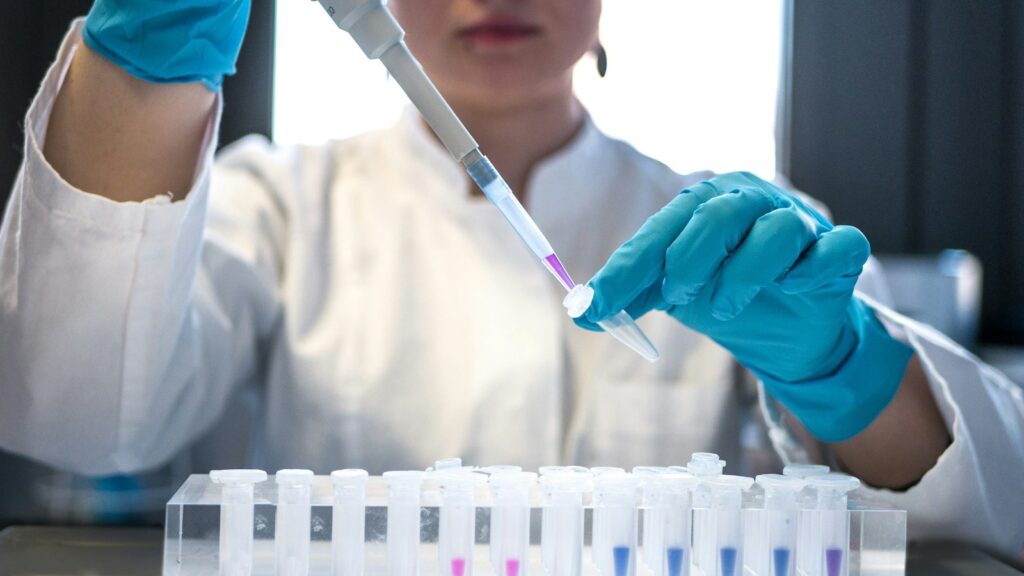
KLOW is one of the fastest-growing search terms in peptide research, and one of the least explained. It isn’t a molecule. It’s a recipe: four peptides with very different sizes, histories and levels of evidence, freeze-dried together in a single vial.
This guide covers what’s in a KLOW vial, what the research on each component actually shows, why the blend is far more lopsided than its name suggests, how it compares with GLOW, and how to verify a blend before it goes into a study.
The short answer
- KLOW is a market name for a four-peptide blend of GHK-Cu, BPC-157, TB-500 and KPV. The most common formulation is 50 mg of GHK-Cu plus 10 mg of each of the other three, 80 mg in total.
- GLOW is the same blend without KPV. Put simply, KLOW is GLOW plus KPV.
- Each component has its own research literature, mostly cell and animal studies. We found no peer-reviewed study of the four-peptide combination itself.
- Counted by molecules rather than milligrams, GHK-Cu makes up roughly three quarters of the blend.
- Blends are harder to verify than single peptides. A useful COA confirms every component by mass spectrometry, not just one overall purity figure.
- None of the four is an approved drug. BPC-157 and TB-500 are prohibited in sport, and all four appeared in Health Canada’s April 2026 warning about peptides sold online. KLOW is a laboratory reagent.
KLOW
Market shorthand for GLOW plus KPV. Four peptides in one lyophilized vial.
GHK-Cu · copper-bound tripeptide · about 402 g/mol
- G
- H
- K
- Cu²⁺
KPV · the last three amino acids of alpha-MSH · about 342 g/mol
- K
- P
- V
TB-500 · fragment form of thymosin beta-4 shown · about 889 g/mol
- Ac
- L
- K
- K
- T
- E
- T
- Q
BPC-157 · gastric-juice-derived pentadecapeptide · about 1,419.5 g/mol
- G
- E
- P
- P
- P
- G
- K
- P
- A
- D
- D
- A
- G
- L
- V
Blue bead: the acetyl cap on the TB-500 fragment. Dashed bead: the copper ion carried by GHK. Some suppliers use full-length thymosin beta-4, 43 amino acids long, instead of the fragment, which is why the mass on the COA matters.
- Components
- GHK-Cu, BPC-157, TB-500, KPV
- Common formulation
- 50 + 10 + 10 + 10 mg, 80 mg total
- Our vial
- 80 mg total fill, lyophilized, with a batch-matched COA
- The name
- A market name, not a scientific or regulatory one
- Status
- No component is an approved drug; two are prohibited in sport
Published research on the four-peptide combination itself
- Cell studies
- Animal studies
- Human studies
- Controlled clinical trials
We found no peer-reviewed study of the combination at any level. Each component has its own literature, summarized below.
What is KLOW?
KLOW came out of the research-peptide market rather than a laboratory paper. It builds on GLOW, an earlier three-peptide blend of GHK-Cu, BPC-157 and TB-500, and adds KPV, the anti-inflammatory tripeptide from alpha-melanocyte-stimulating hormone (alpha-MSH). The usual formulation is heavily weighted toward GHK-Cu: 50 mg of GHK-Cu and 10 mg each of BPC-157, TB-500 and KPV.
Because KLOW is a trade name, nothing guarantees that two suppliers’ vials contain the same ratio, or even the same form of TB-500. The label and the batch certificate of analysis, not the name, define what you have. Our KLOW vial is an 80 mg lyophilized fill, and our GLOW vial is 70 mg.
The four components at a glance
| Component | What it is | Main research themes | Human evidence | Full guide |
|---|---|---|---|---|
| GHK-Cu | Gly-His-Lys bound to copper, first isolated from human plasma in 1973 | Collagen and matrix signalling, wound models, gene-expression studies | Small topical cosmetic studies; no injectable trials | GHK-Cu |
| BPC-157 | 15-amino-acid fragment of a protein in human gastric juice | Tendon, muscle and gut healing in rodents; blood-vessel growth | Three small uncontrolled pilot studies | BPC-157 safety |
| TB-500 | Thymosin beta-4, or its seven-amino-acid LKKTETQ fragment | Actin binding, cell migration, wound and heart repair in animals | Full-length thymosin beta-4 has been tested as eye drops in clinical trials; the fragment has not | TB-500 |
| KPV | Lys-Pro-Val, the last three amino acids of alpha-MSH | Inflammatory signalling; colitis models in mice | None published | KPV |
KLOW blend: an 80 mg lyophilized vial with a batch-matched COA.
View KLOWBy weight vs by molecule: what’s really in the vial
A label reading 50 + 10 + 10 + 10 mg suggests a blend that is a bit over half GHK-Cu. Counting molecules tells a different story. GHK-Cu and KPV are tiny tripeptides, so each milligram contains far more molecules than a milligram of BPC-157 or thymosin beta-4. Receptors and enzymes respond to molecules, not milligrams, so the molar view is the one that matters when interpreting a study.
| Component | Label amount | Approx. molecular weight | Approx. amount |
|---|---|---|---|
| GHK-Cu | 50 mg | 402 g/mol | 124 µmol |
| KPV | 10 mg | 342.4 g/mol | 29.2 µmol |
| TB-500, LKKTETQ fragment | 10 mg | 889 g/mol | 11.2 µmol |
| TB-500, full-length thymosin beta-4 | 10 mg | 4,963 g/mol | 2.0 µmol |
| BPC-157 | 10 mg | 1,419.5 g/mol | 7.0 µmol |
Two things follow. First, KLOW is mostly a GHK-Cu reagent with three minor partners: BPC-157 supplies only about 4% of the molecules. Second, the form of TB-500 changes its share more than five-fold, because full-length thymosin beta-4 is about 5.6 times heavier than the fragment. To turn any of these into molar concentrations for your own solutions, our peptide calculator does the arithmetic.
Why combine them, and what’s still unknown
The logic behind KLOW is coverage. Each component maps to a different part of the repair-and-inflammation story studied in cells and animals:
- GHK-Cu, matrix building. It stimulates collagen, elastin and glycosaminoglycan production by fibroblasts in culture and has been studied in animal wound models for decades.
- BPC-157, blood supply and tissue repair. It promotes new blood-vessel growth through VEGFR2 and speeds healing in rodent tendon, muscle and gut injury models.
- TB-500, cell movement. Thymosin beta-4 binds G-actin, the building block of the cell’s internal scaffold, and is studied for cell migration in wound and heart models.
- KPV, inflammation. In mouse colitis models, intestinal cells take up KPV through the PepT1 transporter, and it dampens inflammatory signalling.
That is a plausible design rationale. It is not evidence that the components work better together. Combination effects can add up, cancel out or interfere, and peptides mixed in one solution can interact chemically. None of this has been tested for KLOW.
Reasonably well established
- Each component has published cell and animal research of its own.
- GHK-Cu has decades of skin and collagen research, including small topical studies in people.
- Thymosin beta-4 binds G-actin and has reached clinical trials as eye drops.
- KPV reduced colitis in mice in a PepT1-dependent way.
Open questions
- Whether the four act additively, synergistically or against each other.
- Whether mixing them changes stability, for example through copper-related oxidation in solution.
- Why this particular ratio, and whether the minor components reach meaningful concentrations.
- Any data at all on the combination in people.
KLOW vs GLOW and other blends
KLOW is one of several pre-combined repair-research vials. The differences come down to which components a study design needs.
| Blend | What’s in it | When a study design might use it |
|---|---|---|
| KLOW | GHK-Cu, BPC-157, TB-500, KPV (80 mg vial) | Repair-plus-inflammation designs that use all four at a fixed ratio |
| GLOW | GHK-Cu, BPC-157, TB-500 (70 mg vial) | The same design without the inflammatory component |
| Coremend | TB-500, KPV, BPC-157 | Repair and inflammation without GHK-Cu dominating the mix |
| GHK-Cu + KPV | GHK-Cu, KPV | Matrix and inflammation work without BPC-157 or TB-500 |
| BPC-157 + TB-500 | BPC-157, TB-500 | The classic two-peptide repair pairing |
Single-component vials remain the better choice whenever a study needs to vary the ratio or attribute an effect to one peptide. See BPC-157 vs TB-500 for the most common pairing.
 KLOW blendGHK-Cu, BPC-157, TB-500 and KPVView product and COA
 GLOW blendGHK-Cu, BPC-157 and TB-500View product and COA
 Coremend blendTB-500, KPV and BPC-157View product and COA
 GHK-Cu + KPVCopper peptide with the alpha-MSH tripeptideView product and COA
How to verify a KLOW vial
A single-peptide certificate of analysis answers two questions: is it the right molecule, and how pure is it? A blend COA has to answer them four times. Look for:
- Four identities by mass spectrometry. Expect signals matching GHK (about 340 g/mol, since copper is often lost under analytical conditions), KPV (about 342), BPC-157 (about 1,419.5) and TB-500 (about 889 for the fragment, or about 4,963 for full-length thymosin beta-4). GHK and KPV differ by only about 2 g/mol, so the report should resolve them clearly.
- An HPLC method that separates all four. Short, water-loving peptides such as KPV and GHK are poorly retained on standard C18 columns and can elute near the solvent front, so a method tuned for one peptide may hide another. A single purity percentage for a whole blend says little. See our HPLC testing guide.
- Copper accounted for. Under the acidic conditions used in most reversed-phase HPLC, copper can separate from GHK, so the chromatogram may show free GHK. If copper content matters to your work, it needs its own test.
- The TB-500 form stated. Fragment or full-length? Only the measured mass settles it.
- Per-component amounts, not just the total fill. An 80 mg total says nothing about the ratio inside.
- A lot number matching your vial. Our COA guide explains every field, and how to spot fake or underdosed peptides covers the red flags.
Regulatory status in the US and sport
United States. In 2023 the FDA placed BPC-157, KPV, the TB-500 fragment and injectable GHK-Cu in Category 2 of its compounding list, the group that raises significant safety risks. It removed them in 2026. In July 2026 its Pharmacy Compounding Advisory Committee narrowly recommended BPC-157, KPV and TB-500 for the list of substances pharmacies may compound, against the advice of FDA staff, and injectable GHK-Cu is due for committee review before February 2027. None has been added to the list, and none is an FDA-approved drug.
Sport. The World Anti-Doping Agency prohibits BPC-157 (class S0) and thymosin beta-4 and its derivatives, including TB-500 (class S2), at all times. Every KLOW vial therefore contains two prohibited substances.
Sourcing KLOW in Canada
If a study design calls for a fixed four-peptide ratio, the blend saves four separate reconstitutions. If it calls for isolating any one component, start with single vials instead.
 GHK-CuThe copper tripeptide on its ownView product and COA
 BPC-157The 15-amino-acid peptide on its ownView product and COA
 TB-500 (thymosin beta-4)Check the COA mass for the formView product and COA
 TB-500 fragmentThe short actin-binding fragmentView product and COA
Research use only. KLOW and GLOW from Pure Peptides Canada are laboratory reagents for in-vitro research. They are not drugs, supplements or cosmetics, they are not for human or veterinary use, and nothing in this article is dosing or medical guidance.
Frequently asked questions
What is KLOW peptide?
KLOW is a market name for a research blend of four peptides in one lyophilized vial: GHK-Cu, BPC-157, TB-500 and KPV. It is not a single molecule, and it is not a scientific or regulatory name.
What is the ratio in a KLOW blend?
The most common formulation is 50 mg of GHK-Cu plus 10 mg each of BPC-157, TB-500 and KPV, for 80 mg in total. Ratios can differ between suppliers, so check the label and the batch COA.
What is the difference between KLOW and GLOW?
GLOW contains GHK-Cu, BPC-157 and TB-500. KLOW adds a fourth peptide, KPV, the anti-inflammatory tripeptide from alpha-MSH. Otherwise the two are built the same way.
Has the KLOW combination been studied?
Not as a combination, as far as we could find. Each of the four peptides has its own published cell and animal research, but we found no peer-reviewed study testing the four together.
Why is GHK-Cu the largest part of KLOW?
In the common formulation GHK-Cu is 50 of the 80 mg. Because it is a very small molecule, it also makes up roughly three quarters of the molecules in the vial, so the blend is far more lopsided than the four-peptide label suggests.
How do you verify a KLOW blend?
A useful COA identifies all four components by mass spectrometry, uses an HPLC method that separates them, states which form of TB-500 is present, reports per-component amounts and carries a lot number that matches your vial.
Is KLOW legal or approved in Canada?
None of its four components is authorized as a drug in Canada. Health Canada’s April 2026 advisory named BPC-157, TB-500, GHK-Cu and KPV among seized unauthorized injectable peptides and said research-use-only labelling does not make such products legal or exempt from regulatory requirements.
Is KLOW banned in sport?
In effect, yes. It contains BPC-157, prohibited by the World Anti-Doping Agency under class S0, and TB-500, prohibited under class S2 as a thymosin beta-4 derivative.
KLOW and GLOW, tested batch by batch
Pre-combined repair-research blends with independent COAs, tracked delivery across Canada and pricing in Canadian dollars.
References
- Pickart L, Thaler MM. Tripeptide in human serum which prolongs survival of normal liver cells and stimulates growth in neoplastic liver. Nat New Biol. 1973;243:85–87.
- Pickart L, Vasquez-Soltero JM, Margolina A. GHK peptide as a natural modulator of multiple cellular pathways in skin regeneration. Biomed Res Int. 2015;2015:648108.
- Dalmasso G, et al. PepT1-mediated tripeptide KPV uptake reduces intestinal inflammation. Gastroenterology. 2008;134(1):166–178.
- Goldstein AL, Hannappel E, Sosne G, Kleinman HK. Thymosin β4: a multi-functional regenerative peptide. Basic properties and clinical applications. Expert Opin Biol Ther. 2012;12(1):37–51.
- Hsieh MJ, et al. Therapeutic potential of pro-angiogenic BPC157 is associated with VEGFR2 activation and up-regulation. J Mol Med. 2017;95(3):323–333.
- US Food and Drug Administration. Bulk drug substances nominated for use in compounding under section 503A. FDA
- Health Canada. Think twice before injecting peptides bought online: unauthorized products can seriously harm you. Public advisory, April 9, 2026. Government of Canada
- World Anti-Doping Agency. The Prohibited List. WADA
For laboratory research use only. Not for human or veterinary use. This article summarizes published research for educational purposes and is not medical advice. Nothing here is intended to diagnose, treat, cure or prevent any disease.