
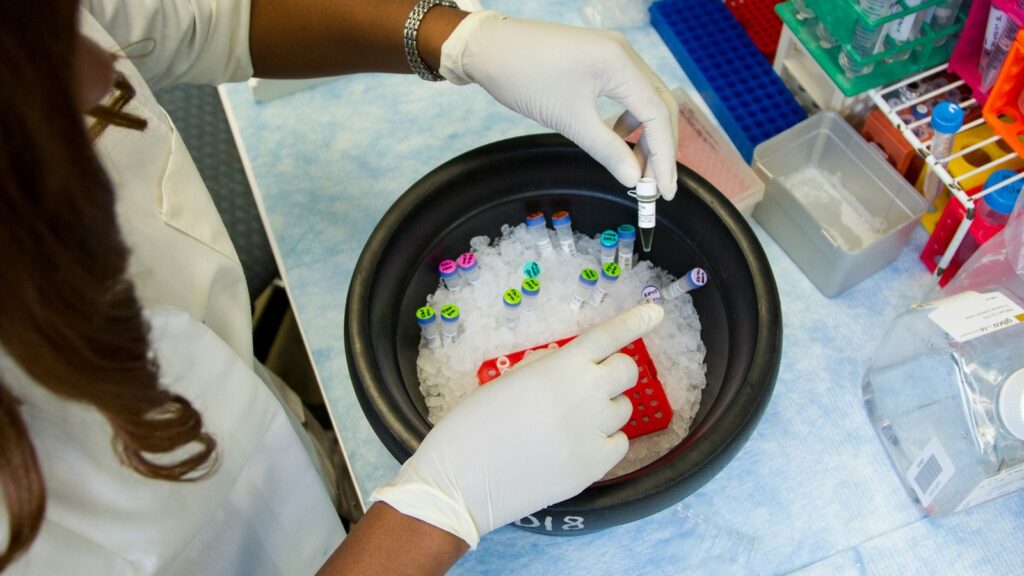
A vial labelled 10 mg rarely contains 10 mg of peptide. The difference is not fraud: it is counter-ions and water left behind by synthesis and purification. That difference has a name, net peptide content, and it starts to matter the moment you need a concentration that is actually correct.
This guide explains what is in a lyophilized peptide powder, why HPLC purity and net peptide content are different numbers, what TFA and acetate salts are, and when the salt form can change an experiment’s result.
The short answer
- Net peptide content is the percentage of a powder’s mass that is peptide. The rest is mostly counter-ions and water.
- HPLC purity answers a different question: how much of the peptide material is the right peptide. A sample can be 99% pure and still be well under 100% peptide by weight.
- Peptides purified by reversed-phase HPLC usually end up as trifluoroacetate (TFA) salts, because TFA is used both to cut the finished peptide from its synthesis resin and in the HPLC mobile phase.
- TFA can distort cell-based assays. A 1999 study found TFA at 10⁻⁸ to 10⁻⁷ M reduced osteoblast proliferation, and made TFA salts of peptides look less active than their hydrochloride salts.
- For sensitive cell work, labs often prefer acetate or hydrochloride salts, or exchange the counter-ion before testing.
What is actually in the vial
A lyophilized peptide powder has four main components: the target peptide, small amounts of related peptide impurities from synthesis, counter-ions bound to the peptide’s charged groups, and residual water. Only the first two are peptide.
Purity vs content
| Measure | Question it answers | Typical method | What it does not tell you |
|---|---|---|---|
| HPLC purity | Of the peptide material, how much is the target? | Reversed-phase HPLC with UV detection | How much of the powder is peptide at all |
| Identity | Is it the right molecule? | Mass spectrometry | How much is there, or how pure it is |
| Net peptide content | How much of the powder’s weight is peptide? | Amino acid analysis or nitrogen analysis | Whether the peptide is the right one or pure |
This is why a certificate of analysis needs more than one number. Our COA guide walks through each field, and our HPLC testing guide explains how purity is measured.
Where TFA comes from
Most research peptides are made by solid-phase peptide synthesis, building the chain one residue at a time on a resin bead. At the end, a strongly acidic cocktail based on trifluoroacetic acid cuts the peptide from the resin and strips its protecting groups. The crude peptide is then purified by reversed-phase HPLC, where TFA is also a standard additive in the mobile phase. TFA is a strong acid, so its trifluoroacetate anion stays bound to the positively charged groups on the peptide, such as lysine and arginine side chains and the N-terminus. The result is a TFA salt.
The more basic residues a peptide has, the more counter-ions it carries, and the larger the share of the powder’s weight they take up.
Need the true peptide concentration? Adjust for content in our calculator.
Open the peptide calculatorTFA vs acetate vs hydrochloride
| Salt form | How it arises | Notes for researchers |
|---|---|---|
| Trifluoroacetate (TFA) | Default result of TFA cleavage and HPLC purification | Most common form; can interfere with some cell-based assays |
| Acetate | Counter-ion exchange after purification | Often preferred for biological work; requires an extra processing step |
| Hydrochloride (HCl) | Counter-ion exchange after purification | Used in the 1999 comparison as the reference salt; also requires an extra step |
Counter-ion exchange is done with methods such as ion-exchange resins or solid-phase extraction. It adds cost and time, which is one reason TFA salts remain the default for research-grade peptides.
When the salt form changes results
The best-known evidence comes from Jillian Cornish and colleagues at the University of Auckland. In 1999 they reported that TFA at 10⁻⁸ to 10⁻⁷ M reduced cell numbers and DNA synthesis in fetal rat osteoblast cultures within 24 hours, with similar effects in chondrocytes and mouse bone tissue. When they compared TFA and hydrochloride salts of the same peptides, amylin and calcitonin, the TFA salts consistently produced less proliferation, enough to hide a real growth effect or create a false anti-growth one.
Their conclusion was that the issue is likely relevant to studies of purified peptides at concentrations above 10⁻⁹ M in any cell or tissue type, and that peptides should be converted to a hydrochloride or equivalent salt before biological testing. For analytical or binding work the salt form often matters less. For sensitive cell assays, it is worth knowing which salt you have.
How net peptide content is measured
- Amino acid analysis hydrolyses the peptide into its amino acids and quantifies them, giving the absolute amount of peptide in a weighed sample.
- Nitrogen (elemental) analysis measures nitrogen content, which can be converted to peptide content from the sequence.
- Counter-ion analysis, for example by ion chromatography, measures how much TFA or acetate is present.
- Karl Fischer titration measures residual water.
If your certificate of analysis reports a measured quantity of peptide per vial, use that figure in your calculations. If it reports only purity, remember that purity is not content. Whether a supplier reports net peptide content and salt form is worth checking when choosing the best research peptide supplier in Canada.
Research peptides with published test reports
Purity and net peptide content both start with knowing what is in the vial. Each research peptide below has a Janoshik test report listed on our Lab Testing page, and is priced in Canadian dollars and shipped tracked across Canada.
 BPC-15715-amino-acid research peptideView product
 TB-500Thymosin beta-4 research peptideView product
 GHK-CuCopper tripeptideView product
 KPVLys-Pro-Val tripeptideView product
Research use only. Pure Peptides Canada products are laboratory reagents, not for human or veterinary use. Nothing in this article is dosing, administration or medical guidance.
Frequently asked questions
What is net peptide content?
Net peptide content is the percentage of a lyophilized powder’s mass that is actually peptide. The remainder is mainly counter-ions, such as trifluoroacetate or acetate, and residual water.
Does a 10 mg vial contain 10 mg of peptide?
Usually not. The 10 mg typically refers to the powder, which includes counter-ions and water. The actual peptide mass is the powder mass multiplied by the net peptide content.
What is the difference between HPLC purity and net peptide content?
HPLC purity measures how much of the peptide material is the target peptide. Net peptide content measures how much of the whole powder is peptide. A sample can have 99% purity and a much lower net content.
What is a TFA salt?
A TFA salt is a peptide paired with trifluoroacetate counter-ions, the default result of standard synthesis and HPLC purification, which both use trifluoroacetic acid.
Should I use an acetate or hydrochloride salt instead?
For sensitive cell-based assays, many researchers prefer acetate or hydrochloride salts, because TFA has been shown to affect cell proliferation at low concentrations. For many analytical uses, the TFA salt is acceptable.
How do I correct a concentration for net peptide content?
Multiply the powder mass by the net peptide content before dividing by volume. For example, 10 mg of powder at 80% content contains 8 mg of peptide. Our peptide calculator does this automatically.
Documented research peptides, tested batch by batch
Every batch is independently tested by Janoshik Analytical for purity and identity, with a batch-matched COA, tracked delivery across Canada and pricing in Canadian dollars.
References
- Cornish J, Callon KE, Lin CQ, Xiao CL, Mulvey TB, Cooper GJ, Reid IR. Trifluoroacetate, a contaminant in purified proteins, inhibits proliferation of osteoblasts and chondrocytes. Am J Physiol. 1999;277(5):E779–E783.
For laboratory research use only. Not for human or veterinary use. This article is educational and is not medical advice.