
KPV is about as small as a bioactive peptide gets: three amino acids, lysine, proline and valine, clipped from the tail of a hormone better known for darkening skin. That hormone, alpha-MSH, is also a strong anti-inflammatory signal, and much of that activity appears to sit in its last three residues.
This guide covers where KPV comes from, what the gut-inflammation studies showed, why it turns up in so many research blends, and what to check before ordering it in Canada.
The short answer
- KPV is the tripeptide Lys-Pro-Val, the final three residues (11–13) of alpha-melanocyte-stimulating hormone (α-MSH).
- In cell and animal studies it keeps much of α-MSH’s anti-inflammatory activity without acting as a pigmentation signal.
- A 2008 study in Gastroenterology showed KPV enters gut and immune cells through the transporter PepT1 and reduced colitis in mice. A separate 2008 study found it still worked in mice without a functional MC1R receptor.
- Later mouse work packaged KPV in nanoparticles designed to deliver it to the colon.
- There are no human clinical trials. Research-grade KPV is a laboratory reagent.
KPV
Lys-Pro-Val. Also called α-MSH(11–13).
- K
- P
- V
- Parent hormone
- α-MSH, a 13-residue peptide cut from POMC
- Mass
- About 342 g/mol
- Cell entry
- The di- and tripeptide transporter PepT1
- Research themes
- Intestinal inflammation, skin inflammation, NF-κB signalling
Where the evidence stands
- Cell studies
- Animal studies
- Human studies
- Controlled clinical trials
From α-MSH to KPV
Alpha-MSH is a 13-amino-acid hormone cut from a larger precursor, proopiomelanocortin (POMC). Through the melanocortin receptor MC1R it stimulates pigment production in skin, but since the 1980s it has also been recognized as a potent anti-inflammatory molecule. Researchers working out which part of it carried that second role kept arriving at the same answer: the C-terminal tripeptide, Lys-Pro-Val.
Where KPV sits in α-MSH
α-MSH, N-terminally acetylated and C-terminally amidated.
- Ac
- S
- Y
- S
- M
- E
- H
- F
- R
- W
- G
- K
- P
- V
- NH₂
Blue beads: KPV. Outlined beads: Met-Glu-His-Phe, the same four residues Semax is built on, because α-MSH and ACTH share their first 13 amino acids.
The PepT1 studies
The key mechanistic work came from Didier Merlin’s group at Georgia State University. In a 2008 paper in Gastroenterology, Dalmasso and colleagues showed that KPV is carried into intestinal epithelial cells and immune cells by PepT1, a transporter for di- and tripeptides that is upregulated in inflamed colon. Inside the cells, KPV dampened NF-κB and MAP kinase inflammatory signalling.
The same paper tested KPV given in drinking water to mice with chemically induced colitis, in two standard models, and found less inflammation and lower pro-inflammatory cytokine expression. A separate 2008 study reported that KPV still reduced colitis in mice lacking a functional MC1R, which suggests its anti-inflammatory action does not depend on the melanocortin receptor that α-MSH uses for pigmentation.
Research-grade KPV with a batch-matched COA.
View KPVBeyond the gut
Later studies explored ways to get KPV where it is needed. In 2010 the same Georgia State group reported KPV-loaded nanoparticles that reduced colitis in mice, and a 2017 study used hyaluronic acid-coated nanoparticles to target KPV to inflamed colon tissue. A 2016 mouse study linked PepT1 to colitis-associated cancer and reported that KPV reduced tumour formation in that model. Other researchers have tested KPV in skin and oral-mucosa models.
What is established and what is open
Reasonably well established
- KPV is the C-terminal tripeptide of α-MSH.
- It enters intestinal and immune cells through PepT1.
- It reduced chemically induced colitis in several mouse studies.
Open questions
- Whether any of this translates to humans; there are no clinical trials.
- How its effects compare across tissues outside the gut.
- The best way to deliver such a small, quickly cleared peptide.
KPV in research blends
Because KPV adds an inflammatory-signalling component to repair-focused designs, it appears in several pre-combined vials. GHK-Cu + KPV pairs it with the copper tripeptide, KLOW adds it to GHK-Cu, BPC-157 and TB-500, and Coremend combines it with TB-500 and BPC-157. See the KLOW blend explainer and GHK-Cu guide for the partner peptides.
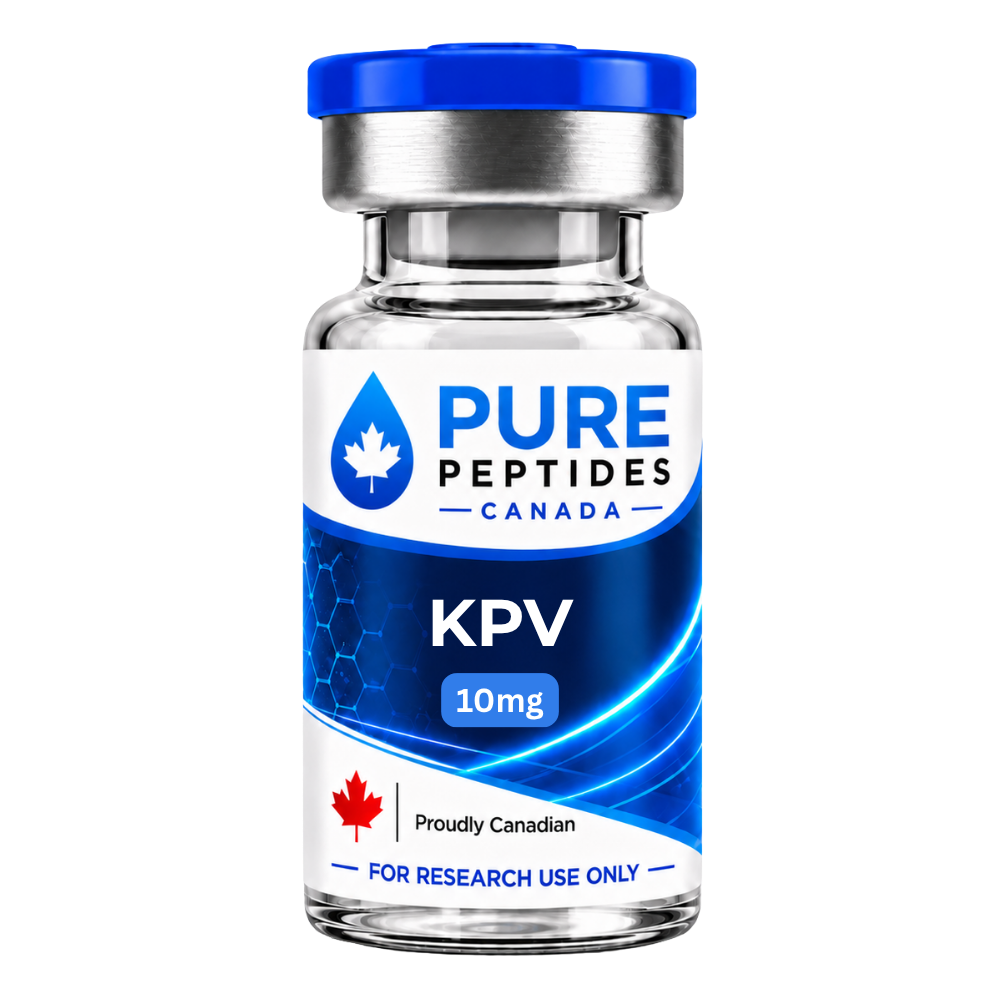 KPVThe α-MSH tripeptide on its ownView product and COA
 GHK-Cu + KPVCopper peptide with KPVView product and COA
 KLOW blendGHK-Cu, BPC-157, TB-500, KPVView product and COA
 Coremend blendTB-500, KPV, BPC-157View product and COA
Sourcing KPV in Canada
KPV is tiny, which changes what matters on the COA. Before ordering, check that:
- The mass matches, at about 342 g/mol. See HPLC vs mass spectrometry.
- You understand net peptide content. In a peptide this small, counter-ions such as acetate or TFA left from purification can make up a meaningful share of the powder’s weight.
- Purity is reported by HPLC and the COA matches your lot. How to read a certificate of analysis walks through it.
- Storage is cold, dry and dark. See our peptide storage guide.
Regulatory status in 2026
KPV is not an approved drug anywhere. In April 2026, Health Canada’s advisory on unauthorized injectable peptides listed KPV among products it had seized, and stated that “For Research Use Only” labelling does not make such products legal or exempt from regulatory requirements.
In the United States, the FDA placed KPV in Category 2 of its compounding list, the group of substances that raise significant safety risks, in 2023 and removed it in 2026. On July 23, 2026, its Pharmacy Compounding Advisory Committee voted 8 to 6, with one abstention, to recommend adding KPV to the list of substances pharmacies may compound, overriding FDA staff, who had recommended against it. KPV has not been added to the list, and formal rulemaking would still be required.
Research use only. KPV from Pure Peptides Canada is a laboratory reagent. It is not an approved drug, it is not for human or veterinary use, and nothing in this article is dosing or medical guidance.
Frequently asked questions
What is KPV?
KPV is the tripeptide Lys-Pro-Val, the last three amino acids of alpha-melanocyte-stimulating hormone (α-MSH). It is studied for the anti-inflammatory activity it retains from its parent hormone, mainly in cell and mouse models.
How is KPV different from α-MSH?
α-MSH is a 13-residue hormone that drives pigmentation through MC1R and also has anti-inflammatory effects. KPV is just its final three residues, which appear to carry much of the anti-inflammatory activity without acting as a pigmentation signal.
How does KPV work?
In a 2008 mouse and cell study, KPV entered intestinal and immune cells through the transporter PepT1 and reduced NF-κB and MAP kinase inflammatory signalling. Its effect did not require the MC1R receptor.
Has KPV been tested in humans?
No clinical trials of KPV in humans have been published. The evidence comes from cell studies and mouse models of colitis and other inflammation.
Why is KPV in so many blends?
Blends such as GHK-Cu + KPV, KLOW and Coremend add KPV as an inflammatory-signalling component alongside repair-focused peptides. Separate vials remain the better choice when a study needs to isolate one compound’s effect.
Is KPV approved or legal in Canada?
No. KPV is not an authorized drug in Canada or anywhere else. Health Canada’s April 2026 advisory listed it among unauthorized injectable peptides it had seized, and a July 2026 FDA advisory committee vote recommending it for the US compounding list is not an approval. Pure Peptides Canada sells KPV strictly as a laboratory research reagent that is not for human or veterinary use.
Does Pure Peptides Canada ship KPV across Canada?
Yes. Orders ship tracked and discreetly across Canada, usually arriving by Xpresspost in 3–7 days, or free in 4–12 days on orders over $299, with free shipping on orders over $299.
KPV, tested batch by batch
Lyophilized KPV and KPV blends with independent COAs, tracked delivery across Canada and pricing in Canadian dollars.
References
- Dalmasso G, Charrier-Hisamuddin L, Nguyen HT, Yan Y, Sitaraman S, Merlin D. PepT1-mediated tripeptide KPV uptake reduces intestinal inflammation. Gastroenterology. 2008. PubMed Central
- Kannengiesser K, et al. Melanocortin-derived tripeptide KPV has anti-inflammatory potential in murine models of inflammatory bowel disease. Inflamm Bowel Dis. 2008.
- Laroui H, et al. Drug-loaded nanoparticles targeted to the colon with polysaccharide hydrogel reduce colitis in a mouse model. Gastroenterology. 2010.
- Xiao B, et al. Orally targeted delivery of tripeptide KPV via hyaluronic acid-functionalized nanoparticles efficiently alleviates ulcerative colitis. Mol Ther. 2017.
For laboratory research use only. Not for human or veterinary use. This article summarizes published research for educational purposes and is not medical advice. Nothing here is intended to diagnose, treat, cure or prevent any disease.