
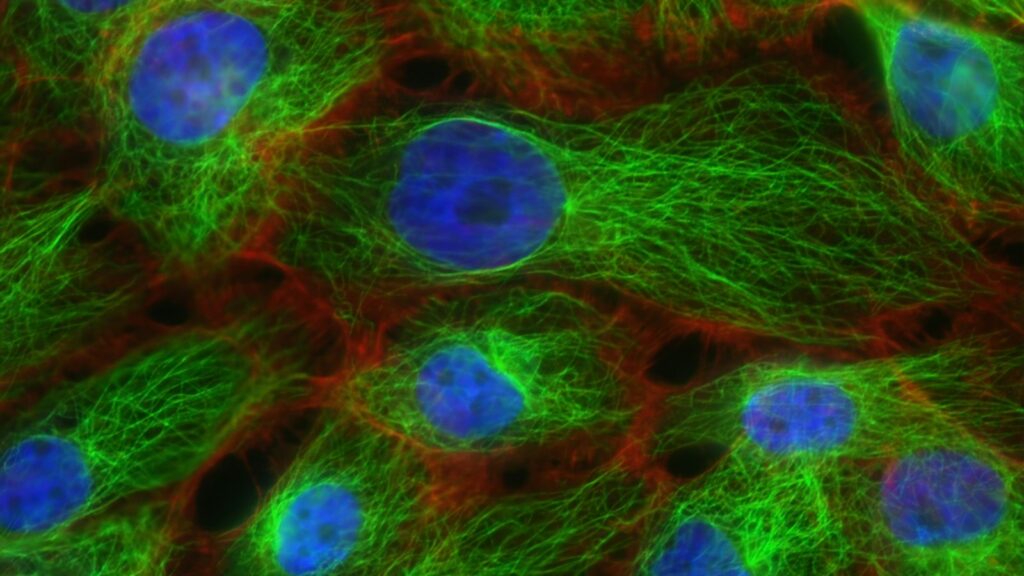
Some damaged cells don’t die. They stop dividing for good, linger in the tissue and release a steady stream of inflammatory signals. Biologists call them senescent cells; headlines call them zombie cells. In mice, clearing them delays several features of ageing, and since 2015 a class of compounds called senolytics has been developed to do exactly that. The human evidence so far comes from small trials with mixed results.
This guide explains what cellular senescence is, how senolytics were discovered, which compounds are studied, what the human trials have and haven’t shown, where the peptide FOXO4-DRI fits, and why no senolytic is approved for ageing anywhere.
The short answer
- Senescent cells have permanently stopped dividing but resist dying. They build up with age and secrete a mix of inflammatory signals and enzymes called the senescence-associated secretory phenotype, or SASP.
- Senolytics are agents that selectively kill senescent cells. The term was introduced in 2015 by a Mayo Clinic-led team that showed the leukemia drug dasatinib plus the plant flavonoid quercetin reduced the burden of senescent cells in mice. Senomorphics leave the cells alive but dampen what they secrete.
- In mice, genetically clearing senescent cells delayed age-related disorders and extended median lifespan by 24% to 27%, and senolytic drugs improved physical function in old animals.
- In people, studies have been small and short. A 2024 randomized trial in 60 postmenopausal women missed its main bone endpoint, and a 2026 trial in 31 people with fibrotic fatty liver disease reported less scarring along with more adverse events.
- No senolytic is approved for ageing anywhere. Leading researchers in the field have said senolytics should not be used outside clinical trials until they are shown to be safe and effective.
Senolytics at a glance
Part of a wider group called senotherapeutics, which also includes senomorphics.
- Target
- Senescent cells, which have stopped dividing but resist apoptosis
- Term introduced
- 2015, by Zhu, Tchkonia, Kirkland and colleagues (Mayo Clinic, with Scripps Research)
- Best-known candidates
- Dasatinib plus quercetin (D+Q), fisetin, navitoclax and the peptide FOXO4-DRI
- Related approach
- Senomorphics such as rapamycin, which blunt the SASP instead of killing cells
- Approved for ageing
- None, anywhere
Where the evidence stands
- Cell studies
- Animal studies
- Small human trials
- Approved medicine
Human studies so far are small, short and early-stage, and their results have been mixed.
What senescent cells are
Cellular senescence is a state in which a cell permanently stops dividing but does not die. It can be triggered by DNA damage, by telomeres wearing down after many rounds of division, by cancer-causing genes switching on, and by chemotherapy or radiation. In the short term this is protective: a damaged cell that cannot divide cannot grow into a tumour. Our guide to telomeres and telomerase covers one of the triggers in detail.
The trouble is that senescent cells linger. They resist apoptosis, the orderly self-destruction that removes most damaged cells, and they secrete inflammatory cytokines, chemokines and protein-cutting enzymes. In 2008, Coppé and colleagues named this output the senescence-associated secretory phenotype, or SASP. Senescent cells accumulate with age, and in 2013 “cellular senescence” was listed as one of nine hallmarks of ageing in an influential review in Cell; the 2023 update expanded the list to twelve. Their refusal to die, and the damage they do to the tissue around them, is what earned them the nickname “zombie cells”.
In the lab, senescent cells are usually identified by a combination of markers: the cell-cycle brakes p16Ink4a and p21, and a stain for senescence-associated β-galactosidase (SA-β-gal). No single marker is definitive, which matters when trials try to measure whether a drug cleared them.
From the Hayflick limit to senolytics
- 1961Leonard Hayflick and Paul Moorhead report that normal human fetal cells stop dividing after about 40 to 60 divisions in culture. The term “Hayflick limit” came later, coined by Macfarlane Burnet in 1974.
- 2008Coppé and colleagues name the senescence-associated secretory phenotype (SASP).
- 2011A Mayo Clinic team shows that clearing p16Ink4a-positive cells in fast-ageing mice delays age-related disorders.
- 2013Cellular senescence is named one of nine hallmarks of ageing.
- 2015Mayo Clinic and Scripps Research scientists introduce the term “senolytics” and show that dasatinib plus quercetin reduces the burden of senescent cells in mice.
- 2016Clearing p16Ink4a-positive cells extends median lifespan in normal mice, and the experimental cancer drug navitoclax is shown to kill senescent cells.
- 2017Researchers at Erasmus MC in Rotterdam report the senolytic peptide FOXO4-DRI.
- 2018Studies report that D+Q improves physical function in old mice and that fisetin extends mouse lifespan.
- 2019The first small human pilot studies of D+Q are published.
- 2020–2025Unity Biotechnology’s two lead candidates miss their main trial goals, and the company dissolves in 2025.
- 2024–2026Randomized trials report a missed bone endpoint in 2024 and improved liver fibrosis, with more adverse events, in 2026.
Canadian labs are part of the field. In Montréal, groups led by Francis Rodier and Gerardo Ferbeyre at the Université de Montréal and its hospital research centre, the CRCHUM, study senescence and its links to cancer.
The mouse studies behind the idea
Genetic clearance. The case for senolytics rests on mouse genetics. A Mayo Clinic team built INK-ATTAC mice, in which cells that switch on the senescence marker p16Ink4a can be made to self-destruct on command. In 2011, clearing these cells in fast-ageing (BubR1 progeroid) mice “delayed onset” of age-related problems in fat, muscle and the eye. Survival was “not substantially extended”, because these mice die of heart failure, so the result was about healthspan rather than lifespan.
In 2016, the same approach in normal mice extended median lifespan by 27% in one genetic background and 24% in another. Maximum lifespan rose only in the mixed-background mice. Mayo’s announcement put the range at 17% to 35% across subgroups, which is where the often-quoted “35%” comes from. All of this used a genetic switch, not a drug.
The first drugs. In 2015, Yi Zhu, Tamara Tchkonia, James Kirkland and colleagues used gene-expression data to look for the survival pathways senescent cells depend on, the “Achilles’ heel” of the paper’s title, and for drugs that block them. They introduced “a new class of drugs termed senolytics”. Dasatinib eliminated senescent human fat-cell progenitors, quercetin worked better against senescent endothelial cells, and the combination reduced the burden of senescent cells in aged, irradiated and fast-ageing mice.
Function and survival. In 2018, Xu and colleagues showed that transplanting “relatively small numbers of senescent cells” into mice caused lasting physical dysfunction. In old mice, intermittent D+Q “increased post-treatment survival by 36% while reducing mortality hazard to 65%”. That 36% refers to the survival remaining from the start of treatment in very old mice, not to total lifespan.
The main senolytic candidates
| Candidate | What it is | Key finding | Where it stands |
|---|---|---|---|
| Dasatinib + quercetin (D+Q) | A prescription leukemia drug (a kinase inhibitor) combined with a plant flavonoid | Reduced the burden of senescent cells in aged, irradiated and fast-ageing mice (2015); improved physical function in old mice (2018) | The most studied combination in people; all trials so far are small |
| Fisetin | A plant flavonoid | “The most potent senolytic” of 10 flavonoids tested; extended median and maximum lifespan when given to mice late in life (2018) | Mayo Clinic trials have no posted results; a 2026 review called the human evidence “limited and heterogeneous” |
| Navitoclax (ABT-263) | A BCL-2 and BCL-xL inhibitor developed as a cancer drug | Killed senescent cells and rejuvenated blood-forming stem cells in aged mice (2016) | Blocking BCL-xL lowers platelet counts, a known on-target side effect |
| UBX0101 | Unity Biotechnology’s first candidate, studied in knee osteoarthritis | No significant difference from placebo in a 183-patient phase 2 trial (2020) | Developer dissolved in 2025 |
| Foselutoclax (UBX1325) | A BCL-xL inhibitor from Unity, studied in diabetic eye disease | Missed the primary analysis of the ASPIRE trial against aflibercept (2025) | Developer dissolved in 2025 |
| FOXO4-DRI | A cell-penetrating D-retro-inverso peptide | Killed senescent cells and restored fitness, fur density and kidney function in mice (2017) | No published human trials |
| Rapamycin (a senomorphic) | An mTOR inhibitor | Blunts the inflammatory SASP without killing senescent cells (2015) | Studied as a SASP suppressor rather than a senolytic |
“Senomorphics” is the term reviews use for SASP suppressors. A 2015 study found that rapamycin “selectively blunts the pro-inflammatory phenotype of senescent cells”, which makes it a commonly cited example.
What human trials have shown
Human senolytic research has mostly tested D+Q, given in short, intermittent courses. The studies below are the main published ones. Our guide to clinical trial phases explains what “open-label”, “phase 1” and “randomized” mean for how much weight each one can bear.
| Study | Who and how | What it found |
|---|---|---|
| Justice et al., 2019 | 14 people with idiopathic pulmonary fibrosis; open-label, no placebo, D+Q over three weeks | Walking distance, gait speed and chair-stand performance improved; lung function and frailty did not |
| Hickson et al., 2019 | 9 people with diabetic kidney disease; open-label, one three-day course of D+Q | Fewer cells carrying senescence markers in fat tissue, and lower blood levels of the inflammatory signals IL-1α and IL-6 |
| UBX0101 phase 2, 2020 | 183 people with knee osteoarthritis; randomized, placebo-controlled | “No statistically significant difference between any arm of UBX0101 and placebo” |
| Gonzales et al., 2023 | 5 people with mild Alzheimer’s disease; open-label phase 1, 12 weeks | Dasatinib reached the cerebrospinal fluid in 4 of 5 participants; quercetin was not detected; cognition did not change |
| Farr et al., 2024 | 60 postmenopausal women; randomized controlled phase 2, 20 weeks | The primary endpoint, a blood marker of bone breakdown, did not differ between groups. In a post hoc subgroup with the highest levels of the senescence marker p16 in blood T cells, forearm (radius) bone density rose 2.7% |
| STAMINA (Millar et al., 2025) | 12 older adults at risk of Alzheimer’s disease; single-arm pilot | The overall change in cognitive score was not significant; those with the lowest starting scores gained 2 points |
| Foselutoclax ASPIRE, 2025 | 52 people with diabetic macular edema; randomized against the approved eye drug aflibercept | Did not meet non-inferiority on the primary analysis, although it was non-inferior at weeks 24 and 36 |
| Koning et al., 2026 | 31 people with fibrotic MASH (fatty liver disease with scarring); double-blind, randomized, placebo-controlled phase 2, 21 weeks | Fibrosis improved by at least one stage in 47% on D+Q vs 7% on placebo (P = 0.02); adverse events in 82% vs 43% |
The 2026 liver trial, published on October 1, 2026 in Nature Metabolism, is the most encouraging controlled result so far: it was double-blind and placebo-controlled, and fibrosis is a meaningful outcome. It was also small, the authors describe it as “proof-of-principle”, and adverse events were nearly twice as common on D+Q. It needs to be repeated in a larger trial before it can be read as more than a promising lead.
The Unity Biotechnology story
Unity Biotechnology was one of the most prominent companies built on senolytics. Its first candidate, UBX0101, showed no significant benefit over placebo in knee osteoarthritis in August 2020. Its second, the BCL-xL inhibitor foselutoclax, missed the primary analysis of its ASPIRE eye-disease trial in May 2025. Unity laid off its staff that month, its shares were suspended from Nasdaq in July, and stockholders approved its dissolution in September 2025. The setbacks don’t disprove the biology, but they show how hard it has been to turn mouse results into medicines.
Why the results are hard to read
- Most studies are tiny and open-label. Trials of 5 to 14 people without a placebo group can’t separate a drug effect from chance or expectation.
- There is no agreed way to count senescent cells in people. Trials measure different markers in different tissues, such as p16 and p21, SA-β-gal staining or blood SASP factors, so “fewer senescent cells” can mean different things.
- Getting the drug to the target is not guaranteed. In the Alzheimer’s pilot, quercetin was not detected in cerebrospinal fluid.
- Mouse numbers are often stretched. The 2011 study showed healthier ageing, not longer life; the “35%” lifespan figure is the top of a subgroup range; and the 36% survival gain applies to time remaining in very old mice.
- Side effects are real. Dasatinib is a cancer drug, navitoclax lowers platelets, and adverse events were nearly twice as common on D+Q in the 2026 liver trial.
- Senescence has jobs. It is a barrier against cancer, so removing senescent cells repeatedly over years could carry costs that short trials cannot detect.
Where FOXO4-DRI fits
FOXO4-DRI is the best-known peptide senolytic. Reported in 2017 by Peter de Keizer’s group at Erasmus MC in Rotterdam, it is a D-retro-inverso peptide designed to break the bond between the proteins FOXO4 and p53 inside senescent cells. Released from FOXO4, p53 leaves the nucleus and the cell undergoes apoptosis. In mice, the peptide countered the toxicity of the chemotherapy drug doxorubicin and “restored fitness, fur density, and renal function in both fast aging XpdTTD/TTD and naturally aged mice”. No human trials have been published.
Unlike D+Q, which repurposes existing drugs, FOXO4-DRI was designed from the biology of senescence itself, and it has become one of the best-known senolytic research tools. Our full guide, FOXO4-DRI: the senolytic peptide explained, covers its design and the evidence in detail, and our anti-aging peptides guide maps it against other ageing-research peptides.
Research-grade FOXO4-DRI is available as a lyophilized laboratory reagent.
View FOXO4-DRIWhat’s established and what isn’t
Reasonably well established
- Senescent cells accumulate with age and secrete the inflammatory SASP.
- Genetically clearing p16Ink4a-positive cells in mice delayed age-related disorders and extended median lifespan.
- D+Q, fisetin, navitoclax and FOXO4-DRI kill senescent cells in culture and in mice.
- Navitoclax lowers platelet counts.
Open questions
- Whether any senolytic improves health or lifespan in people.
- Which marker reliably measures senescent-cell burden in humans.
- The long-term safety of repeatedly clearing senescent cells.
- Whether the 2026 liver-fibrosis result holds up in larger trials.
Senolytic research reagents in Canada
Most senolytic candidates are small molecules, but FOXO4-DRI is a peptide, and it raises testing questions of its own. Before ordering, check that:
- The mass matches the expected sequence. For a peptide of this size, the report should give a deconvoluted molecular mass. See how to read a peptide mass spectrum.
- You know what was not tested. FOXO4-DRI is built from D-amino acids, which have the same mass as their L-forms, and routine purity methods generally cannot tell them apart. If chirality matters to your work, ask whether it was checked. Our guide to D-amino acids explains why.
- Net peptide content is taken into account, because counter-ions such as TFA or acetate add to the weight of the powder. See net peptide content.
- The batch number on the certificate matches your vial, and the peptide is stored cold, dry and dark. See our COA guide and peptide storage guide.
 FOXO4-DRISenolytic D-retro-inverso peptideView product
 EpitalonTelomerase research tetrapeptideView product
 NAD+Coenzyme studied in ageing researchView product
 MOTS-cMitochondrial-derived peptideView product
Research use only. Pure Peptides Canada products are laboratory reagents for in-vitro research, not for human or veterinary use. This article explains published research for education; it is not medical, dietary or dosing guidance.
Frequently asked questions
What are senolytics?
Senolytics are drugs or compounds that selectively kill senescent cells, which have permanently stopped dividing but resist dying. The term was introduced in 2015 by a Mayo Clinic-led team that showed dasatinib plus quercetin could reduce the burden of senescent cells in mice.
What are zombie cells?
Zombie cells is a popular nickname for senescent cells: cells that have stopped dividing for good but do not die, and that release inflammatory signals known as the senescence-associated secretory phenotype (SASP). They build up with age.
What is the difference between senolytics and senomorphics?
Senolytics kill senescent cells. Senomorphics leave them alive but dampen the inflammatory signals they release; rapamycin is a commonly cited example.
Do senolytics work in humans?
It is not yet known. Human studies have been small and short. A 2024 randomized trial in postmenopausal women missed its main bone endpoint, and a 2026 randomized trial in fibrotic fatty liver disease reported less scarring along with more adverse events. Larger trials are needed.
What is dasatinib plus quercetin?
Dasatinib plus quercetin (D+Q) is the most studied senolytic combination. Dasatinib is a prescription leukemia drug and quercetin is a plant flavonoid. In 2015 the pair reduced the burden of senescent cells in aged, irradiated and fast-ageing mice.
Is FOXO4-DRI a senolytic?
Yes. FOXO4-DRI is a peptide designed to disrupt the binding of FOXO4 and p53 in senescent cells, which pushes them into apoptosis. It was reported in mice in 2017 by researchers at Erasmus MC in Rotterdam, and no human trials have been published.
Are senolytics approved in Canada?
No senolytic is approved in Canada or elsewhere for ageing or for clearing senescent cells. Dasatinib is authorized only as a prescription cancer drug, and Pure Peptides Canada sells FOXO4-DRI only as a laboratory research reagent.
Ageing research reagents
Research-grade FOXO4-DRI and other ageing-research compounds, priced in Canadian dollars and shipped tracked from inside Canada.
References
- Hayflick L, Moorhead PS. The serial cultivation of human diploid cell strains. Exp Cell Res. 1961;25:585–621. DOI
- Coppé JP, et al. Senescence-associated secretory phenotypes reveal cell-nonautonomous functions of oncogenic RAS and the p53 tumor suppressor. PLoS Biol. 2008;6(12):e301. DOI
- López-Otín C, et al. The hallmarks of aging. Cell. 2013;153:1194–1217. DOI
- López-Otín C, et al. Hallmarks of aging: an expanding universe. Cell. 2023;186:243–278. DOI
- Baker DJ, et al. Clearance of p16Ink4a-positive senescent cells delays ageing-associated disorders. Nature. 2011;479:232–236. DOI
- Baker DJ, et al. Naturally occurring p16Ink4a-positive cells shorten healthy lifespan. Nature. 2016;530:184–189. DOI
- Zhu Y, et al. The Achilles’ heel of senescent cells: from transcriptome to senolytic drugs. Aging Cell. 2015;14:644–658. DOI
- Chang J, et al. Clearance of senescent cells by ABT263 rejuvenates aged hematopoietic stem cells in mice. Nat Med. 2016;22:78–83. DOI
- Souers AJ, et al. ABT-199, a potent and selective BCL-2 inhibitor, achieves antitumor activity while sparing platelets. Nat Med. 2013;19:202–208. DOI
- Baar MP, et al. Targeted apoptosis of senescent cells restores tissue homeostasis in response to chemotoxicity and aging. Cell. 2017;169:132–147. DOI
- Xu M, et al. Senolytics improve physical function and increase lifespan in old age. Nat Med. 2018;24:1246–1256. DOI
- Yousefzadeh MJ, et al. Fisetin is a senotherapeutic that extends health and lifespan. EBioMedicine. 2018;36:18–28. DOI
- Laberge RM, et al. MTOR regulates the pro-tumorigenic senescence-associated secretory phenotype by promoting IL1A translation. Nat Cell Biol. 2015;17:1049–1061. DOI
- Niedernhofer LJ, Robbins PD. Senotherapeutics for healthy ageing. Nat Rev Drug Discov. 2018;17:377. DOI
- Justice JN, et al. Senolytics in idiopathic pulmonary fibrosis: results from a first-in-human, open-label, pilot study. EBioMedicine. 2019;40:554–563. DOI
- Hickson LJ, et al. Senolytics decrease senescent cells in humans: preliminary report from a clinical trial of dasatinib plus quercetin in individuals with diabetic kidney disease. EBioMedicine. 2019;47:446–456. DOI
- Gonzales MM, et al. Senolytic therapy in mild Alzheimer’s disease: a phase 1 feasibility trial. Nat Med. 2023;29:2481–2488. DOI
- Farr JN, et al. Effects of intermittent senolytic therapy on bone metabolism in postmenopausal women: a phase 2 randomized controlled trial. Nat Med. 2024;30:2605–2612. DOI
- Millar CL, et al. A pilot study of senolytics to improve cognition and mobility in older adults at risk for Alzheimer’s disease. EBioMedicine. 2025;113:105612. DOI
- Koning M, et al. Senolytics dasatinib and quercetin in metabolic dysfunction-associated steatohepatitis: a proof-of-principle randomized, controlled trial. Nat Metab. 2026. DOI
- Unity Biotechnology. UBX0101 phase 2 results in knee osteoarthritis. News release filed with the US SEC, August 17, 2020. SEC EDGAR
- Unity Biotechnology. SEC filing reporting ASPIRE trial results, May 2025. SEC EDGAR
- Unity Biotechnology. Form 8-K on stockholder approval of dissolution, September 2025. SEC EDGAR
- Sandoval-Caballero C, et al. Clinical translation of fisetin for age-related diseases: current evidence and future opportunities. Nutrients. 2026;18:2999. DOI
- Chaib S, Tchkonia T, Kirkland JL. Cellular senescence and senolytics: the path to the clinic. Nat Med. 2022;28:1556–1568. DOI
- Rodier F, Zhou D, Ferbeyre G. Cellular senescence, geroscience, cancer and beyond. Aging (Albany NY). 2018;10:2233–2242. DOI
- Mayo Clinic News Network. Mayo Clinic researchers extend lifespan by as much as 35 percent in mice. February 2016. Mayo Clinic
- Embryo Project Encyclopedia. Leonard Hayflick. Arizona State University. Embryo Project
- ClinicalTrials.gov. AFFIRM (NCT03430037) and AFFIRM-LITE (NCT03675724), fisetin trials led by Mayo Clinic. NCT03430037 · NCT03675724
- Health Canada. Summary Basis of Decision: Sprycel (dasatinib). Health Canada
For laboratory research use only. Not for human or veterinary use. This article summarizes published research for educational purposes and is not medical advice.