

Description
MOTS-c is a 16-amino-acid peptide encoded not in the cell nucleus but in mitochondrial DNA, discovered in 2015 and now a cornerstone of mitochondrial-signalling and metabolic research. Pure Peptides Canada supplies it as a lyophilized research reagent in 10, 20 and 40 mg vials, with an independent Janoshik HPLC and mass-spectrometry report, CAD pricing and tracked shipping from inside Canada.
MOTS-c at a glance
- What it is: MRWQEMGYIFYPRKLR, a mitochondrial-derived peptide encoded within the 12S rRNA gene of mitochondrial DNA.
- What researchers study: AMPK activation, glucose and fat metabolism, exercise capacity in ageing mice, and mitochondria-to-nucleus signalling under stress.
- Evidence level: extensive cell and mouse work. An analogue reached early-phase human testing, but MOTS-c is not an approved medicine.
- Supplied as: sealed lyophilized powder in 10, 20 or 40 mg, single vial or box of 10.
- Delivery: ships from inside Canada by tracked Xpresspost in 3–7 days ($25 CAD), or free in 4–12 days on orders over $299.
MOTS-c
Mitochondrial open reading frame of the 12S rRNA-c · mitochondrial-derived peptide
- M
- R
- W
- Q
- E
- M
- G
- Y
- I
- F
- Y
- P
- R
- K
- L
- R
One-letter code, N-terminus to C-terminus.
- Length
- 16 amino acids
- Molecular formula
- C101H152N28O22S2
- Molecular weight
- ≈ 2174.6 g/mol
- CAS number
- 1627580-64-6
- Encoded by
- Mitochondrial 12S rRNA gene (MT-RNR1)
- Form
- Lyophilized powder, sealed vial
- Sizes
- 10 mg · 20 mg · 40 mg (single or box of 10)
- SKU
- PP-MOTSC
Where the evidence stands
- Cell studies
- Animal models
- Controlled human trials
- Approved medicine
Mouse and cell findings are substantial. Human evidence is limited to observational data and early analogue testing.
What is MOTS-c?
For decades, mitochondrial DNA was thought to encode only 13 proteins, all used inside mitochondria. In 2015, Pinchas Cohen’s group at the University of Southern California reported in Cell Metabolism that a short open reading frame hidden within the mitochondrial 12S rRNA gene produces a 16-residue peptide that leaves the mitochondria and acts elsewhere in the cell. They named it MOTS-c.
In mice, MOTS-c activated the energy sensor AMPK, improved insulin sensitivity and prevented diet-induced weight gain. A 2018 study showed it moves into the nucleus under metabolic stress and influences gene expression, and a 2021 Nature Communications paper reported that it improved physical capacity in older mice. Circulating levels in people fall with age and rise with exercise. Together these findings make MOTS-c one of the most active topics in mitochondrial biology, though the evidence remains preclinical.
What MOTS-c research looks at
- AMPK signalling: activation through the folate cycle and AICAR accumulation.
- Glucose and lipid metabolism: insulin sensitivity and diet-induced obesity models in mice.
- Exercise biology: exercise-induced MOTS-c and physical capacity in ageing mice.
- Retrograde signalling: nuclear translocation and gene regulation under stress.
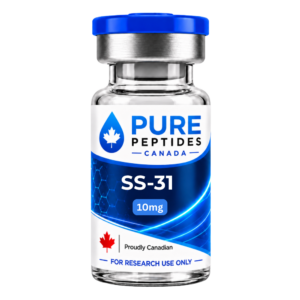
- Mitochondrial peptide comparisons: alongside humanin and the mitochondria-targeted SS-31.
Regulatory status: MOTS-c is not an authorized drug in Canada, and Health Canada’s April 2026 public advisory on unauthorized injectable peptides names it. We sell it strictly as a laboratory reagent for in-vitro research.
Why researchers order MOTS-c from Pure Peptides Canada
Choose 10, 20 or 40 mg above. Orders over $299 ship free across Canada.
See lab resultsMOTS-c FAQ
Where can I buy MOTS-c in Canada?
Pure Peptides Canada stocks MOTS-c as a lyophilized research reagent in 10, 20 and 40 mg vials and ships it from inside Canada by tracked Xpresspost in 3–7 days ($25 CAD), or free in 4–12 days on orders over $299.
Why is MOTS-c called a mitochondrial-derived peptide?
Because its code sits in mitochondrial DNA, inside the 12S rRNA gene, rather than in the cell nucleus. It is one of a small family of such peptides that also includes humanin.
What is the difference between MOTS-c and SS-31?
MOTS-c is a natural mitochondria-encoded signalling peptide. SS-31 is a synthetic tetrapeptide designed to target the inner mitochondrial membrane. Our mitochondrial peptides guide compares them.
Is this MOTS-c third-party tested?
Yes. The listing links an HPLC purity and mass-spectrometry identity report from Janoshik Analytical, an independent lab. Our COA guide explains how to read it.
Can MOTS-c be used in people or animals?
No. This product is for in-vitro laboratory research only and is not a drug, supplement or food. We do not provide dosing or administration information.
For laboratory research use only. Not a drug, supplement, food or cosmetic, not for human or veterinary use, and not intended to diagnose, treat, cure or prevent any disease.





Elijah Young –
Great. will definitely buy again. I have my eye on some other products too.
Gianna Lavoie –
Great product to add to any stack, great site to buy from. Will always buy my peps here. Satisfied customer since Sep, 2023!