
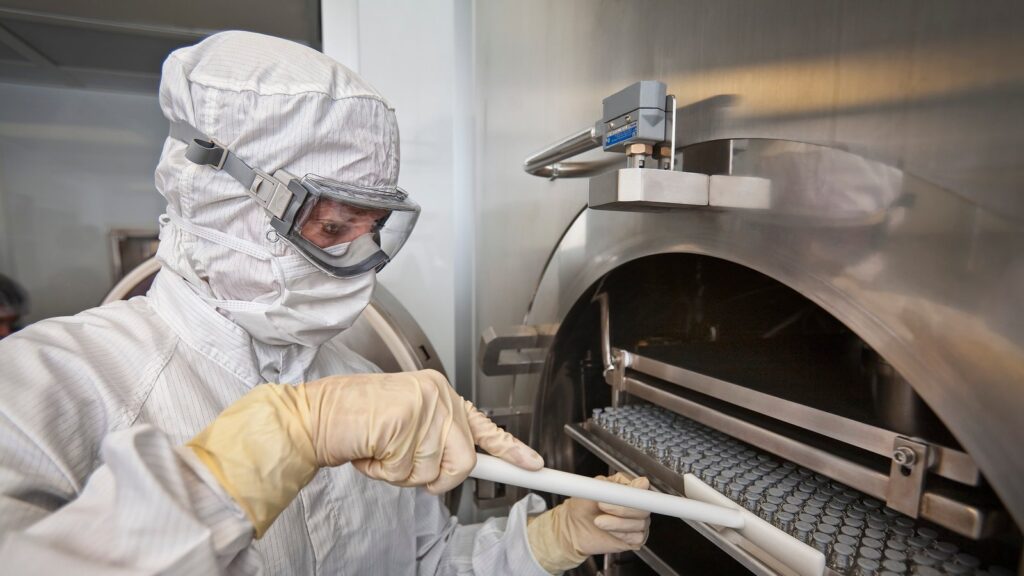
Nearly every research peptide arrives the same way: a small glass vial holding what looks like a white puck or a dusting of powder. That solid is the result of lyophilization, better known as freeze-drying, the same process used to preserve vaccines, antibiotics and astronaut food. Here is what the word means, how the process works, and why it matters for the peptide in the vial.
The short answer
- Lyophilized means freeze-dried: the product was frozen, then its ice was removed directly as vapour under vacuum, without passing through a liquid stage.
- The word comes from Greek roots usually translated as “solvent-loving”, because the dry product dissolves readily again.
- The process has three stages: freezing, primary drying, when ice sublimes away, and secondary drying, when bound water is removed.
- Removing water slows the chemical reactions that degrade peptides, which is why lyophilized powder keeps far longer than a solution.
- A good lyophilized peptide is a dry, intact cake or powder. A collapsed, shrunken or sticky residue can signal moisture or a process problem.
What “lyophilized” means
To lyophilize something is to freeze-dry it. The term grew out of the older chemistry word “lyophilic”, meaning solvent-loving, and it describes the result: a dry, porous solid that welcomes its solvent back and redissolves quickly. In everyday use, “lyophilized” and “freeze-dried” mean the same thing.
The technique was refined in laboratories in the early twentieth century and scaled up during the Second World War to preserve blood plasma and penicillin. Today it is standard in pharmaceutical manufacturing and familiar from instant coffee and camping meals.
How freeze-drying works
Water can go straight from solid to vapour, a process called sublimation, but only when the pressure is low enough. Freeze-drying exploits that: it keeps the product frozen while lowering the pressure, so ice leaves as vapour without ever melting.
- FreezingThe peptide solution is frozen solid. The way ice crystals form sets the structure of the final cake.
- Primary dryingUnder deep vacuum and with gentle, controlled heat, the ice sublimes away, leaving a porous scaffold. This is the longest stage.
- Secondary dryingThe temperature is raised further to drive off water still bound to the solid, leaving a low residual moisture content.
- SealingVials are stoppered, often under vacuum or dry inert gas, before air and humidity can get back in.
Why research peptides are lyophilized
Water is the enemy of peptide stability. Many of the reactions that break peptides down, such as deamidation, aspartimide formation and hydrolysis, need water, and almost all of them speed up with warmth. Taking the water out slows them dramatically. Our guide to how peptides degrade explains each reaction.
| Feature | Lyophilized powder | Peptide in solution |
|---|---|---|
| Stability | High when kept cold, dry and sealed | Much lower; degradation continues even when cold |
| Shipping | Light and robust | Heavier and more temperature-sensitive |
| Flexibility | Researcher chooses the solvent and concentration for the assay | Fixed at the supplier’s choice |
| Main risk | Moisture getting in after opening | Time, temperature and repeated freeze-thaw |
Every peptide we supply ships lyophilized with a batch-matched COA.
Browse the catalogueWhat a good vial looks like
A well-made lyophilized peptide usually appears as a dry, intact cake or a loose powder, often white or off-white. Small fills may look like little more than a thin film on the glass. Some compounds have their own colour: GHK-Cu, for example, is blue because of its bound copper; see our GHK-Cu guide.
Signs worth questioning include a shrunken or collapsed cake, a glassy or sticky residue, visible droplets, or an unexpected colour. These can point to moisture or a drying problem. Appearance cannot confirm identity, purity or quantity, though; only analytical testing can. Our peptide COA guide explains what to check.
 GHK-CuLyophilized, naturally blueView product and COA
 BPC-157Lyophilized research peptideView product and COA
 EpitalonLyophilized tetrapeptideView product and COA
 TesamorelinLyophilized GHRH analogueView product and COA
Storing lyophilized peptides
Lyophilized does not mean indestructible. The dry solid is hygroscopic, meaning it pulls water from the air, so the main job is keeping moisture out:
- Keep vials sealed, cold, dry and away from light until they are needed.
- Let a cold vial reach room temperature before opening it, so moisture does not condense on the cake.
- Avoid repeatedly warming and cooling the same vial.
- For in-vitro work, prepare only what an experiment needs and divide solutions into single-use aliquots.
Our peptide storage guide covers temperatures and handling in detail, and our net peptide content guide explains why a dry powder is never 100% peptide by weight.
Research use only. Pure Peptides Canada products are laboratory reagents, not for human or veterinary use. The handling notes above apply to in-vitro laboratory work, and nothing here is dosing, administration or medical guidance.
Frequently asked questions
What does lyophilized mean?
Lyophilized means freeze-dried. The product is frozen and its ice is then removed as vapour under vacuum, leaving a dry, porous solid that dissolves easily again.
Is lyophilized the same as freeze-dried?
Yes. Lyophilization is the technical name for freeze-drying, and the two terms are used interchangeably.
Why are peptides lyophilized?
Removing water slows the chemical reactions that degrade peptides, makes them lighter and more robust to ship, and lets researchers choose their own solvent and concentration.
How long do lyophilized peptides last?
Far longer than peptides in solution, provided they stay sealed, cold, dry and away from light. Exact shelf life depends on the sequence, salt form and storage, so it varies from peptide to peptide.
What should a lyophilized peptide look like?
Usually a dry, intact cake or powder, often white or off-white, though some compounds such as GHK-Cu are coloured. A collapsed, glassy or sticky residue can indicate moisture or a drying problem.
Does freeze-drying damage peptides?
It is a gentle process for most peptides, but freezing and drying do stress molecules, so manufacturers control the conditions carefully. Analytical testing of the finished batch confirms the result.
Lyophilized research peptides, tested batch by batch
Every peptide ships freeze-dried with an independent, batch-matched COA, priced in Canadian dollars and tracked across Canada.
References
- Tang X, Pikal MJ. Design of freeze-drying processes for pharmaceuticals: practical advice. Pharm Res. 2004;21(2):191–200.
- Manning MC, Chou DK, Murphy BM, Payne RW, Katayama DS. Stability of protein pharmaceuticals: an update. Pharm Res. 2010;27(4):544–575.
Featured image: Integrity Bio, CC BY-SA 3.0, via Wikimedia Commons (cropped).
For laboratory research use only. Not for human or veterinary use. This article is educational and is not medical advice.