
CJC-1295 and ipamorelin both increase growth hormone release in research models, but they reach the same pituitary cells through different receptors. CJC-1295 is an engineered version of growth hormone-releasing hormone (GHRH). Ipamorelin mimics ghrelin at the GHS-R1a receptor. That difference is why researchers so often study them side by side.
This guide explains how each peptide works, what “DAC” means on a label, what the human studies actually found, and what to check when sourcing either one in Canada.
The short answer
- CJC-1295 is a modified GHRH (1–29) analogue developed by the Canadian biotech ConjuChem. Its DAC form binds albumin and had an estimated half-life of 5.8 to 8.1 days in healthy adults.
- CJC-1295 without DAC, also called modified GRF (1–29), shares the same core but is short-acting.
- Ipamorelin is a five-residue ghrelin mimetic from Novo Nordisk, described in 1998 as the first selective growth hormone secretagogue.
- Neither is an approved medicine anywhere, and both are on the World Anti-Doping Agency’s 2026 Prohibited List.
CJC-1295
Modified GRF (1–29). The four substituted positions are highlighted; the DAC version adds a lysine carrying an albumin-binding group (dashed).
- Y
- dA
- D
- A
- I
- F
- T
- Q
- S
- Y
- R
- K
- V
- L
- A
- Q
- L
- S
- A
- R
- K
- L
- L
- Q
- D
- I
- L
- S
- R
- K-DAC
- NH₂
- Target
- GHRH receptor
- Developer
- ConjuChem Biotechnologies, Canada
- Half-life (DAC)
- 5.8 to 8.1 days in healthy adults (2006)
- Mass
- 3,367.9 g/mol without DAC
Furthest stage of research
- Cell studies
- Animal studies
- Human pharmacology
- Efficacy trials
Ipamorelin
Selective ghrelin-receptor (GHS-R1a) agonist
- Aib
- His
- D-2Nal
- D-Phe
- Lys
- NH₂
- Target
- GHS-R1a, the ghrelin receptor
- Developer
- Novo Nordisk, first described 1998
- Known for
- GH release in swine without ACTH or cortisol rises
- Length
- Five residues, three of them non-standard (Aib, D-2-Nal and D-Phe)
Furthest stage of research
- Cell studies
- Animal studies
- Human pharmacology
- Efficacy trials
Its one published efficacy trial, for post-surgical bowel recovery, found no benefit over placebo.
Two routes to the same cell
Growth hormone is released in pulses from somatotroph cells in the pituitary. The hypothalamus controls those pulses with two opposing signals: GHRH pushes release up, and somatostatin holds it down. A third signal, ghrelin, also increases release, but through its own receptor, GHS-R1a.
CJC-1295 and related GHRH analogues act on the GHRH receptor. Ipamorelin and the older growth hormone-releasing peptides act on GHS-R1a. The released growth hormone then drives production of IGF-1, mainly in the liver, and IGF-1 feeds back to slow the system down.
CJC-1295, with and without DAC
Natural GHRH lasts only minutes in circulation, which limits its usefulness as a research tool. CJC-1295 was designed to fix that in two steps. First, four amino acids in the active 1–29 fragment were substituted (D-alanine at position 2, glutamine at 8, alanine at 15 and leucine at 27) to make the peptide more resistant to enzymatic breakdown. Second, the developers added a lysine carrying a reactive group, the Drug Affinity Complex or DAC, which bonds to albumin in the blood after injection.
In rats, CJC-1295 was still detectable in plasma beyond 72 hours, attached to albumin. In a 2006 study of healthy adults aged 21 to 61, a single dose raised growth hormone two- to ten-fold for six days or more and IGF-1 1.5- to three-fold for 9 to 11 days, with an estimated half-life of 5.8 to 8.1 days. A follow-up study found growth hormone was still released in pulses during that continuous stimulation, with the biggest change in trough levels between pulses.
What “no DAC” means on a label
Vials sold as “CJC-1295 without DAC” or “no DAC” contain modified GRF (1–29): the same four substitutions, without the albumin-binding lysine. It is short-acting, so it behaves very differently from the DAC form in any experiment that depends on timing. The two names look almost identical on a shelf, which makes the COA especially important here.
Ipamorelin, the selective secretagogue
Ipamorelin came out of a Novo Nordisk chemistry programme and was described in 1998 as “the first selective growth hormone secretagogue”. It is a five-residue peptide built partly from non-natural amino acids. In conscious swine it released growth hormone with potency similar to the older peptide GHRP-6. Unlike GHRP-6 and GHRP-2, it did not raise ACTH or cortisol, even at doses more than 200 times higher than those needed for growth hormone release.
That selectivity is the main reason ipamorelin became a reference compound. Its clinical record is thin, however. Pharmacology studies were run in healthy volunteers, and in a 2014 phase 2 trial in 114 patients recovering from bowel surgery, ipamorelin showed no significant difference from placebo on recovery of gut function.
Side-by-side comparison
| Feature | CJC-1295 (DAC) | CJC-1295 no DAC | Ipamorelin |
|---|---|---|---|
| Mimics | GHRH | GHRH | Ghrelin |
| Receptor | GHRH receptor | GHRH receptor | GHS-R1a |
| Length | 29 residues plus a modified lysine | 29 residues | 5 residues |
| Duration of action | Days (bound to albumin) | Short | Short |
| Published human data | Pharmacology studies in healthy adults | Little direct data | Pharmacology studies; one negative phase 2 trial |
| Approved as a medicine | No | No | No |
| WADA 2026 list | Prohibited | Prohibited | Prohibited |
Why researchers pair them
Because the two compounds act through separate receptors and signalling pathways, they aren’t redundant. Endocrine research has long found that combining a GHRH signal with a ghrelin-receptor signal produces a larger growth hormone response than either signal alone. That is the main reason CJC-1295 and ipamorelin appear together so often in study designs, and why pre-combined vials exist.
A pre-combined vial fixes the ratio and saves a preparation step. Separate vials are the better choice when a study needs to vary the ratio or isolate one compound’s effect. Further reading: CJC-1295 and Ipamorelin: What’s in a Blended Vial.
Both peptides, pre-combined in one batch-tested vial.
View CJC-1295 + ipamorelin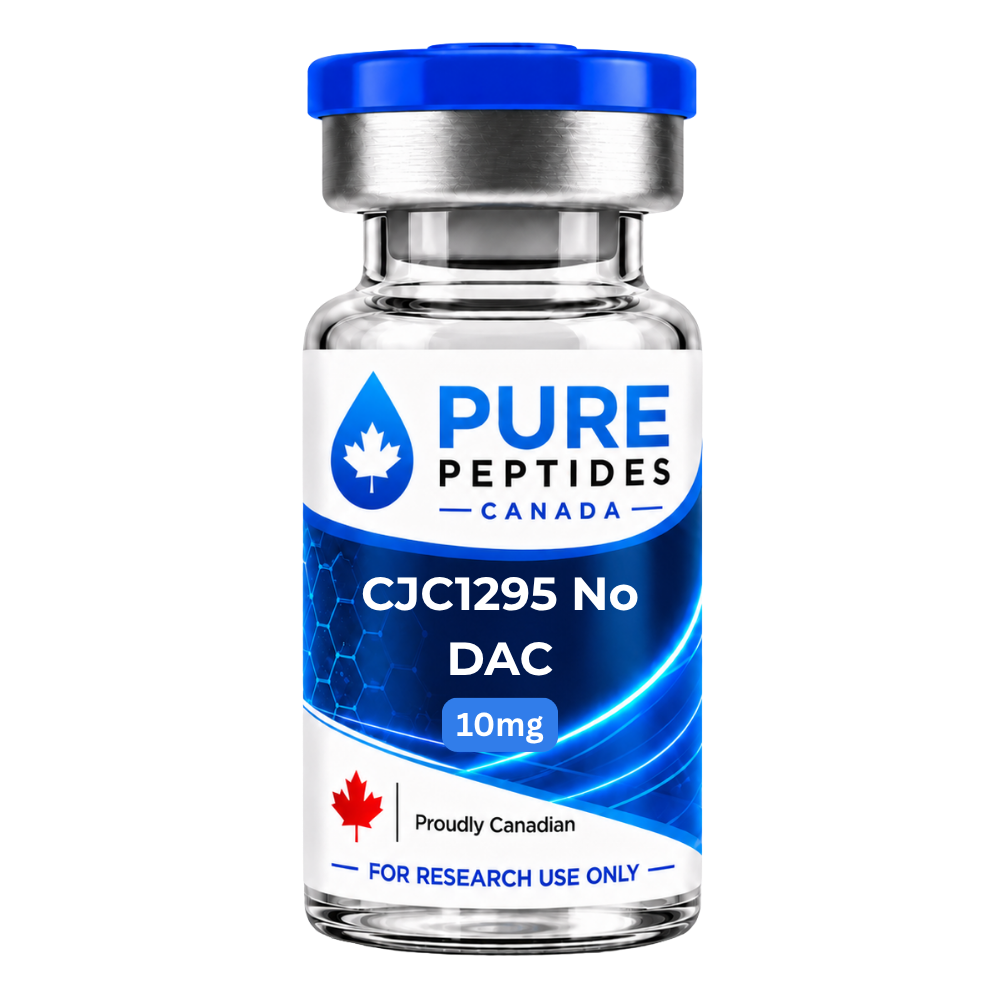 CJC-1295 no DACModified GRF (1–29), the short-acting form.View product and COA
 CJC-1295 DACThe albumin-binding, long-acting form.View product and COA
 IpamorelinSelective ghrelin-receptor agonist.View product and COA
 CJC-1295 + ipamorelinBoth peptides pre-combined in one vial.View product and COA
The same growth and signalling category also includes sermorelin, the unmodified GRF (1–29) sequence that preceded CJC-1295; tesamorelin; the older secretagogues GHRP-2, GHRP-6 and hexarelin; and the tesamorelin + ipamorelin and tesamorelin + ipamorelin + CJC-1295 blends.
Canadian context and sourcing
This corner of peptide research has unusually deep Canadian roots. CJC-1295 was developed by ConjuChem Biotechnologies, a Canadian biotech. Tesamorelin, another GHRH analogue, was discovered by Montreal’s Theratechnologies; it was approved by the US FDA in 2010 and received a Health Canada notice of compliance in April 2014 under the name Egrifta. That approval covers the specific drug product, not research-grade peptides.
Athletes should know that the World Anti-Doping Agency’s 2026 Prohibited List bans GHRH analogues, including CJC-1295, sermorelin and tesamorelin, and growth hormone secretagogues, including ipamorelin, at all times. Canadian athletes are tested under the Canadian Anti-Doping Program, which applies that list.
Pure Peptides Canada is a Canadian-owned supplier of laboratory research peptides, established in 2023. Before ordering any secretagogue, check:
- Which CJC-1295 you’re getting. Mass spectrometry tells the forms apart: the DAC version is roughly 280 g/mol heavier than modified GRF (1–29) at 3,367.9 g/mol.
- A batch-specific COA. The lot number should match your vial. See our COA guide.
- Purity and identity both. HPLC shows purity; mass spectrometry confirms identity. Here’s how they differ.
- Cold, dry storage. Our storage guide covers lyophilized peptides.
Regulatory status in 2026
In April 2026, Health Canada’s advisory on unauthorized injectable peptides listed both CJC-1295 and ipamorelin among products it had seized, and stated that “For Research Use Only” labelling does not make such products legal or exempt from regulatory requirements. Neither peptide is an approved drug anywhere, and both remain prohibited in sport.
Independently testedEvery batch verified by Janoshik Analytical.
Batch-matched COALinked from each product page.
Tracked across CanadaDiscreet delivery by Xpresspost in 3–7 days, or free in 4–12 days on orders over $299.
Free shipping over $299Plus discounts on bulk orders.
Frequently asked questions
What is the difference between CJC-1295 and ipamorelin?
CJC-1295 is a modified version of growth hormone-releasing hormone (GHRH) that acts on the GHRH receptor. Ipamorelin is a five-residue ghrelin mimetic that acts on the GHS-R1a receptor. Both increase growth hormone release in research models, through different receptors on the same pituitary cells.
What does DAC mean in CJC-1295?
DAC stands for Drug Affinity Complex, a reactive group on an added lysine that bonds to albumin in the blood. In healthy adults, the DAC form had an estimated half-life of 5.8 to 8.1 days. CJC-1295 without DAC lacks this group and is short-acting.
Is CJC-1295 without DAC the same as sermorelin?
No. Sermorelin is the native GRF (1-29) sequence. CJC-1295 without DAC, also called modified GRF (1-29), carries four amino-acid substitutions that make it more resistant to enzymatic breakdown.
Why are CJC-1295 and ipamorelin studied together?
They stimulate growth hormone release through two separate receptors, and endocrine research has long found that combining a GHRH signal with a ghrelin-receptor signal produces a larger response than either alone.
Are CJC-1295 and ipamorelin approved medicines?
No. Neither has been approved as a medicine in any country, and Health Canada’s April 2026 advisory listed both among unauthorized injectable peptides it had seized. A related GHRH analogue, tesamorelin, is approved in Canada and the US for one specific indication under the name Egrifta. Research-grade peptides are not for human use.
Are CJC-1295 and ipamorelin banned in sport?
Yes. The World Anti-Doping Agency’s 2026 Prohibited List bans GHRH analogues, including CJC-1295, and growth hormone secretagogues, including ipamorelin, at all times.
Growth and signalling reagents, batch-tested
CJC-1295, ipamorelin and related secretagogues, each with a COA matched to your vial’s lot number and tracked shipping across Canada.
References
- Jetté L, et al. Human growth hormone-releasing factor (hGRF)1-29-albumin bioconjugates activate the GRF receptor on the anterior pituitary in rats: identification of CJC-1295 as a long-lasting GRF analog. Endocrinology. 2005;146(7).
- Teichman SL, et al. Prolonged stimulation of growth hormone (GH) and insulin-like growth factor I secretion by CJC-1295, a long-acting analog of GH-releasing hormone, in healthy adults. J Clin Endocrinol Metab. 2006;91(3):799-805. DOI
- Ionescu M, Frohman LA. Pulsatile secretion of growth hormone (GH) persists during continuous stimulation by CJC-1295, a long-acting GH-releasing hormone analog. J Clin Endocrinol Metab. 2006;91(12):4792-7. PubMed
- Raun K, et al. Ipamorelin, the first selective growth hormone secretagogue. Eur J Endocrinol. 1998;139(5):552-61. PubMed
- Beck DE, Sweeney WB, McCarter MD. Prospective, randomized, controlled, proof-of-concept study of the ghrelin mimetic ipamorelin for the management of postoperative ileus in bowel resection patients. Int J Colorectal Dis. 2014;29(12):1527-34. DOI
- World Anti-Doping Agency. The 2026 Prohibited List, section S2.2.4. WADA
- Theratechnologies. Health Canada approves EGRIFTA (tesamorelin for injection). April 30, 2014. News release
Prepared by Pure Peptides Canada. Sources checked October 2026. For laboratory research use only; not for human or veterinary use. This article summarizes published research for education and is not medical advice. Nothing here is intended to diagnose, treat, cure or prevent any disease.