

Thymosin alpha-1 (TA1) is a 28-amino-acid peptide first isolated from calf thymus extract in 1977. Unlike most research peptides, it has a long clinical record: a synthetic version, thymalfasin, is approved in more than 35 countries, mainly for chronic hepatitis B. That history makes it a useful case study in how promising immune research holds up in large trials.
This guide covers what TA1 is, where it came from, what the clinical research found, how it differs from TB-500, and what to check when sourcing it in Canada.
The short answer
- TA1 is an N-terminally acetylated 28-amino-acid peptide cut from the larger protein prothymosin alpha.
- Allan Goldstein’s group isolated and sequenced it in 1977 from thymosin fraction 5, a calf-thymus extract.
- Thymalfasin (Zadaxin) is approved in more than 35 countries, but not in the United States.
- In 2025, the largest randomized trial to date, in 1,106 adults with sepsis, found no reduction in 28-day mortality.
Thymosin alpha-1
28 residues with an N-terminal acetyl group (dashed)
- Ac
- S
- D
- A
- A
- V
- D
- T
- S
- S
- E
- I
- T
- T
- K
- D
- L
- K
- E
- K
- K
- E
- V
- V
- E
- E
- A
- E
- N
- Mass
- 3,108.3 g/mol
- Precursor
- Prothymosin alpha
- First isolated
- 1977, Allan Goldstein’s laboratory
- Drug name
- Thymalfasin (Zadaxin); approved in 35+ countries, not in the US
Furthest stage of research
- Cell studies
- Animal studies
- Human studies
- Controlled efficacy trials
Its largest trial to date, in sepsis (2025), found no reduction in mortality.
What thymosin alpha-1 is
Thymosin alpha-1, often shortened to TA1 or Tα1, is a 28-amino-acid peptide whose first residue carries an acetyl group. It is cut from a larger protein, prothymosin alpha, and was first isolated from thymus tissue, the gland where T cells mature. That origin is why most TA1 research focuses on the immune system.
Despite the shared name, thymosin alpha-1 is unrelated to thymosin beta-4, the parent protein of TB-500. “Thymosin” began as a label for a mixed thymus extract, and the peptides later isolated from it turned out to be biochemically distinct. If your research is about TB-500, our BPC-157 vs TB-500 guide is the better starting point.
From thymus extract to one peptide
In the 1960s, Allan Goldstein and Abraham White described “thymosin”, a thymus extract with immune activity. Their working preparation, thymosin fraction 5, was a mixture of many small peptides. In 1977 the group isolated and sequenced thymosin alpha-1 from that fraction, and it proved far more potent than the crude mixture in T-cell assays. A synthetic version, thymalfasin, was later developed and marketed as Zadaxin.
How TA1 is thought to work
Cell and animal studies describe TA1 as an immune modulator rather than a simple stimulant. Research links it to activation of dendritic cells through Toll-like receptor signalling, to T-cell maturation and to shifts in cytokine production. Those mechanisms come mostly from laboratory models, and they explain why TA1 has so often been tested in infection-related settings.
What clinical research found
Thymalfasin is approved in more than 35 countries, mainly for chronic hepatitis B, and has been studied as a vaccine adjuvant and alongside standard treatment in other settings. It is not approved in the United States.
Sepsis has been the clearest test of how TA1 performs in a large, modern trial. Earlier small trials had suggested lower death rates in treated patients. The TESTS trial, published in The BMJ in January 2025, randomized 1,106 adults with sepsis at 22 hospitals in China to TA1 or placebo. Twenty-eight-day mortality was 23.4% with TA1 and 24.1% with placebo, and the authors found no clear evidence of a benefit. A possible signal in people with diabetes was flagged as a question for future trials.
A meta-analysis published later in 2025 pooled randomized trials, including TESTS, and still reported an overall mortality signal, with large differences between patient subgroups. So the question isn’t fully closed. The pattern of promising small studies followed by a neutral large trial is common in immunology, and it’s the main reason TA1 remains a research compound outside its existing approvals.
Research-grade thymosin alpha-1 with a batch-matched COA.
View thymosin alpha-1Related thymic and immune peptides
Several peptides in our catalogue are often studied alongside TA1. Thymulin is a zinc-dependent nonapeptide produced by the thymus. Thymogen is a dipeptide, glutamyl-tryptophan, from the short bioregulator family covered in our bioregulator explainer. LL-37 is the human cathelicidin, an antimicrobial peptide of the innate immune system.
 Thymosin alpha-1The acetylated 28-residue thymic peptide.View product and COA
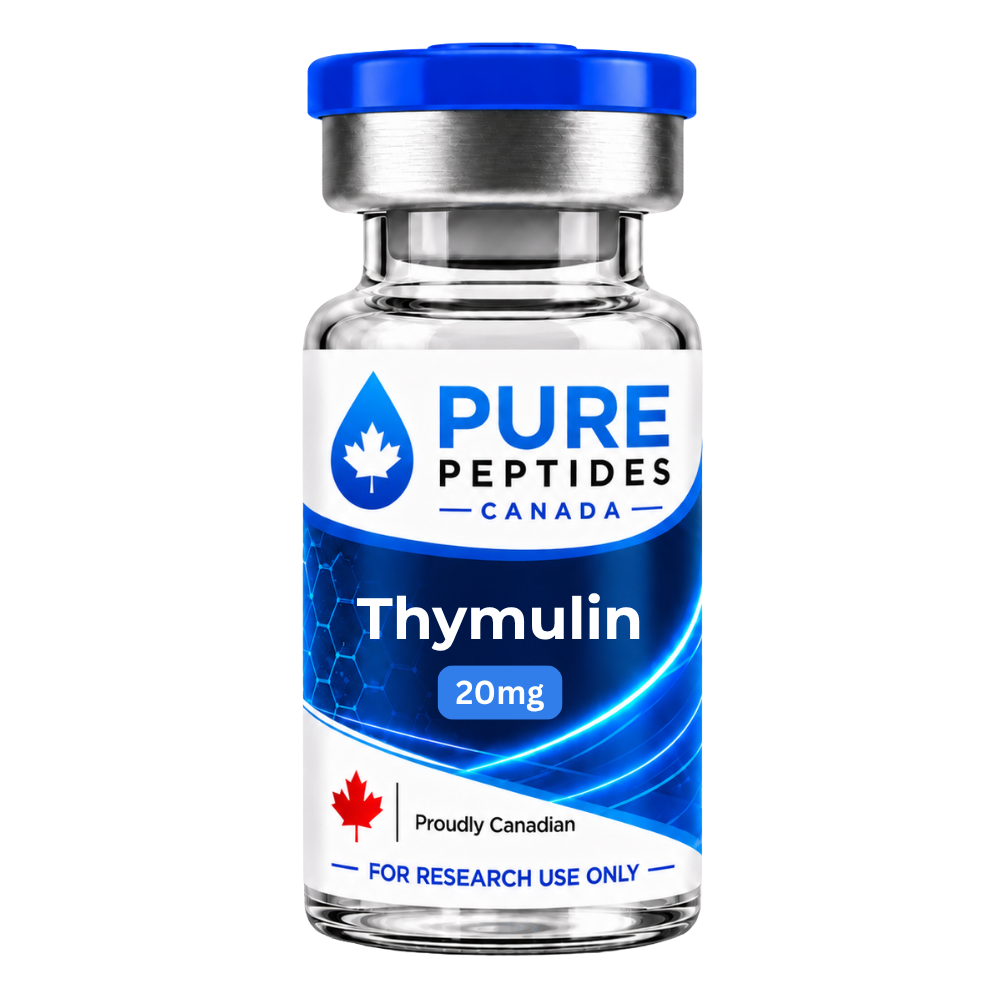 ThymulinZinc-dependent thymic nonapeptide.View product and COA
 ThymogenGlu-Trp dipeptide from the bioregulator family.View product and COA
 LL-37The human cathelicidin antimicrobial peptide.View product and COA
Sourcing thymosin alpha-1 in Canada
Pure Peptides Canada is a Canadian-owned supplier of laboratory research peptides, established in 2023. Before ordering TA1 from any supplier, check:
- The acetyl group is there. Mass spectrometry should match 3,108.3 g/mol. A version missing the N-terminal acetyl group would come in about 42 g/mol lighter.
- A batch-specific COA. The lot number should match your vial. See our COA guide.
- Purity and identity both. Here’s what HPLC and mass spectrometry each tell you.
- Cold, dry storage. The C-terminal asparagine can deamidate over time, so keep vials sealed, cold and dry. Our storage guide has the details.
Independently testedEvery batch verified by Janoshik Analytical.
Batch-matched COALinked from each product page.
Tracked across CanadaDiscreet delivery by Xpresspost in 3–7 days, or free in 4–12 days on orders over $299.
Free shipping over $299Plus discounts on bulk orders.
Frequently asked questions
What is thymosin alpha-1?
Thymosin alpha-1 is a 28-amino-acid, N-terminally acetylated peptide cut from the protein prothymosin alpha. It was isolated from calf thymus extract and sequenced in 1977, and it is studied mainly as an immune modulator.
Is thymosin alpha-1 the same as thymalfasin?
Thymalfasin is the drug name for synthetic thymosin alpha-1, sold as Zadaxin in countries where it is approved. Research-grade thymosin alpha-1 is a laboratory reagent, not the approved drug product.
Is thymosin alpha-1 an approved drug?
As thymalfasin, it is approved in more than 35 countries, mainly for chronic hepatitis B. It is not approved in the United States. Thymosin alpha-1 sold by Pure Peptides Canada is a research reagent and is not for human use.
Is thymosin alpha-1 the same as TB-500?
No. TB-500 is derived from thymosin beta-4, a different and biochemically unrelated protein. The two share the thymosin name only because both were first found in thymus extracts.
Did thymosin alpha-1 reduce mortality in sepsis?
Not in the largest trial so far. The 2025 TESTS trial of 1,106 adults with sepsis found 28-day mortality of 23.4% with thymosin alpha-1 versus 24.1% with placebo, with no clear evidence of benefit.
Does Pure Peptides Canada ship thymosin alpha-1 across Canada?
Yes. Orders ship tracked and discreetly across Canada, usually arriving by Xpresspost in 3–7 days, or free in 4–12 days on orders over $299, with free shipping on orders over $299.
Thymosin alpha-1, batch-tested
Every batch is independently tested, with a certificate of analysis matched to the lot number on your vial.
References
- Goldstein AL, et al. Thymosin α1: isolation and sequence analysis of an immunologically active thymic polypeptide. Proc Natl Acad Sci USA. 1977;74(2):725-9.
- Wu J, et al.; TESTS study collaborator group. The efficacy and safety of thymosin α1 for sepsis (TESTS): multicentre, double blinded, randomised, placebo controlled, phase 3 trial. BMJ. 2025;388:e082583. DOI
- Gu, et al. Systematic review and meta-analysis of thymosin α1 in sepsis. Front Cell Infect Microbiol. 2025;15:1673959. DOI
Prepared by Pure Peptides Canada. Sources checked October 2026. For laboratory research use only; not for human or veterinary use. This article summarizes published research for education and is not medical advice. Nothing here is intended to diagnose, treat, cure or prevent any disease.