
Most peptide hormones last minutes in the bloodstream. CJC-1295 with DAC was engineered to last about a week. Developed in Montreal in the early 2000s, it combined a stabilized fragment of growth hormone-releasing hormone with a chemical hook that grabs the blood protein albumin. Its human data still make it one of the best-documented GHRH analogues that never became a medicine.
This guide explains what the “DAC” is, how the albumin trick works, what the 2006 human studies found, why development stopped, and how it differs from the version sold as “CJC-1295 without DAC”.
The short answer
- CJC-1295 with DAC is a 30-residue analogue of GHRH(1–29): four amino-acid substitutions for stability, plus an added lysine carrying a reactive maleimide group, the Drug Affinity Complex.
- In the body, that maleimide bonds covalently to the single free cysteine on albumin, so the peptide rides on albumin and escapes rapid breakdown and kidney clearance.
- It was developed by ConjuChem Biotechnologies in Montreal. In a 2006 study in healthy adults, single doses raised growth hormone 2- to 10-fold for 6 days or more and IGF-I 1.5- to 3-fold for 9 to 11 days, with an estimated half-life of 5.8 to 8.1 days.
- Development stopped in 2006 after a participant died during a phase 2 trial. The death was reported as unrelated to the drug, but the programme never resumed, and CJC-1295 has never been approved anywhere.
- “CJC-1295 without DAC” is really Mod GRF(1–29): the same stabilized peptide without the albumin hook, lasting minutes rather than days.
CJC-1295 with DAC
Also called DAC:GRF. Based on GHRH(1–29), the active fragment also used in sermorelin.
- Y
- a
- D
- A
- I
- F
- T
- Q
- S
- Y
- R
- K
- V
- L
- A
- Q
- L
- S
- A
- R
- K
- L
- L
- Q
- D
- I
- L
- S
- R
- K-DAC
- NH₂
Blue beads: the four stabilizing substitutions (D-alanine 2, glutamine 8, alanine 15, leucine 27) shared with Mod GRF(1–29). The added lysine 30 carries the albumin-binding DAC group. Lowercase “a” marks a D-amino acid; see our amino acid code chart.
- Developer
- ConjuChem Biotechnologies, Montreal
- Receptor
- GHRH receptor, a class B GPCR
- Half-life
- 5.8 to 8.1 days in the 2006 study; minutes without DAC
- Mass
- About 3,647 g/mol (Mod GRF(1–29): about 3,368)
- Status
- Never approved; development stopped in 2006
Where the evidence stands
- Cell studies
- Animal studies
- Small human studies
- Controlled efficacy trials
Two small 2006 studies in healthy adults; development stopped before efficacy trials were completed.
Why albumin?
Natural GHRH is broken down within minutes, chiefly by the enzyme DPP-4 and by filtration through the kidneys. Albumin, the most abundant protein in blood, has the opposite profile: it is too large to be filtered out and circulates for weeks. A small peptide attached to albumin borrows that longevity. Our guide to how peptides are made to last compares this strategy with the fatty-acid approach used in semaglutide, which binds albumin loosely rather than permanently.
How the DAC works
The Drug Affinity Complex is a maleimidopropionic acid group attached to the side chain of an extra lysine at the end of the peptide. Maleimides react readily with thiol groups, and albumin has exactly one free thiol on its surface, on cysteine 34. The reaction forms a stable covalent bond, so the peptide becomes a permanent passenger on the albumin molecule.
The four substitutions in the peptide itself do separate jobs. D-alanine at position 2 blocks DPP-4, which normally cuts GHRH after its second residue. The other three swap out residues prone to degradation or rearrangement, such as replacing methionine 27, which oxidizes easily. Our guides to D-amino acids and peptide stability explain both tricks.
From a Montreal lab to the clinic
- Early 2000sConjuChem Biotechnologies, a Montreal company, develops its albumin-conjugation platform and applies it to a stabilized GHRH fragment.
- 2005Animal studies show the albumin-bound analogue keeps activating the GHRH receptor in the pituitary for days.
- 2006Two studies in healthy adults report sustained rises in growth hormone and IGF-I. A companion study finds that natural growth hormone pulses persist, with higher baseline levels between pulses.
- 2006Development stops after a participant in a phase 2 trial dies; the death was reported as unrelated to the drug, but the programme is not restarted.
ConjuChem used the same albumin-binding idea on other peptides, including an exendin-4 conjugate studied for type 2 diabetes. For the wider family of growth hormone research peptides, see our growth hormone peptides map, and for Canada’s long history in this field, Canada’s century of peptide discovery.
Research-grade CJC-1295 with DAC with a Janoshik certificate.
View CJC-1295 with DACWith DAC vs without DAC
| Feature | CJC-1295 with DAC | “CJC-1295 without DAC” (Mod GRF 1–29) |
|---|---|---|
| Structure | Stabilized GHRH(1–29) plus lysine with a maleimide DAC group | The same stabilized GHRH(1–29), no DAC |
| Albumin binding | Covalent, after injection in studies | None |
| Half-life | About 6 to 8 days in the 2006 study | Minutes |
| Growth hormone pattern | Raised baseline for days, with pulses preserved | Short pulse after each exposure |
| Published human data | Two small 2006 studies | No dedicated published human trial |
Strictly, the name CJC-1295 belongs to the DAC version; “CJC-1295 without DAC” is a marketing label for Mod GRF(1–29). For how both compare with ipamorelin, which acts on a different receptor, see CJC-1295 vs ipamorelin.
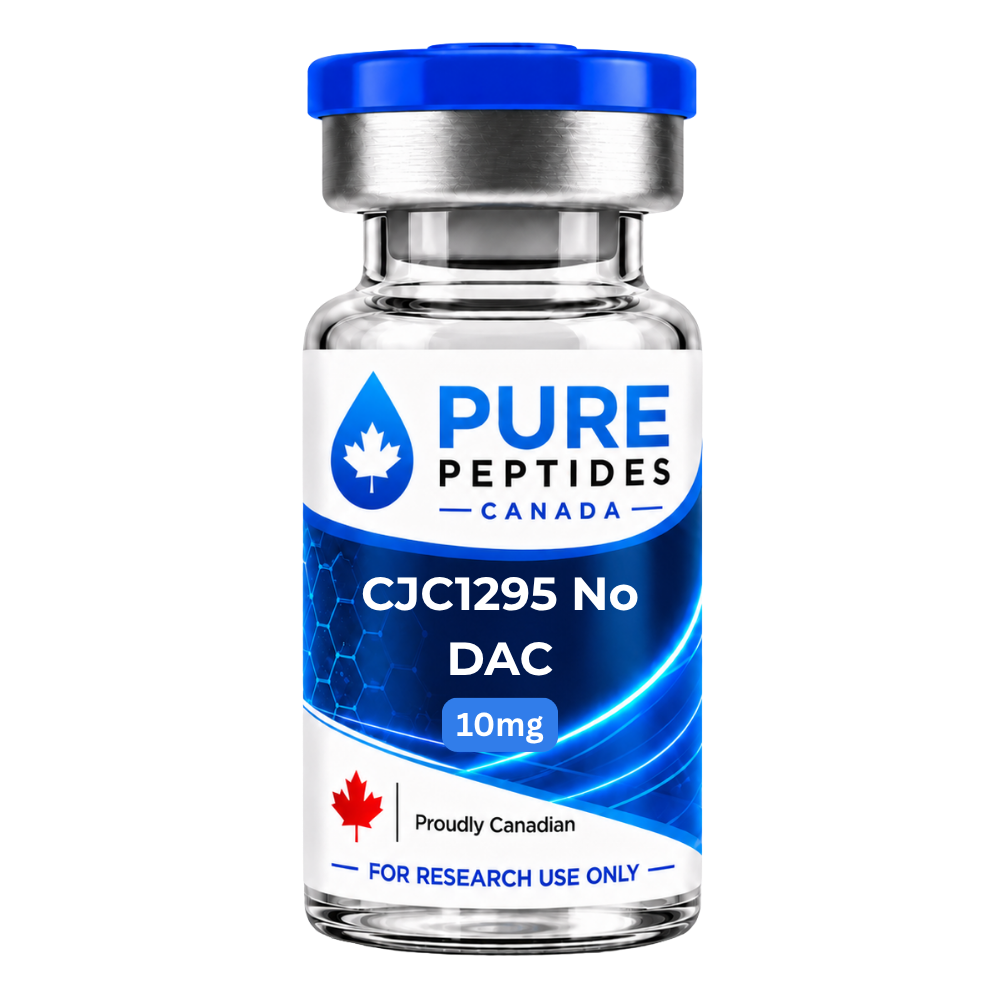 CJC-1295 no DACMod GRF(1–29)View product and COA
 SermorelinUnmodified GHRH(1–29)View product and COA
 IpamorelinGhrelin-receptor agonistView product and COA
What is established and what is open
Reasonably well established
- The DAC binds albumin covalently and extends half-life to days.
- Single doses raised GH and IGF-I for days in healthy adults.
- Natural GH pulses persisted during continuous stimulation.
Open questions
- Long-term safety, which was never established before development stopped.
- Effects of sustained rather than pulsed GHRH-receptor stimulation over months.
- Any efficacy in a defined condition, which was never shown in completed trials.
Sourcing CJC-1295 with DAC in Canada
Before ordering from any supplier, check that:
- The mass shows the DAC. At about 3,647 g/mol, the DAC version is roughly 280 g/mol heavier than Mod GRF(1–29). A certificate showing about 3,368 is the version without DAC. See our HPLC testing guide.
- The certificate names your batch. Match the batch number on your vial to its report; our peptide COA guide explains how to read it.
- Storage protects the reactive group. The maleimide can hydrolyze in solution, which removes its ability to bind albumin, so keep the powder sealed, cold and dry. See our guide to lyophilized peptides.
Research use only. CJC-1295 with DAC from Pure Peptides Canada is a laboratory reagent. It is not an approved drug, it is not for human or veterinary use, and nothing in this article is dosing, administration or medical guidance.
Frequently asked questions
What is CJC-1295 with DAC?
It is a synthetic analogue of growth hormone-releasing hormone, built from a stabilized GHRH(1–29) fragment plus an added lysine carrying a Drug Affinity Complex that binds albumin covalently. It was developed by ConjuChem Biotechnologies in Montreal and never approved.
What does DAC stand for?
DAC stands for Drug Affinity Complex: a maleimidopropionic acid group that reacts with the free cysteine on albumin, attaching the peptide to albumin so it circulates for days instead of minutes.
How long does CJC-1295 with DAC last?
In a 2006 study in healthy adults, its estimated half-life was 5.8 to 8.1 days, and single doses kept IGF-I raised for 9 to 11 days. Without the DAC, the peptide lasts minutes.
What is the difference between CJC-1295 with and without DAC?
Both share the same stabilized GHRH(1–29) sequence. The DAC version adds an albumin-binding group that extends its half-life to days; the version without DAC, properly called Mod GRF(1–29), lasts minutes and has no dedicated published human trial.
Is CJC-1295 approved in Canada?
No. Its development stopped in 2006, it has never been approved anywhere, and it is not authorized by Health Canada as a drug. Pure Peptides Canada supplies it only as a laboratory research reagent.
Who developed CJC-1295?
ConjuChem Biotechnologies, a Montreal biotechnology company, developed CJC-1295 in the early 2000s using its albumin-conjugation platform.
CJC-1295 with DAC for laboratory research
With a Janoshik certificate listed by batch, priced in Canadian dollars and shipped tracked from inside Canada.
References
- Teichman SL, Neale A, Lawrence B, Gagnon C, Castaigne JP, Frohman LA. Prolonged stimulation of growth hormone (GH) and insulin-like growth factor I secretion by CJC-1295, a long-acting analog of GH-releasing hormone, in healthy adults. J Clin Endocrinol Metab. 2006;91(3):799–805. DOI
- Ionescu M, Frohman LA. Pulsatile secretion of growth hormone (GH) persists during continuous stimulation by CJC-1295, a long-acting GH-releasing hormone analog. J Clin Endocrinol Metab. 2006;91(12):4792–4797.
- Jetté L, et al. hGRF1-29-albumin bioconjugates activate the GRF receptor on the anterior pituitary in rats: identification of CJC-1295 as a long-lasting GRF analog. Endocrinology. 2005;146(7):3052–3058.
For laboratory research use only. Not for human or veterinary use. This article summarizes published research for educational purposes and is not medical advice.