
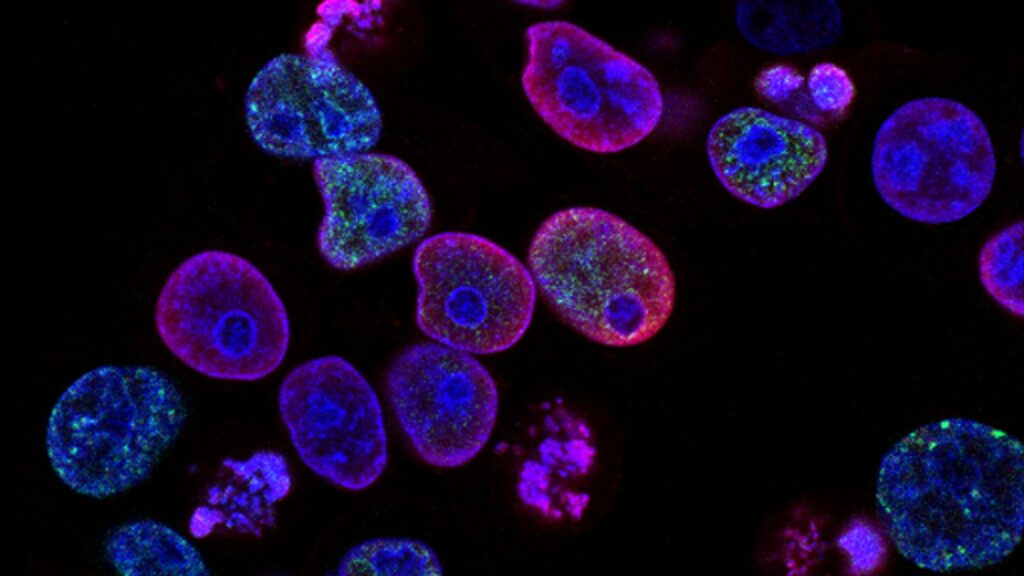
LL-37 is the only cathelicidin the human body makes: a 37-amino-acid peptide that damages bacterial membranes, calls in immune cells and helps close wounds. It also has a Canadian chapter. Researchers at the University of British Columbia helped show that it is far more than a natural antibiotic.
This guide covers what LL-37 is, how vitamin D controls it, what cell and tissue studies show, where the evidence stops, and what to check before ordering research-grade LL-37 in Canada.
The short answer
- LL-37 is a 37-amino-acid peptide named for its first two residues, both leucine. It is cut from a larger precursor, hCAP18, encoded by the CAMP gene.
- hCAP18 is the only cathelicidin protein in humans. It is stored in neutrophils and produced by skin and other barrier tissues.
- Vitamin D switches the CAMP gene on, and ultraviolet B exposure raises hCAP18 in human skin.
- Beyond killing microbes, LL-37 changes how immune cells behave, a role mapped in part by a 2002 study from Robert Hancock’s laboratory at UBC.
- LL-37 is not an approved medicine. Research-grade LL-37 is a laboratory reagent.
LL-37
Human cathelicidin antimicrobial peptide; the C-terminal fragment of hCAP18.
- L
- L
- G
- D
- F
- F
- R
- K
- S
- K
- E
- K
- I
- G
- K
- E
- F
- K
- R
- I
- V
- Q
- R
- I
- K
- D
- F
- L
- R
- N
- L
- V
- P
- R
- T
- E
- S
Highlighted: the two leucines that give LL-37 its name.
- Gene
- CAMP (cathelicidin antimicrobial peptide)
- Precursor
- hCAP18, about 18 kDa, cleaved by proteinase 3
- Mass
- About 4,493 g/mol
- Charge
- Strongly cationic, about +6 at neutral pH
- Research themes
- Innate immunity, wound repair, vitamin D biology
Where the evidence stands
- Cell studies
- Animal studies
- Human studies
- Controlled clinical trials
Human data are mostly observational and tissue-expression studies.
What LL-37 is
Cathelicidins are a family of host-defence peptides found across mammals. Many species make several; humans make just one, a protein called hCAP18. Neutrophils, the immune system’s first responders, store it in their granules, and skin, airway and gut linings produce it too. When hCAP18 is released, the enzyme proteinase 3 cuts off its last 37 amino acids. That fragment is LL-37.
LL-37 folds into an amphipathic helix, with positive charges along one face and water-repelling residues along the other. That shape lets it bind the negatively charged membranes of bacteria and disrupt them, which is the classic antimicrobial mechanism.
The vitamin D connection
The CAMP gene contains vitamin D response elements, so the active form of vitamin D directly switches it on. In laboratory studies, 1,25-dihydroxyvitamin D strongly induces hCAP18 in macrophages and dendritic cells. In human skin, ultraviolet B exposure sufficient to make vitamin D raises hCAP18, and topical treatment with a vitamin D analogue enhanced the rise in hCAP18 after skin injury.
Population data fit the same picture. A 2012 study of healthy adults found that circulating hCAP18/LL-37 rose with blood levels of 25-hydroxyvitamin D. That is a correlation, not proof that changing vitamin D status changes infection outcomes.
Research-grade LL-37 with a batch-matched COA.
View LL-37More than an antibiotic
For years LL-37 was thought of mainly as a natural antibiotic. A 2002 study from Robert Hancock’s laboratory at the University of British Columbia, a long-running centre for host-defence peptide research, helped change that view. The team described LL-37 as a multifunctional modulator of innate immune responses: in cell studies it altered the expression of genes in immune cells, increased chemokine signals that recruit other cells and dampened some inflammatory responses to bacterial endotoxin.
That work helped establish the idea that host-defence peptides steer the immune system as well as attack microbes, a theme that now runs through much of the antimicrobial peptide field.
Wound repair and a double edge
In normal skin, hCAP18 is low until injury, when it rises quickly. A 2003 study found LL-37 is involved in re-epithelialization, the regrowth of skin over a wound, and that it was lacking in the epithelium of chronic ulcers. Those findings made LL-37 a candidate in wound-healing research.
The same signalling power has a downside. Research has linked LL-37 to inflammatory skin conditions such as psoriasis and rosacea, where too much activity appears to feed inflammation rather than resolve it. For researchers, that dual role is one of the most interesting things about the peptide.
What is still open
Reasonably well established
- LL-37 is the only human cathelicidin peptide, released from hCAP18.
- It kills a range of microbes in laboratory conditions.
- Vitamin D regulates its gene directly.
- It modulates immune-cell signalling in cell studies.
Open questions
- How lab findings translate to living tissue, where salts and proteins blunt its activity.
- When its effects help and when they drive inflammation.
- Whether it has a role as a therapy; it is not an approved medicine.
Related research peptides
LL-37 often appears alongside other peptides studied in immunity and repair. KPV is a tripeptide from the tail of alpha-MSH studied for inflammatory signalling, thymosin alpha-1 is a thymic immune peptide with a clinical history abroad, and BPC-157 is a widely studied repair peptide.
 LL-37The human cathelicidin peptideView product and COA
 KPVAlpha-MSH-derived tripeptideView product and COA
 Thymosin alpha-1Thymic immune peptideView product and COA
 BPC-157Repair-research pentadecapeptideView product and COA
Sourcing LL-37 in Canada
LL-37 is long, sticky and highly charged, so it rewards careful testing. Before ordering from any supplier, check that:
- The mass matches, at about 4,493 g/mol. See HPLC vs mass spectrometry.
- Purity is reported with the method. Longer sequences leave more room for deletion errors during synthesis. Purity versus net peptide content explains the numbers.
- You know the salt form if it matters. Highly charged peptides usually carry counter-ions such as TFA or acetate from purification, which affects net peptide content.
- The COA matches your lot, and storage is cold, dry and dark. See our peptide storage guide.
Regulatory status in 2026
LL-37 is not an approved drug in Canada or the United States. In spring 2026 the FDA announced it was removing LL-37, listed as cathelicidin LL-37, from Category 2 of its compounding list, the group of substances that raise significant safety risks, and that it would consult its Pharmacy Compounding Advisory Committee at a meeting expected before February 2027. Removal from Category 2 does not by itself make it eligible for US compounding.
In Canada, Health Canada’s April 2026 advisory on unauthorized injectable peptides did not name LL-37, but it warned that many other unauthorized peptide drugs exist and that “For Research Use Only” labelling does not make such products legal or exempt from regulatory requirements.
Research use only. LL-37 from Pure Peptides Canada is a laboratory reagent. It is not an approved drug, it is not for human or veterinary use, and nothing in this article is dosing or medical guidance.
Frequently asked questions
What is LL-37?
LL-37 is the only cathelicidin antimicrobial peptide made by humans. It is a 37-amino-acid peptide released from the precursor protein hCAP18, and it is studied for its roles in killing microbes, modulating immune responses and wound repair.
Why is it called LL-37?
The name comes from its first two amino acids, both leucine (L), and its length of 37 amino acids.
What is the difference between LL-37 and hCAP18?
hCAP18 is the full precursor protein, about 18 kDa, stored in neutrophils and made by barrier tissues. LL-37 is the active 37-amino-acid fragment that proteinase 3 cuts from its end.
How is LL-37 related to vitamin D?
The CAMP gene that encodes hCAP18 contains vitamin D response elements, so active vitamin D switches it on. In healthy adults, circulating hCAP18/LL-37 levels track with vitamin D levels.
Is LL-37 an approved medicine?
No. LL-37 has been studied extensively in laboratories, but it is not an approved medicine in Canada or elsewhere in North America. The US FDA’s 2026 decision to move it out of its compounding safety-risk category and refer it for advisory review is not an approval. Pure Peptides Canada sells it strictly as a research reagent that is not for human use.
Does Pure Peptides Canada ship LL-37 across Canada?
Yes. Orders ship tracked and discreetly across Canada, usually arriving by Xpresspost in 3–7 days, or free in 4–12 days on orders over $299, with free shipping on orders over $299.
LL-37, tested batch by batch
Lyophilized LL-37 with an independent COA for every batch, tracked delivery across Canada and pricing in Canadian dollars.
References
- Scott MG, Davidson DJ, Gold MR, Bowdish D, Hancock REW. The human antimicrobial peptide LL-37 is a multifunctional modulator of innate immune responses. J Immunol. 2002;169(7):3883–3891.
- Gombart AF, Borregaard N, Koeffler HP. Human cathelicidin antimicrobial peptide (CAMP) gene is a direct target of the vitamin D receptor and is strongly up-regulated in myeloid cells by 1,25-dihydroxyvitamin D3. FASEB J. 2005.
- Dixon BM, et al. Positive correlation between circulating cathelicidin antimicrobial peptide (hCAP18/LL-37) and 25-hydroxyvitamin D levels in healthy adults. BMC Res Notes. 2012;5:575. PubMed Central
- Heilborn JD, et al. The cathelicidin anti-microbial peptide LL-37 is involved in re-epithelialization of human skin wounds and is lacking in chronic ulcer epithelium. J Invest Dermatol. 2003.
For laboratory research use only. Not for human or veterinary use. This article summarizes published research for educational purposes and is not medical advice. Nothing here is intended to diagnose, treat, cure or prevent any disease.