
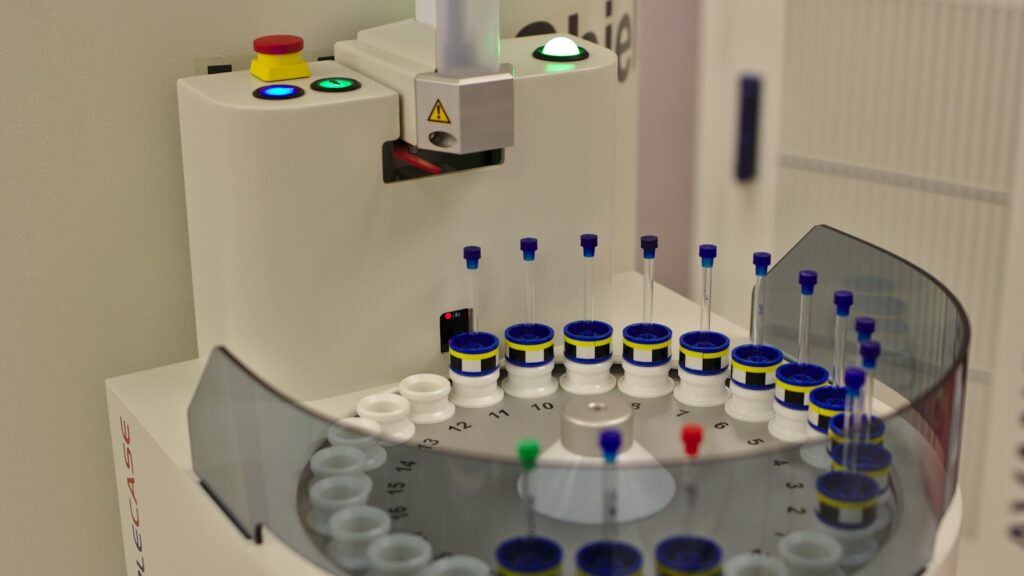
CJC-1295 and ipamorelin are often supplied together in a single vial. The reasoning behind the pairing is real and comes out of 1990s endocrinology: two compounds that raise growth hormone through different receptors should, in principle, do more together than either alone. What is usually left unsaid is that the published synergy data involve a different peptide, and that no study has tested this particular pair at all.
This guide covers what each half of the blend is, where the combination idea comes from and how far the evidence actually goes, and then the question a blended vial creates that a single-peptide vial does not: how do you verify that two peptides are both present, both pure, and in the ratio the label claims?
The short answer
- CJC-1295 is an analogue of growth hormone-releasing hormone (GHRH), the hypothalamic hormone that tells the pituitary to release growth hormone. It came out of ConjuChem, a company that describes its origins in Montréal.
- Ipamorelin is a five-residue growth hormone secretagogue, first described by Raun and colleagues at Novo Nordisk in 1998. It works through a different receptor, the one ghrelin would later be found to use.
- The rationale for combining them rests on studies from 1990 onward showing that a GHRH analogue plus a growth hormone-releasing peptide release growth hormone synergistically. Those studies used GHRP-6, not ipamorelin.
- No published study has tested CJC-1295 together with ipamorelin, in people or in animals. Claims of proven synergy for this specific pair are not supported.
- A blended vial needs more documentation, not less. Reversed-phase HPLC should resolve each component as its own peak with its own purity figure, mass spectrometry should find each expected mass, and net peptide content applies separately to each component.
CJC-1295 + ipamorelin
Two peptides, two receptors, one vial.
- CJC-1295
- GHRH analogue; acts at the GHRH receptor. Sold both with DAC and without.
- Ipamorelin
- Pentapeptide secretagogue, Aib-His-D-2-Nal-D-Phe-Lys-NH2; acts at the ghrelin receptor.
- Origin of the pairing
- GHRH + GHRP co-administration studies, from 1990 onward
- Studies of this exact pair
- None published
- Approved as a medicine
- No approved product identified in any jurisdiction
- What to ask for
- Identity, purity and content attributable to each component
Where the evidence stands
- Cell studies
- Animal studies
- Human studies of each compound alone
- Studies of the combination
Each compound has been studied in people separately. The combination has not been.
Two peptides, two targets
Growth hormone is released from the anterior pituitary under two opposing hypothalamic signals: GHRH, which stimulates release, and somatostatin, which restrains it. The two halves of this blend enter that system at different points.
CJC-1295, a GHRH analogue
CJC-1295 is a modified version of the first 29 residues of GHRH. Its distinguishing feature is a chemical group called a DAC, for drug affinity complex: a maleimidopropionic acid moiety which, according to the developer, binds to a specific site on albumin, the most abundant protein in blood. Tethering a short-lived peptide to a long-lived blood protein is a standard way to extend its life in circulation; our guide to peptide half-life engineering covers the family of tricks it belongs to.
The effect was substantial. In the key published human study, Teichman and colleagues reported in the Journal of Clinical Endocrinology & Metabolism in 2006 that CJC-1295 had an estimated half-life of “5.8–8.1 d” in healthy adults, that growth hormone rose “by 2- to 10-fold for 6 d or more”, and that IGF-I, the downstream marker of growth hormone activity, rose “by 1.5- to 3-fold for 9–11 d”. A GHRH fragment on its own survives minutes in blood. This one lasted days.
Ipamorelin, a selective secretagogue
Ipamorelin was described in 1998 by Kirsten Raun and colleagues, in a paper titled “Ipamorelin, the first selective growth hormone secretagogue”. It is a pentapeptide, built partly from non-standard residues: Aib (a methylated alanine) and two D-amino acids, which are mirror images of the forms found in natural proteins. Our guides to amino acid codes and D-amino acids explain the notation.
“Selective” referred to what it did not do. Earlier growth hormone-releasing peptides such as GHRP-6 and GHRP-2 also raised ACTH and cortisol, the stress hormones. In the 1998 study, ipamorelin did not do so at exposures more than 200 times those needed for its growth hormone effect, and the authors concluded it was “the first GHRP-receptor agonist with a selectivity for GH release similar to that displayed by GHRH”.
One historical detail matters for reading older papers: the 1998 paper describes a “GHRP-like receptor”, because ghrelin, the natural hormone that binds that receptor, was not identified until 1999. Ipamorelin is classed today as a ghrelin-receptor agonist, or ghrelin mimetic, but its discovery predates the hormone it mimics. Our guide to ghrelin covers that discovery, and how peptide receptors work explains the receptor family both compounds act on.
Ipamorelin reached human trials for a non-hormonal use. A phase 2 study published by Beck and colleagues in 2014 tested it for postoperative ileus, the temporary shutdown of the bowel after abdominal surgery, in patients undergoing bowel resection. It did not work: the median time to the first tolerated solid meal was 25.3 hours against 32.6 hours on placebo, a difference that did not reach statistical significance (p = 0.15), and the authors reported “no significant differences between ipamorelin and placebo in the key and secondary efficacy analyses”. Development was discontinued after those results.
The CJC-1295 naming problem
“CJC-1295” is sold in two forms, and the difference is not cosmetic.
| Form | What it is | What the published human data cover |
|---|---|---|
| CJC-1295 with DAC | The GHRH analogue carrying the albumin-binding DAC group | This is the molecule in the 2006 Teichman study, with the multi-day half-life |
| CJC-1295 without DAC | Also sold as modified GRF (1-29) or tetrasubstituted GRF (1-29): the same peptide backbone with four substitutions from natural GHRH, but no DAC group | No comparable published human half-life study |
Two things follow. First, the multi-day figures from the 2006 study belong to the DAC version only; applying them to a no-DAC product is a mistake. Second, “CJC-1295 without DAC” is not sermorelin. Sermorelin is unsubstituted GHRH(1-29) amide; the no-DAC molecule carries four amino-acid substitutions. Anti-doping authorities list CJC-1295 and sermorelin as separate named substances. Our CJC-1295 with DAC guide covers the DAC chemistry in detail, and our sermorelin guide covers the unmodified fragment.
Both forms are stocked separately, as well as the blend.
Browse growth researchWhere the combination idea comes from
The argument for pairing a GHRH analogue with a secretagogue is mechanistic, and it has genuine support in the literature — for a different peptide.
In 1990, Bowers and colleagues reported in the Journal of Clinical Endocrinology & Metabolism that submaximal amounts of a growth hormone-releasing peptide given with GHRH “stimulated GH release synergistically” in healthy men. The peptide in that study was the hexapeptide GHRP-6. A 1995 study by Popovic and colleagues then showed why the two classes complement each other: in patients whose hypothalamus was disconnected from the pituitary, the synergy disappeared, which the authors read as placing GHRP-6’s main action in the hypothalamus rather than the pituitary. By 1998, Micic and colleagues were describing GHRH plus GHRP-6 as among the most effective growth hormone-releasing stimuli tested.
So the two-class rationale is well founded. What does not follow is that it has been demonstrated for this blend. Every one of those studies used GHRP-6 or a close relative, not ipamorelin, and we could find no published study, human or animal, that administered CJC-1295 and ipamorelin together. Vendor and clinic pages that cite “studies showing synergy” for this pair are borrowing results from a different molecule. Our guide to GHRP-6, GHRP-2 and hexarelin covers the peptides that were actually tested, and how to read a peptide study covers this kind of substitution in general.
The two components side by side
| CJC-1295 | Ipamorelin | |
|---|---|---|
| Class | GHRH analogue | Growth hormone secretagogue / ghrelin mimetic |
| Receptor | GHRH receptor | Ghrelin receptor |
| Length | 29 residues plus, in the DAC form, a linker | 5 residues |
| First described | ConjuChem; key human study published 2006 | Raun et al., 1998 |
| Main reported site of action | Pituitary | Hypothalamus |
| Furthest human study | Pharmacodynamic study in healthy adults, 2006 | Phase 2 trial in postoperative ileus, 2014; primary endpoint not met |
| Analytical note | A 29-residue chain, so a well-resolved main peak matters more than a bare percentage | Contains Aib and D-amino acids, which mass alone cannot distinguish from alternatives |
| Approved anywhere | No | No |
Verifying two peptides in one vial
This is where a blend differs from a single-peptide reagent, and where documentation is most often thin. A certificate that reports one purity figure and one mass for a two-peptide vial has not characterised what is in it.
Regulatory guidance treats a product with more than one active substance as exactly that. ICH Q6A defines a “combination product” as “a drug product which contains more than one drug substance”, and requires that identity testing “establish the identity of the new drug substance(s)” — the bracketed plural is doing real work — with a stability-indicating assay for strength and acceptance limits stated for individual specified degradation products. ICH Q2(R2), the guideline on validating analytical procedures, defines selectivity as the extent to which particular analytes in mixtures can be measured “without interferences from other components with similar behaviour”, and notes that where one procedure cannot discriminate, “a combination of two or more procedures is recommended”.
Translated into what to look for on a report for a blended vial:
- A chromatogram that resolves both components. Reversed-phase HPLC separates peptides by how strongly they stick to the column, and two peptides as different as a 29-residue GHRH analogue and a pentapeptide should elute well apart. You want to see both main peaks identified, not one peak and a purity number. Our guide to reading an HPLC chromatogram explains retention time and peak assignment.
- Purity stated per component. A single percentage for a mixture is ambiguous: it cannot tell you whether an impurity belongs to one component or whether the two are present in the intended proportions.
- Two masses confirmed. Mass spectrometry identity work should find the expected mass of each peptide. Note what mass cannot tell you: it “cannot distinguish between isomers”, so it cannot confirm ipamorelin’s D-amino acids or its Aib residue against same-mass alternatives. That needs chiral or derivatisation methods. See how to read a peptide mass spectrum.
- A stated ratio, and how it was shown. Quantitation by HPLC assumes a quantitative reference standard for each component; where none exists, a gravimetric approach is used in which both standard and sample are “corrected for counterion content and water content”.
- Net peptide content, per component. Synthetic peptides are supplied as salts, carrying trifluoroacetate or acetate counter-ions, and peptides “are quite hygroscopic” so uncontrolled moisture “can lead to erroneous assay results”. In a blend, a single total labelled mass covers two peptides with two different counter-ion and water loads. Our guide to net peptide content works through the arithmetic.
What to ask for. For any blended vial, ask for the chromatogram itself rather than a summary figure, and ask which component each reported number belongs to. A supplier who can answer that has characterised the blend; one who cannot has tested it as though it were a single peptide.
What’s established and what isn’t
Reasonably well established
- CJC-1295 with DAC raised growth hormone and IGF-I for days in healthy adults.
- Ipamorelin raises growth hormone without the ACTH and cortisol rise seen with earlier GHRPs.
- GHRH plus GHRP-6 releases growth hormone synergistically, and GHRP-6 acts mainly at the hypothalamus.
- No approved product containing either compound has been identified in any jurisdiction.
Open questions
- Whether CJC-1295 and ipamorelin interact as GHRH and GHRP-6 do; the pair has not been studied.
- What the no-DAC form of CJC-1295 does over time in people.
- Whether raising growth hormone in this way produces any durable outcome; the one phase 2 trial of ipamorelin missed its endpoint.
- Long-term effects of either compound, which no published trial has examined.
Sourcing a blended vial in Canada
Everything that applies to a single research peptide applies here, plus the per-component checks above. Before ordering, confirm that:
- The documentation names both peptides. Identity, purity and content should each be attributable to a component.
- You know which CJC-1295 you are getting. With DAC and without are different molecules with different published evidence.
- The batch number on the certificate matches your vial. See our COA guide.
- Storage is cold, dry and dark, and the vial is lyophilized on arrival. See the peptide storage guide and what lyophilized means.
 CJC-1295 + IpamorelinThe two peptides in one vialView product
 CJC-1295 with DACThe DAC-bearing formView product
 CJC-1295 No DACModified GRF (1-29)View product
 IpamorelinThe pentapeptide on its ownView product
Research use only. Pure Peptides Canada products are laboratory reagents for in-vitro research, not for human or veterinary use. This article explains published research for education; it is not medical, dietary or dosing guidance.
Frequently asked questions
What is CJC-1295 and ipamorelin?
They are two separate research peptides often supplied together in one vial. CJC-1295 is an analogue of growth hormone-releasing hormone and acts at the GHRH receptor; ipamorelin is a five-residue growth hormone secretagogue that acts at the ghrelin receptor. Because they act at different receptors, they are commonly supplied as a pair.
Why are CJC-1295 and ipamorelin combined?
The rationale comes from studies of a GHRH analogue given with a growth hormone-releasing peptide, which from 1990 onward reported synergistic growth hormone release. Those studies used GHRP-6 rather than ipamorelin, and no published study has tested CJC-1295 and ipamorelin together.
Has any study tested CJC-1295 with ipamorelin?
No. We found no published study, in people or in animals, that administered the two together. Each compound has been studied separately: CJC-1295 with DAC in a 2006 pharmacodynamic study in healthy adults, and ipamorelin in a 2014 phase 2 trial for postoperative ileus that did not meet its primary endpoint.
Is CJC-1295 without DAC the same as sermorelin?
No. Sermorelin is unsubstituted GHRH(1-29) amide. CJC-1295 without DAC, also sold as modified or tetrasubstituted GRF (1-29), carries four amino-acid substitutions. Anti-doping authorities list them as separate substances, and the multi-day half-life reported in 2006 applies only to the DAC-bearing form.
How do you check the purity of a peptide blend?
Per component. Reversed-phase HPLC should resolve each peptide as its own peak with its own purity figure, mass spectrometry should confirm each expected mass, and net peptide content applies separately to each peptide because each carries its own counter-ion and water load. A single purity number for a two-peptide vial does not characterise it.
Is CJC-1295 and ipamorelin approved in Canada?
No. Neither compound is authorized by Health Canada as a drug and neither has a DIN. Both are also prohibited in sport at all times under the World Anti-Doping Agency’s S2 class. Pure Peptides Canada supplies them only as laboratory reagents for in-vitro research.
What does the Aib in ipamorelin’s sequence mean?
Aib is alpha-aminoisobutyric acid, a non-standard amino acid not used in natural proteins. Ipamorelin’s sequence is Aib-His-D-2-Nal-D-Phe-Lys-NH2, which also includes two D-amino acids. These residues matter analytically because mass spectrometry cannot distinguish them from same-mass alternatives.
Growth hormone research peptides, documented by batch
CJC-1295, ipamorelin and the blended vial, priced in Canadian dollars and shipped tracked from inside Canada.
References
- Raun K, Hansen BS, Johansen NL, et al. Ipamorelin, the first selective growth hormone secretagogue. Eur J Endocrinol. 1998;139(5):552–561. DOI
- Teichman SL, Neale A, Lawrence B, Gagnon C, Castaigne JP, Frohman LA. Prolonged stimulation of growth hormone (GH) and insulin-like growth factor I secretion by CJC-1295, a long-acting analog of GH-releasing hormone, in healthy adults. J Clin Endocrinol Metab. 2006;91(3):799–805. DOI
- Beck DE, Sweeney WB, McCarter MD; Ipamorelin 201 Study Group. Prospective, randomized, controlled, proof-of-concept study of the ghrelin mimetic ipamorelin for the management of postoperative ileus in bowel resection patients. Int J Colorectal Dis. 2014;29(12):1527–1534. DOI
- Bowers CY, et al. Growth hormone (GH)-releasing peptide stimulates GH release in normal men and acts synergistically with GH-releasing hormone. J Clin Endocrinol Metab. 1990;70(4):975–982. DOI
- Popovic V, Damjanovic S, Micic D, Djurovic M, Dieguez C, Casanueva FF. Blocked growth hormone-releasing peptide (GHRP-6)-induced GH secretion and absence of the synergic action of GHRP-6 plus GH-releasing hormone in patients with hypothalamopituitary disconnection. J Clin Endocrinol Metab. 1995;80(3):942–947. DOI
- Micic D, Popovic V, Doknic M, Macut D, Dieguez C, Casanueva FF. Preserved growth hormone (GH) secretion in aged and very old subjects after testing with the combined stimulus GH-releasing hormone plus GH-releasing hexapeptide-6. J Clin Endocrinol Metab. 1998;83(7):2569–2572. DOI
- Swietlow A, Verlander M, Gregg B, et al. Control strategies for synthetic therapeutic peptide APIs — part I: analytical consideration. Pharmaceutical Technology. 2014;38(3).
- International Council for Harmonisation. Q6A: Specifications: test procedures and acceptance criteria for new drug substances and new drug products: chemical substances. Step 4, 6 October 1999.
- International Council for Harmonisation. Q2(R2): Validation of analytical procedures. Step 4, 1 November 2023.
- US Food and Drug Administration. Certain bulk drug substances for use in compounding that may present significant safety risks.
- US Food and Drug Administration. Evaluation of ipamorelin-related bulk drug substances for inclusion on the 503A bulk drug substances list. Pharmacy Compounding Advisory Committee briefing document, meeting of 29 October 2024.
- World Anti-Doping Agency. The 2026 Prohibited List, section S2. Effective 1 January 2026.
- ClinicalTrials.gov. NCT00672074: Safety and efficacy of ipamorelin for management of post-operative ileus.
For laboratory research use only. Not for human or veterinary use. This article summarizes published research for educational purposes and is not medical advice.