
Sermorelin is the shortest piece of growth hormone-releasing hormone that still does the whole job: 29 amino acids out of 44. It was also the first GHRH drug, approved in the United States as Geref and withdrawn in 2008 for business reasons, and it remains the reference point every newer GHRH analogue is measured against.
This guide covers what sermorelin is, where it came from, why it is short-acting, how it compares with tesamorelin and CJC-1295, and what to check before ordering research-grade sermorelin in Canada.
The short answer
- Sermorelin is GHRH(1–29) amide: the first 29 amino acids of human growth hormone-releasing hormone, the shortest fragment that keeps full activity.
- It acts on the GHRH receptor in the pituitary, so it increases the body’s own growth hormone output rather than replacing it.
- The FDA approved it as Geref, as a diagnostic in 1990 and for growth hormone deficiency in children in 1997. The maker discontinued it in 2008 for commercial reasons, not safety.
- Enzymes clip its first two residues quickly, which is why CJC-1295 and tesamorelin were engineered to last longer.
- It is prohibited in sport, and research-grade sermorelin is a laboratory reagent, not a medicine.
Sermorelin
GHRH(1–29)-NH₂, also called GRF 1–29. Former brand name Geref.
- Y
- A
- D
- A
- I
- F
- T
- N
- S
- Y
- R
- K
- V
- L
- G
- Q
- L
- S
- A
- R
- K
- L
- L
- Q
- D
- I
- M
- S
- R
- NH₂
Highlighted: the first two residues, which DPP-4 enzymes clip off. That is one reason the unmodified fragment is short-lived.
- Class
- GHRH analogue (the active 1–29 fragment)
- Length
- 29 amino acids with a C-terminal amide
- Mass
- About 3,358 g/mol
- Regulatory history
- Geref: US approvals 1990 and 1997, discontinued 2008
- Research themes
- Growth hormone secretion, pituitary testing, GH/IGF-1 axis
Where the evidence stands
- Cell studies
- Animal studies
- Human studies
- Controlled clinical trials
Its approvals covered diagnostic testing and growth hormone deficiency in children.
What sermorelin is
Growth hormone-releasing hormone is a 44-amino-acid hormone made in the hypothalamus. It travels a short distance to the pituitary, binds the GHRH receptor on somatotroph cells and triggers a pulse of growth hormone. Researchers found that the first 29 residues carry essentially all of that activity, so the fragment, capped with a C-terminal amide, became a practical drug and research tool. That fragment is sermorelin.
Because sermorelin works at the pituitary rather than replacing growth hormone, the hormone it releases still answers to the body’s normal brakes: somatostatin from the hypothalamus and feedback from IGF-1. That property is a large part of why GHRH analogues interest endocrine researchers.
From pancreatic tumour to approved drug
- 1982Two teams, one led by Roger Guillemin at the Salk Institute and one by Wylie Vale’s group, characterize GHRH from pancreatic tumours that had caused acromegaly. Guillemin, a Nobel laureate, earned his doctorate in Montreal under the stress researcher Hans Selye.
- 1990The US Food and Drug Administration approves Geref Diagnostic, sermorelin acetate for testing the pituitary’s capacity to release growth hormone.
- 1997The FDA approves Geref for idiopathic growth hormone deficiency in children with growth failure.
- 2008EMD Serono discontinues Geref. Recombinant growth hormone had become standard care, and the decision was commercial.
- 2013An FDA notice in the Federal Register addresses whether Geref was withdrawn for safety or effectiveness reasons, the formal step that settles that question.
- TodaySermorelin is a research reagent, and it is listed on the World Anti-Doping Agency’s Prohibited List.
Why sermorelin is short-acting
Unmodified GHRH fragments do not last long in circulation. The enzyme DPP-4 cuts the bond after the second residue, removing tyrosine and alanine and leaving an inactive peptide. Other proteases work on the rest of the chain.
The two best-known successors take different routes around that problem. CJC-1295 keeps the 29-residue length but swaps four amino acids, including a D-alanine at position 2 that DPP-4 cannot cut easily, and its DAC version adds an albumin-binding group that stretches activity to days. Tesamorelin returns to the full 44 residues and caps the vulnerable N-terminus with a hexenoyl group. Sermorelin remains the clean, unmodified baseline.
Research-grade sermorelin with a batch-matched COA.
View sermorelinSermorelin vs CJC-1295 vs tesamorelin
| Feature | Sermorelin | CJC-1295 (no DAC) | Tesamorelin |
|---|---|---|---|
| Sequence | GHRH 1–29, unmodified | GHRH 1–29 with four substitutions | GHRH 1–44 with a hexenoyl cap |
| Mass | About 3,358 g/mol | About 3,368 g/mol | Just over 5,100 g/mol |
| DPP-4 resistance | Low | Improved (D-alanine at position 2) | Improved (protected N-terminus) |
| Regulatory history | Approved as Geref (US), withdrawn 2008 | Never approved | Approved as Egrifta (US 2010, Canada 2014) |
One practical detail follows from that table: sermorelin and CJC-1295 without DAC differ by only about 10 g/mol, so a careful mass check on the COA is the way to confirm which one is in a vial. For the long-acting relatives, read our tesamorelin research guide and CJC-1295 vs ipamorelin.
 SermorelinGHRH(1–29), the original fragmentView product and COA
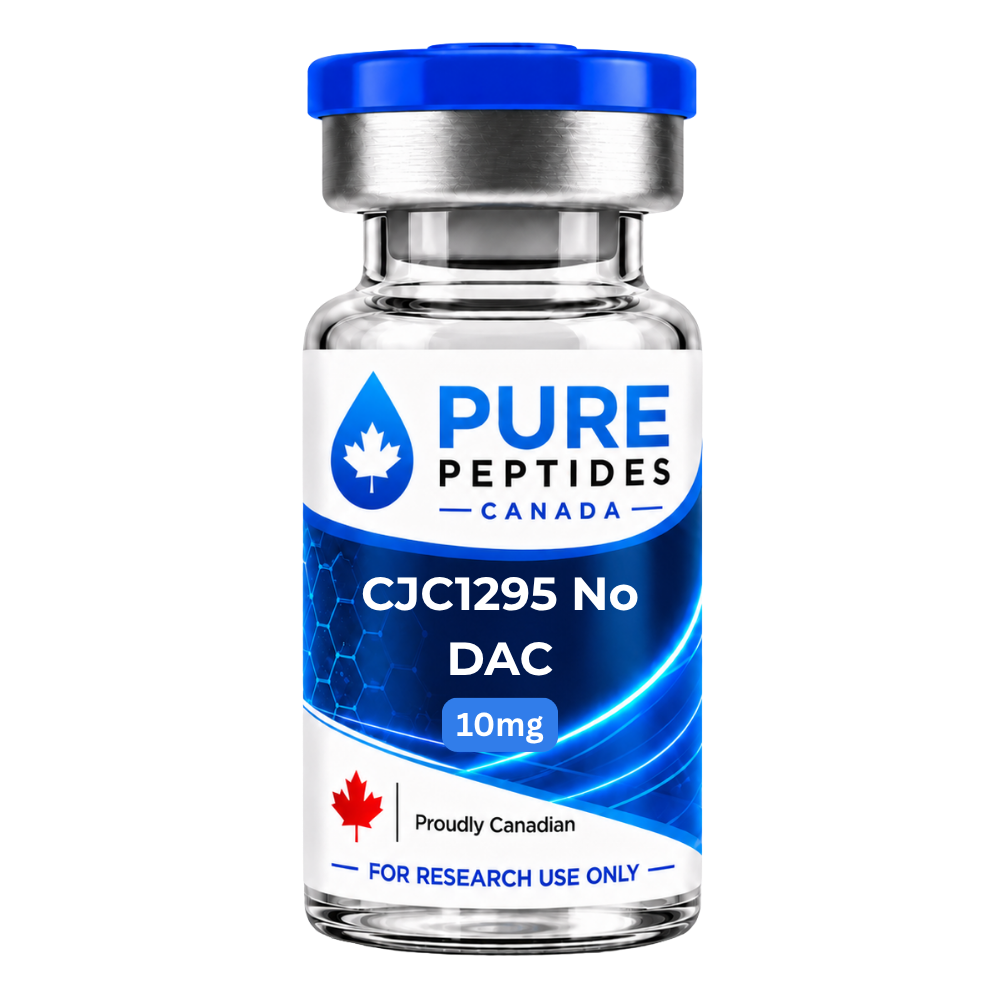 CJC-1295 no DACModified GRF (1–29)View product and COA
 TesamorelinThe 44-residue GHRH analogueView product and COA
 IpamorelinGhrelin-receptor partner peptideView product and COA
Sourcing sermorelin in Canada
Before ordering sermorelin from any supplier, check that:
- The mass is right. Because sermorelin and modified GRF (1–29) are so close in mass, the COA’s mass spectrometry result is the key identity check. See HPLC vs mass spectrometry.
- The COA matches your lot. How to read a certificate of analysis shows what to look for.
- Purity is reported with the method. Purity versus net peptide content explains the numbers.
- Storage is cold, dry and dark. Our peptide storage guide covers the basics.
Research use only. Sermorelin from Pure Peptides Canada is a laboratory reagent. It is not an approved drug, it is not for human or veterinary use, and nothing in this article is dosing or medical guidance.
Frequently asked questions
What is sermorelin?
Sermorelin is a synthetic peptide made of the first 29 amino acids of human growth hormone-releasing hormone (GHRH), with a C-terminal amide. It is the shortest GHRH fragment that keeps full activity at the pituitary GHRH receptor.
Was sermorelin ever FDA-approved?
Yes. The FDA approved it as Geref, as a diagnostic in 1990 and for growth hormone deficiency in children in 1997. EMD Serono discontinued Geref in 2008 for commercial reasons, and no approved sermorelin product is currently marketed in the US.
Why does sermorelin act for such a short time?
The enzyme DPP-4 removes its first two amino acids, which inactivates it, and other proteases break down the rest of the chain. Later analogues such as CJC-1295 and tesamorelin were engineered to resist that breakdown.
What is the difference between sermorelin and CJC-1295 without DAC?
Both are 29 amino acids long. CJC-1295 without DAC, also called modified GRF (1-29), carries four substitutions that make it more resistant to enzymes, while sermorelin is the unmodified natural sequence. Their masses differ by only about 10 g/mol.
What is the difference between sermorelin and tesamorelin?
Sermorelin is the 29-residue fragment of GHRH with no modification. Tesamorelin is the full 44-residue hormone with a hexenoyl group protecting its N-terminus, and it is currently approved as Egrifta in Canada and the US.
Is sermorelin banned in sport?
Yes. The World Anti-Doping Agency’s Prohibited List bans GHRH and its analogues, including sermorelin, at all times.
Sermorelin, tested batch by batch
Lyophilized sermorelin with an independent COA for every batch, tracked delivery across Canada and pricing in Canadian dollars.
References
- US Food and Drug Administration. Determination regarding GEREF (sermorelin acetate) and its withdrawal from sale. Federal Register, 2013. Federal Register
- Guillemin R, et al. Growth hormone-releasing factor from a human pancreatic tumor that caused acromegaly. Science. 1982.
- Prakash A, Goa KL. Sermorelin: a review of its use in the diagnosis and treatment of children with idiopathic growth hormone deficiency. BioDrugs. 1999.
- World Anti-Doping Agency. The 2026 Prohibited List, section S2. WADA
For laboratory research use only. Not for human or veterinary use. This article summarizes published research for educational purposes and is not medical advice. Nothing here is intended to diagnose, treat, cure or prevent any disease.