
Description
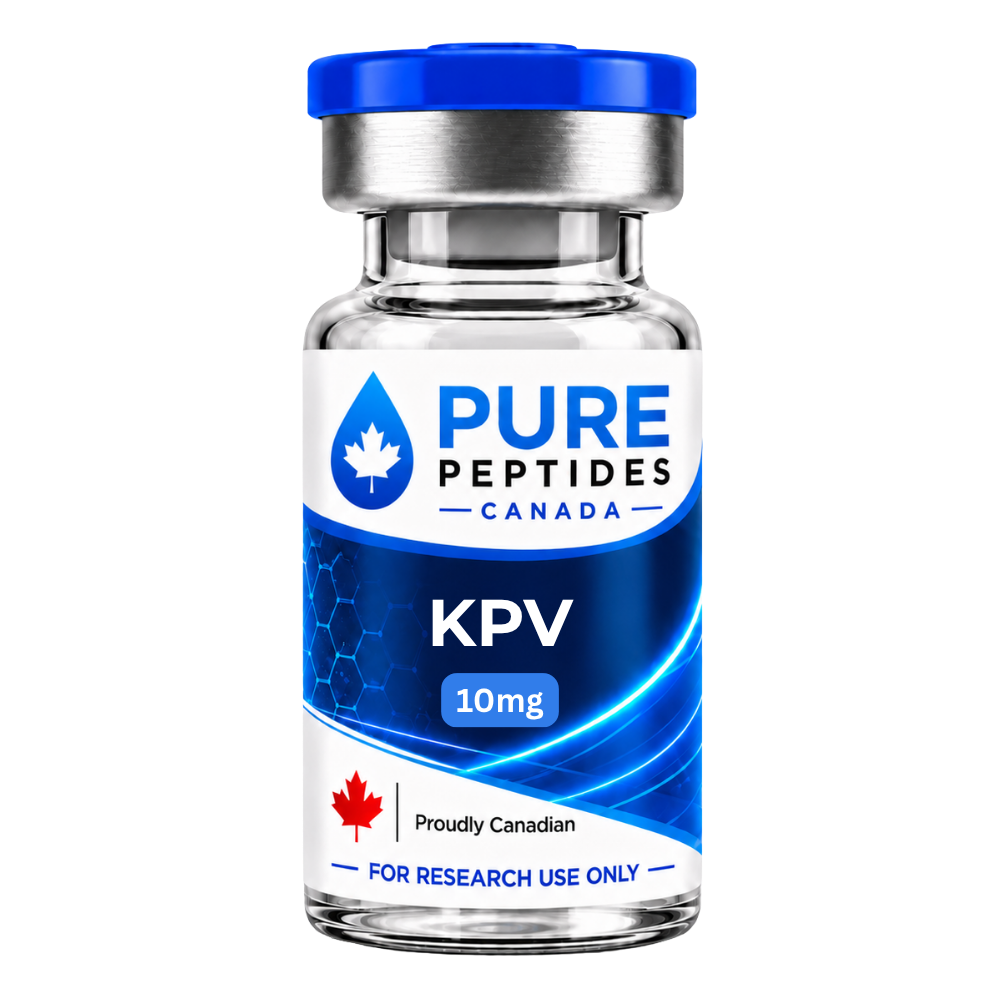
KPV is the tripeptide Lys-Pro-Val, the last three amino acids of alpha-melanocyte-stimulating hormone (α-MSH), and a focus of inflammation research in gut and skin models. Pure Peptides Canada supplies it as a lyophilized research reagent in 10 mg vials, with an independent Janoshik HPLC and mass-spectrometry report, CAD pricing and tracked shipping from inside Canada.
KPV at a glance
- What it is: α-MSH(11-13), a three-residue fragment that keeps much of the parent hormone’s anti-inflammatory activity in laboratory models.
- What researchers study: NF-κB signalling in intestinal and immune cells, PepT1-mediated uptake, colitis models and targeted nanoparticle delivery.
- Evidence level: cell and animal studies. No completed controlled human trials.
- Supplied as: sealed lyophilized powder, 10 mg, single vial or box of 10.
- Delivery: ships from inside Canada by tracked Xpresspost in 3–7 days ($25 CAD), or free in 4–12 days on orders over $299.
KPV
Lys-Pro-Val · α-MSH(11-13) · tripeptide
- K
- P
- V
Lysine, proline, valine: residues 11 to 13 of alpha-MSH.
- Length
- 3 amino acids
- Molecular formula
- C16H30N4O4
- Molecular weight
- 342.44 g/mol
- CAS number
- 67727-97-3
- Form
- Lyophilized powder, sealed vial
- Sizes
- 10 mg (single or box of 10)
- SKU
- PP-KPV
Where the evidence stands
- Cell studies
- Animal models
- Controlled human trials
- Approved medicine
KPV research is preclinical. It is not an approved medicine anywhere.
What is KPV?
Alpha-MSH is a 13-residue hormone best known for skin pigmentation, but by the 1990s researchers had shown it also damps inflammatory signalling. Work on shorter fragments found that the C-terminal tripeptide, Lys-Pro-Val, keeps much of that anti-inflammatory activity in cell and animal models. Because it is so small, it is cheap to make, simple to characterize and easy to build into delivery systems.
KPV became especially interesting to gut researchers after a 2008 Gastroenterology study showed that it is taken up by PepT1, a di- and tripeptide transporter expressed in the inflamed colon, and that it reduced inflammation in mouse colitis models. Later work packaged KPV in hyaluronic-acid nanoparticles targeted to colonic cells. Its effects appear to rely at least partly on pathways other than the classic melanocortin receptors, which is why it is studied separately from α-MSH. All of this is preclinical.
What KPV research looks at
- NF-κB and cytokine signalling: inflammatory pathway activity in intestinal epithelial and immune cells.
- PepT1 transport: how the tripeptide enters colonic cells and why that matters in inflammation models.
- Colitis models: DSS- and TNBS-induced colitis in rodents.
- Targeted delivery: nanoparticle and hydrogel formulations for localized release.
- Combination research: KPV appears in multi-peptide blends with GHK-Cu, BPC-157 and TB-500.
Regulatory status: KPV is not an authorized drug in Canada, and Health Canada’s April 2026 public advisory on unauthorized injectable peptides names it. We sell it strictly as a laboratory reagent for in-vitro research.
Why researchers order KPV from Pure Peptides Canada
Add a 10 mg vial or a box of 10 above. Orders over $299 ship free across Canada.
See lab resultsKPV FAQ
Where can I buy KPV peptide in Canada?
Pure Peptides Canada stocks KPV as a lyophilized research reagent in 10 mg vials and ships it from inside Canada by tracked Xpresspost in 3–7 days ($25 CAD), or free in 4–12 days on orders over $299.
Is KPV the same as alpha-MSH?
No. KPV is only the last three amino acids of the 13-residue alpha-MSH. It is studied for anti-inflammatory signalling and is not associated with the pigmentation effects of the full hormone.
Is this KPV third-party tested?
Yes. The listing links an HPLC purity and mass-spectrometry identity report from Janoshik Analytical, an independent lab. Our COA guide explains how to read it.
Which KPV blends do you carry?
KPV is available alone, with GHK-Cu in the GHK-Cu + KPV Blend, in the four-peptide KLOW Blend, and with TB-500 and BPC-157 in the Coremend Blend.
Is KPV approved by Health Canada?
No. KPV is not an authorized drug in Canada. It is sold here only as a laboratory reagent for in-vitro research.
Can KPV be used in people or animals?
No. It is for in-vitro laboratory research only and is not a drug, supplement or food. We do not provide dosing or administration information.
For laboratory research use only. Not a drug, supplement, food or cosmetic, not for human or veterinary use, and not intended to diagnose, treat, cure or prevent any disease.


Harper Roy –
CURED MY GUT. THIS SH*T IS NO JOKE! DOCTORS COULDNT HELP ME FOR YEARS….