
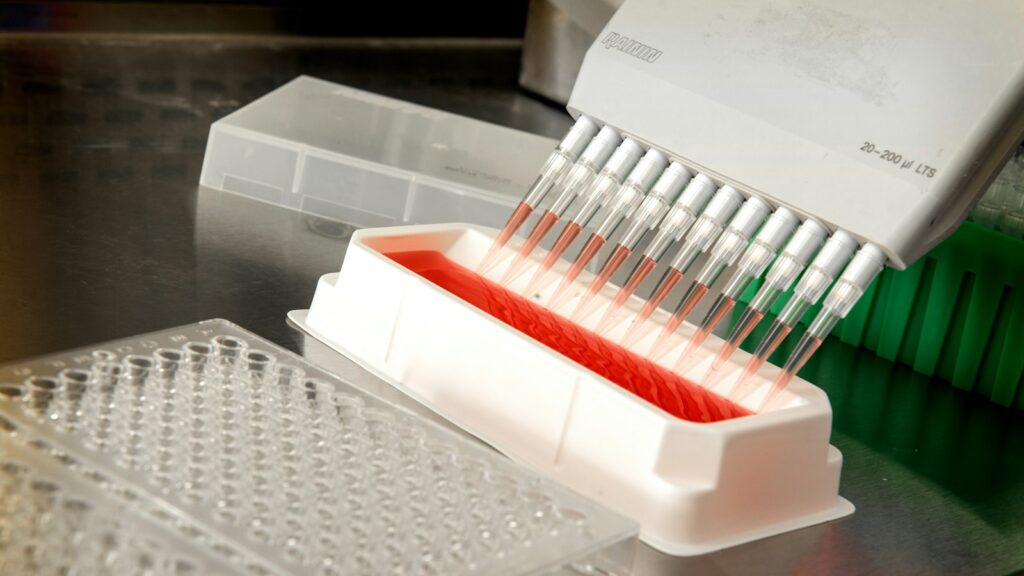
The most informative reagent in a peptide experiment is often the one expected to do nothing — provided it differs from the active peptide in exactly the way you intend. That is the job of a scrambled peptide control: the same residues in a different order, so that a difference in the readout can be attributed to the sequence rather than to what it is made of. The difficulty is that a shuffled sequence is not automatically inert, and a control with quiet activity of its own can mislead more than no control at all.
This guide covers what a scramble tests in a cell-free or cell-culture experiment, the checks worth running before one is ordered, when another control answers better, and why the vehicle and counter-ion need comparisons of their own.
The short answer
- A scrambled control holds composition constant and varies order. It contains the same residues as the active peptide in a different sequence, sharing the molecular formula, mass and ionizable groups while changing everything that depends on residue order.
- It tests sequence specificity, not mechanism. A difference between active and scramble shows the effect depends on residue order. It does not show which residues carry the effect, and cannot exclude a mechanism driven by properties the two molecules share.
- A scramble is not automatically inert. Vadukul and colleagues reported that reversed and scrambled forms of amyloid-β, both widely used as control peptides, self-assembled into fibres within 24 hours.
- Intact mass cannot tell a scramble from its parent. A permutation shares the formula: GHK and KGH both compute to a monoisotopic mass of 340.186 Da. Telling them apart needs fragmentation, the basis of the tandem mass spectrometry sequencing Hunt and colleagues described in 1986.
- The solvent and the counter-ion need their own controls. Cornish and colleagues reported that trifluoroacetate at 10−8 to 10−7 M reduced cell numbers and thymidine incorporation in fetal rat osteoblast cultures after 24 hours.
Scrambled peptide control
Shuffled sequence · composition-matched negative control
- What it is
- A peptide containing the residues of the active sequence, rearranged into a different order
- What it holds constant
- Molecular formula, mass, composition, net charge at a given pH, and — if made and handled alike — salt form and purity
- What it varies
- Residue order, and with it secondary structure, motifs, charge distribution and amphipathicity
- What a difference shows
- That the effect depends on the order of the residues, not merely their identity or number
- Where the term is used
- Standard in amyloid research — Vadukul and colleagues describe reversed and scrambled amyloid-β as widely used control peptides — and common elsewhere in in-vitro peptide work
- Known failure modes
- A preserved or newly created motif, a changed aggregation propensity, and mechanisms tracking charge rather than sequence
- What it is not
- Not a vehicle control, not a substitute for identity and purity evidence, and not a guide to which residues matter
What a scrambled control can support
- Evidence that an effect depends on residue order
- A composition, mass and counter-ion match for the active peptide
- Which residues within the sequence carry the effect
- Exclusion of effects driven by charge, hydrophobicity or aggregation
The first two are what a composition match buys. The last two need a different comparison, because the scramble shares those properties with the active peptide.
What a control peptide is for
A control is a comparison that isolates one variable. The difficulty with peptides is that a vial brings several into the well at once: the sequence, the composition, the counter-ion, process impurities, the solvent, and the bulk character of the chain — charge, hydrophobicity, tendency to assemble. An effect can come from any of them, and only the first is usually the hypothesis — which is why one control is rarely enough.
In their statement on chemical probes, Arrowsmith and 53 co-authors warn that probes “of poor quality or that are used incorrectly generate misleading results”, and a poorly chosen control is one way to use a good reagent incorrectly. The same logic runs through how to read a peptide study: what a finding supports depends on what it was compared against.
What a scrambled sequence tests, and what it does not
A scramble is a permutation: shuffle the residues and the new molecule is identical in composition, different in order. GHK, KGH and HKG are three different molecules sharing the formula C14H24N6O4 and, by calculation from standard residue masses, a monoisotopic mass of 340.186 Da. Net charge at a given pH matches too: the ionizable groups are the same.
What changes is everything downstream of order. Secondary structure depends on sequence, as does the distribution of polar and apolar residues along it. Eisenberg, Weiss and Terwilliger showed this periodicity is measurable: sequences forming α-helices tend to show a strong periodicity in hydrophobicity near 3.6 residues, β-strands near 2.3. Shuffling keeps the residues and scrambles that periodicity, which is why the comparison is informative — and why a scramble can behave in ways nobody planned.
The question a scramble answers is therefore narrow: does the effect depend on residue order? It cannot say which residues are responsible, nor rule out a mechanism running on properties the two molecules share. Wade and colleagues made that limit vivid with all-D enantiomers of cecropin A, magainin 2 amide and melittin: as antibacterial agents the D and L forms of each pair were “equally active, within experimental error”, which they suggested reflects action on membranes “without specific interaction with chiral receptors or enzymes”.
One corollary is easy to miss: because a scramble and its parent share a mass, two mislabelled vials will pass an intact-mass identity check. Only fragmentation separates them, the principle behind the tandem mass spectrometry sequencing Hunt and colleagues described in 1986.
Judging other people’s controls as well as your own? Our guide to reading a peptide study covers what each level of evidence can support.
How to read a studyDesigning a scrambled peptide control: five checks
Shuffling is the easy part; these five checks separate a control from a second peptide.
1. Confirm the motif is actually broken
If activity depends on a short recognition motif, a shuffle leaving it intact is not a control. Pierschbacher and Ruoslahti showed how unforgiving that can be at the fibronectin cell-attachment site: in Arg-Gly-Asp-Ser, conservative substitution of the arginine, glycine or aspartic acid each abolished attachment-promoting activity, while some changes at the serine position were tolerated. Arginine, glycine and aspartic acid, they concluded, are absolutely required for recognition.
2. Check that the shuffle has not created a new one
The reverse risk is easier to overlook: a rearrangement can generate a recognizable motif by accident, or a stretch resembling an unrelated binding site. Searching the proposed sequence against motif databases costs nothing.
3. Look at charge distribution, not just net charge
Composition matching fixes net charge automatically, but not where the charges sit. A shuffle can turn dispersed basic residues into a cationic cluster — a different molecule in any membrane-facing assay, for all that the bulk counts agree.
4. Predict aggregation before trusting inertness
Aggregation propensity is a sequence property, not only a composition one. The AGGRESCAN method of Conchillo-Solé and colleagues rests on the assumption that short, specific sequence stretches modulate aggregation, so a reshuffle can raise or lower that tendency while composition stays fixed. Vadukul and colleagues supply the cautionary case: reversed and scrambled amyloid-β, both routinely used as controls, formed fibres within 24 hours, while having less effect on hippocampal neuron health than the oligomeric parent.
5. Use more than one scramble
A single shuffle is one sample from an enormous space — ten distinct residues can be arranged 3,628,800 ways, twelve nearly 480 million. An inactive scramble is weak evidence alone; two behaving alike is much stronger. Pre-specifying both, rather than picking the quieter one afterwards, keeps the comparison honest.
Other controls, and when they answer better
A scramble is the right tool for one question; two alternatives answer sharper ones.
Alanine substitution. Cunningham and Wells introduced alanine-scanning mutagenesis in 1989, making 62 single substitutions across three segments of human growth hormone to find the side chains that modulate receptor binding. A cluster of a dozen large side chains each cost more than a fourfold drop in affinity; one, Glu174, hindered binding instead — replacing it with alanine raised receptor affinity more than fourfold. Weiss and colleagues later scanned 19 interface side chains combinatorially and found only seven contributing significantly. Where a scramble asks whether order matters, an alanine scan asks which positions do.
Mirror-image and retro-inverso analogues. An all-D version tests whether recognition is chiral, since a chiral receptor or enzyme should discriminate between the two hands while a membrane interaction need not. That is why a D-analogue is a strong control for a receptor hypothesis and a weak one for a membrane hypothesis. Our guide to D-amino acids covers the chemistry.
Uptake studies show how the two can disagree. Wender and colleagues reported that every truncated and alanine-substituted analogue of Tat(49–57) was taken up less efficiently, pointing to the cationic residues — yet a nine-residue L-arginine oligomer was about twenty times more efficient than Tat itself, and the all-D version better again, over a hundredfold. Neither is a control for Tat, but the moral carries: where activity runs on a bulk property such as guanidinium content, inverting every residue need not reduce it, so no D-analogue can be assumed inert because it is a mirror image.
| Control | What it holds constant | What a difference from the active shows | Where it fails |
|---|---|---|---|
| Scrambled sequence | Composition, mass, net charge, salt load | The effect depends on residue order | Mechanisms driven by charge, hydrophobicity or assembly |
| Alanine substitution | Length, most of the sequence | That position contributes to the effect | Effects distributed across the whole chain |
| Truncation or fragment | The remaining sequence | The removed region is needed | Length and solubility change at the same time |
| D-enantiomer or retro-inverso | Composition, charge, hydrophobicity | Recognition is stereochemical | Membrane-driven activity, which is often chirality-blind |
| Vehicle only | Solvent, buffer, handling | The carrier is not producing the effect | Says nothing about the peptide |
| Counter-ion matched | Salt load delivered to the well | The anion is not producing the effect | Needs the salt form of both materials |
Vehicle, solvent and counter-ion controls
Two components reach the well in every peptide experiment and belong to no one’s hypothesis. The first is the vehicle. Verheijen and colleagues exposed three-dimensional cardiac and hepatic microtissues to 0.1% dimethyl sulfoxide and found more than 2,000 differentially expressed genes in each, concluding that the solvent “is not inert”. A vehicle control carries the same solvent, buffer and handling as the peptide arms.
The second is the counter-ion. Sikora and colleagues note that standard Fmoc synthesis followed by reversed-phase purification yields peptides as trifluoroacetate salts, so the anion arrives with the powder unless it has been exchanged. Cornish and colleagues measured what that can do: trifluoroacetate at 10−8 to 10−7 M reduced cell numbers and thymidine incorporation in fetal rat osteoblast cultures after 24 hours, with similar effects in articular chondrocytes and neonatal mouse calvariae. Comparing trifluoroacetate and hydrochloride salts of amylin and calcitonin, proliferation was consistently lower with the trifluoroacetate salts — enough, they wrote, to cause “failure to detect a proliferative effect or wrongly attributing an antiproliferative effect”.
The direction of the artefact is not fixed either: Sikora and colleagues also report work in which trifluoroacetate stimulated glioma cell growth in a concentration-dependent way. So match the salt form: a trifluoroacetate active against an acetate scramble confounds the sequence with the anion. Exchange is also incomplete: in the same review, reported exchange efficacy reaches up to 98% after several repetitions rather than removing trifluoroacetate entirely. Our guide to TFA and acetate counter-ions covers how the salt also changes how much of the powder is peptide.
A control needs the documentation the active gets
A control deserves the evidence standard of the active peptide: a difference between two arms is attributable to the sequence only if nothing else about the two preparations differs.
Brezar and colleagues show what can hide in a peptide vial. Characterizing epitopes in a diabetes model, they traced a CD8+ T-cell response to a contaminant too scarce to detect by direct mass spectrometry, visible only after chromatographic concentration. Their conclusion: “If left undetected, minute impurities in synthetic peptide preparations may thus give spurious results.” That contaminant sat in an active preparation; the same thing in a control produces the opposite error, a control that is not silent.
Obtain identity and purity evidence for the control on the same basis as the active, ideally to the same specification and salt form, and record both lot numbers against every experiment. Label control vials unambiguously, since intact mass will not catch a mix-up. Where a readout is sensitive to inflammatory signalling, endotoxin contamination is worth considering for both arms, not only the active.
What’s established and what isn’t
Established, and citable
- Reversed and scrambled sequences are standard control peptides in amyloid research, and both can form fibres within 24 hours (Vadukul et al., 2017).
- Alanine-scanning mutagenesis identifies side chains that modulate binding; 62 single substitutions mapped the hGH receptor interface (Cunningham & Wells, 1989), and a combinatorial scan of 19 interface side chains found only seven contributing significantly (Weiss et al., 2000).
- D and L enantiomers of several membrane-active peptides were equally active, implying no chiral receptor step (Wade et al., 1990).
- Conservative single substitutions in the fibronectin Arg-Gly-Asp site abolished cell-attachment activity (Pierschbacher & Ruoslahti, 1984).
- Hydrophobicity shows sequence periodicity near 3.6 residues in α-helices and 2.3 in β-strands (Eisenberg et al., 1984).
- Trifluoroacetate at 10−8 to 10−7 M reduced osteoblast proliferation and distorted comparisons between salt forms (Cornish et al., 1999), and 0.1% dimethyl sulfoxide altered more than 2,000 genes in microtissues (Verheijen et al., 2019).
- A peptide contaminant undetectable by direct mass spectrometry drove a T-cell response (Brezar et al., 2011).
Open, or outside what a scramble can show
- Whether a particular scramble is inert. That is an empirical question about one sequence, answered by testing it rather than by its design.
- Which residues carry an effect. A composition match localizes nothing; substitution scans do.
- How many scrambles are enough. We found no accepted standard, though more than one is clearly better.
- Whether a difference reflects structure, assembly or charge distribution, all of which change together when a sequence is shuffled.
- Whether published work matched salt form and purity across its arms, unless the methods say so.
Sourcing actives and controls in Canada
Catalogues are built around sequences people study, so the active peptide in a comparison is often a listed item while its control is not. A scrambled or alanine-substituted analogue is normally a made-to-order synthesis, the distinction our guide to catalogue versus custom synthesis sets out. Planning the control alongside the active, rather than after a first unconvincing dataset, keeps the two comparable.
Three habits help when the arms come from different places. Specify the same salt form for both, the easiest confounder to remove; ask for the control’s identity and purity evidence on the same terms as the active’s; and record both lot numbers in the methods. For the active side of the pair, the catalogue lists research peptides priced in Canadian dollars and shipped from within Canada; we are a supplier, so apply the same documentation checks to us as to the source of your control.
Catalogue peptides for your experiment
Our catalogue stocks the active sequences; scrambled and alanine-substituted controls are custom syntheses. Janoshik test reports for the research peptides below are listed on our Lab Testing page; keep the report on file next to your control’s.
 BPC-15715-amino-acid research peptideView product
 KPVLys-Pro-Val tripeptideView product
 GHK-CuCopper tripeptideView product
 LL-37Human cathelicidin peptideView product
Research use only. Pure Peptides Canada products are laboratory reagents for in-vitro research, not for human or veterinary use. This article explains in-vitro experimental design for education; it is not medical, dietary or dosing guidance.
Frequently asked questions
What is a scrambled peptide control?
A scrambled control contains the same amino acids as the peptide being studied, rearranged into a different order. Being a permutation, it shares the formula, mass and net charge of the active peptide and differs only in sequence. Comparing the two isolates one variable: whether the effect depends on residue order rather than on what the chain is made of.
How do you design a scrambled peptide?
Shuffle the residues, then check the sequence before ordering it. Confirm that any motif the activity depends on has genuinely been broken, and that the shuffle has not created a new one by accident. Look at where the charges now sit, not just the net charge, and run the sequence through an aggregation predictor, since assembly is a sequence property. Two independent scrambles make an inactive outcome far more convincing than one.
Can a scrambled peptide have biological activity?
Yes, and assuming otherwise is the main way the control fails. Vadukul and colleagues found that reversed and scrambled amyloid-β, both used as standard controls, assembled into fibres within 24 hours. Where activity depends on bulk properties such as charge or hydrophobicity rather than a specific sequence, a composition-matched control inherits them — Wade and colleagues found mirror-image antimicrobial peptides as active as the originals.
Why do you need a vehicle or counter-ion control?
Because both arrive in the well alongside the peptide. Verheijen and colleagues found that 0.1% dimethyl sulfoxide changed expression of more than 2,000 genes in cardiac and hepatic microtissues, so the solvent is not a neutral background. Counter-ions matter for the same reason: Cornish and colleagues showed that trifluoroacetate, the salt usually left by synthesis and purification, reduced proliferation in osteoblast cultures at low concentrations.
Does a control peptide need a certificate of analysis?
It needs the same identity and purity evidence as the active peptide, because a difference between the arms is attributable to the sequence only if nothing else differs. Brezar and colleagues traced a T-cell response to a contaminant too scarce to see by direct mass spectrometry, warning that minute impurities in synthetic peptide preparations may give spurious findings. Intact mass also cannot distinguish a scramble from its parent, so clear labelling keeps the two straight.
Document the active and the control alike
Browse the catalogue for documented research peptides, or ask us about a listing.
References
- Vadukul DM, Gbajumo O, Marshall KE, Serpell LC. Amyloidogenicity and toxicity of the reverse and scrambled variants of amyloid-β 1–42. FEBS Lett. 2017;591(5):822–830. DOI
- Cunningham BC, Wells JA. High-resolution epitope mapping of hGH-receptor interactions by alanine-scanning mutagenesis. Science. 1989;244(4908):1081–1085. DOI
- Weiss GA, Watanabe CK, Zhong A, Goddard A, Sidhu SS. Rapid mapping of protein functional epitopes by combinatorial alanine scanning. Proc Natl Acad Sci USA. 2000;97(16):8950–8954. DOI
- Wade D, Boman A, Wåhlin B, Drain CM, Andreu D, Boman HG, Merrifield RB. All-D amino acid-containing channel-forming antibiotic peptides. Proc Natl Acad Sci USA. 1990;87(12):4761–4765. DOI
- Pierschbacher MD, Ruoslahti E. Variants of the cell recognition site of fibronectin that retain attachment-promoting activity. Proc Natl Acad Sci USA. 1984;81(19):5985–5988. DOI
- Eisenberg D, Weiss RM, Terwilliger TC. The hydrophobic moment detects periodicity in protein hydrophobicity. Proc Natl Acad Sci USA. 1984;81(1):140–144. DOI
- Conchillo-Solé O, de Groot NS, Avilés FX, Vendrell J, Daura X, Ventura S. AGGRESCAN: a server for the prediction and evaluation of “hot spots” of aggregation in polypeptides. BMC Bioinformatics. 2007;8:65. DOI
- Wender PA, Mitchell DJ, Pattabiraman K, Pelkey ET, Steinman L, Rothbard JB. The design, synthesis, and evaluation of molecules that enable or enhance cellular uptake: peptoid molecular transporters. Proc Natl Acad Sci USA. 2000;97(24):13003–13008. DOI
- Cornish J, Callon KE, Lin CQ, Xiao CL, Mulvey TB, Cooper GJS, Reid IR. Trifluoroacetate, a contaminant in purified proteins, inhibits proliferation of osteoblasts and chondrocytes. Am J Physiol Endocrinol Metab. 1999;277(5):E779–E783. DOI
- Sikora K, Jaśkiewicz M, Neubauer D, Migoń D, Kamysz W. The Role of Counter-Ions in Peptides—An Overview. Pharmaceuticals. 2020;13(12):442. MDPI
- Verheijen M, Lienhard M, Schrooders Y, et al. DMSO induces drastic changes in human cellular processes and epigenetic landscape in vitro. Sci Rep. 2019;9:4641. DOI
- Brezar V, Čulina S, Østerbye T, et al. T cells recognizing a peptide contaminant undetectable by mass spectrometry. PLoS One. 2011;6(12):e28866. DOI
- Hunt DF, Yates JR, Shabanowitz J, Winston S, Hauer CR. Protein sequencing by tandem mass spectrometry. Proc Natl Acad Sci USA. 1986;83(17):6233–6237. DOI
- Arrowsmith CH, Audia JE, Austin CP, et al. The promise and peril of chemical probes. Nat Chem Biol. 2015;11(8):536–541. DOI
For laboratory research use only. Not for human or veterinary use. This article summarizes published scientific material for educational purposes and is not medical advice.