
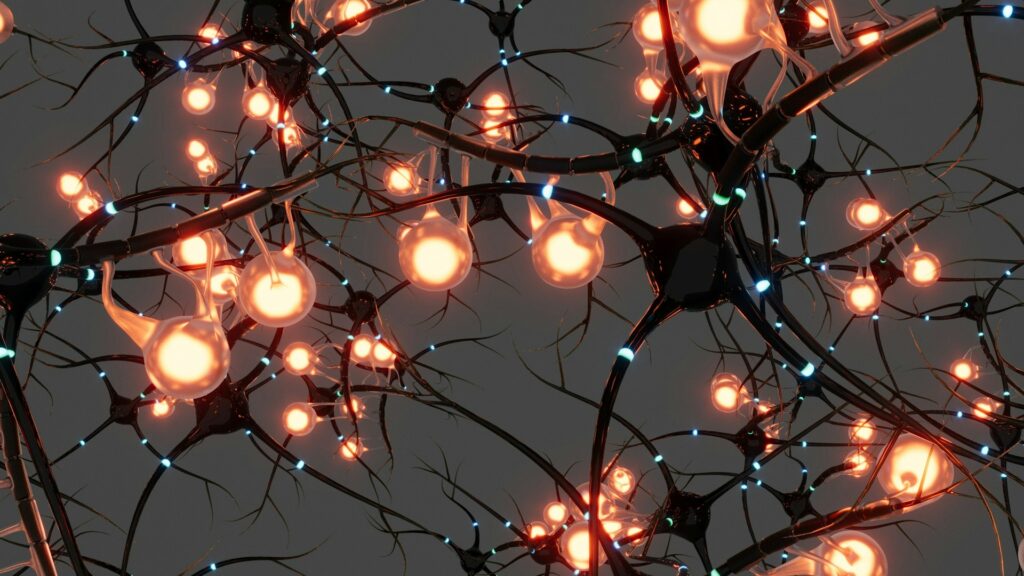
Neurons talk in two languages. The fast one uses small molecules such as glutamate and GABA, released in milliseconds across a single synapse. The slow one uses peptides, released in bursts that can spread, linger and change how whole circuits behave for minutes or hours. Those peptides, more than a hundred of them, are the neuropeptides.
This guide explains what neuropeptides are, how they differ from classic neurotransmitters, the major families, how they were discovered, and which research peptides in our library are neuropeptides or are built from them.
The short answer
- Neuropeptides are peptides made and released by neurons to signal to other cells. More than 100 have been identified.
- Unlike classic neurotransmitters, they are cut from large precursor proteins in the cell body, packed into dense-core vesicles, released mainly during intense firing and not recycled after release.
- Most act through G protein-coupled receptors, so their effects are slower and longer-lasting: more like turning a circuit’s volume up or down than flipping a switch.
- Familiar examples include endorphins and enkephalins, substance P, oxytocin and vasopressin, neuropeptide Y, orexin, VIP and kisspeptin.
- Several research peptides are neuropeptides or are derived from them, including VIP, kisspeptin-10, DSIP and Semax.
Neuropeptides vs classic neurotransmitters
| Feature | Classic neurotransmitters | Neuropeptides |
|---|---|---|
| Size | Small molecules (glutamate, GABA, dopamine) | Chains of roughly 3 to 40-plus amino acids |
| Where made | Often at the nerve terminal | In the cell body, from large precursor proteins, then shipped down the axon |
| Storage | Small clear vesicles | Large dense-core vesicles |
| Release | Single action potentials | Mainly high-frequency or burst firing |
| Clean-up | Taken back up and recycled | Broken down by enzymes; not recycled |
| Receptors | Ion channels and GPCRs | Mostly GPCRs |
| Reach and timing | One synapse, milliseconds | Can diffuse to many cells; seconds to hours |
The two systems usually work together. Many neurons release a classic transmitter for fast signalling and keep a neuropeptide in reserve, releasing it only when firing is intense. That gives the nervous system a way to change the state of a circuit, not just pass along a message. Because neuropeptides mostly act through GPCRs, our guide to how peptide receptors work is useful background.
How neuropeptides were discovered
- 1931Ulf von Euler and John Gaddum find “substance P” in extracts of horse brain and gut, a blood-pressure-lowering factor that turns out to be a peptide.
- 1953Vincent du Vigneaud’s group synthesizes oxytocin, proving a brain-released hormone is a nine-amino-acid peptide.
- 1970Sami Said and Viktor Mutt isolate vasoactive intestinal peptide, later found throughout the nervous system.
- 1975John Hughes and Hans Kosterlitz in Aberdeen identify the enkephalins, the brain’s own opioid peptides, explaining why the brain has opiate receptors.
- 1977Researchers in Basel describe DSIP, a sleep-associated peptide whose receptor is still unknown.
- 1982Kazuhiko Tatemoto and Viktor Mutt in Stockholm isolate neuropeptide Y, one of the most abundant peptides in the brain.
- 1998Two teams independently discover the orexins, also called hypocretins, which turn out to be essential for staying awake.
- 2003Studies of families with absent puberty reveal that kisspeptin signalling is required to start the reproductive axis.
The major families
- Opioid peptides. Endorphins, enkephalins and dynorphins act on opioid receptors to dampen pain and shape reward.
- Tachykinins. Substance P carries pain signals and promotes inflammation in tissues.
- Hypothalamic peptides. Oxytocin and vasopressin, plus the releasing hormones that control the pituitary, such as GHRH, somatostatin and the kisspeptin–GnRH relay. See our kisspeptin guide.
- Appetite peptides. Neuropeptide Y and orexin push toward eating and wakefulness, while POMC-derived peptides such as alpha-MSH push the other way.
- Gut–brain peptides. VIP, cholecystokinin and GLP-1 act in both the gut and the brain. See our VIP guide and GLP-1 map.
Neuro research peptides with batch-matched COAs.
Browse cognitive and neuroNeuropeptides in our research library
| Research peptide | Relationship to neuropeptides | Guide |
|---|---|---|
| VIP | A natural neuropeptide, 28 amino acids | VIP |
| Kisspeptin-10 | The active fragment of the kisspeptins that drive GnRH neurons | Kisspeptin |
| DSIP | A sleep-associated peptide with no confirmed gene or receptor | DSIP |
| Semax | Built on ACTH(4–7), a fragment of a POMC-derived peptide hormone | Semax vs Selank |
| KPV | The final three residues of alpha-MSH, another POMC-derived peptide | KPV |
 Kisspeptin-10Hypothalamic neuropeptide fragmentView product and COA
 DSIPSleep-associated peptideView product and COA
 SemaxACTH(4–7)-based heptapeptideView product and COA
 KPVAlpha-MSH-derived tripeptideView product and COA
VIP is also available as a research reagent. For the wider group of cognition-related research peptides, see our nootropic peptides guide.
Why neuropeptides are hard to study
Three obstacles come up again and again. Peptides cross the blood–brain barrier poorly, so a peptide given into the blood may never reach the brain in meaningful amounts. They are broken down quickly by enzymes. And because they diffuse and act on receptors spread across many cell types, it is hard to pin an effect to one circuit. Much of what is known comes from animal genetics, such as knocking out a peptide or its receptor, rather than from giving the peptide itself.
Reasonably well established
- More than 100 neuropeptides signal mainly through GPCRs.
- They are made from precursors and released during intense firing.
- Specific peptides control pain, feeding, wakefulness, stress and reproduction.
Open questions
- The functions of many lesser-known neuropeptides.
- How peripheral peptides influence the brain, given the blood–brain barrier.
- Which animal findings carry over to humans.
Research use only. Pure Peptides Canada products are laboratory reagents, not for human or veterinary use. This article is general scientific education and is not medical or dosing guidance.
Frequently asked questions
What are neuropeptides?
Neuropeptides are peptides made and released by neurons to signal to other cells. They include endorphins, substance P, oxytocin, neuropeptide Y, orexin and VIP, and they mostly act through G protein-coupled receptors to produce slow, long-lasting effects.
What is the difference between neuropeptides and neurotransmitters?
Classic neurotransmitters are small molecules released at single synapses in milliseconds and recycled. Neuropeptides are larger, made from precursor proteins, released mainly during intense firing, broken down rather than recycled, and act over wider areas for longer.
How many neuropeptides are there?
More than 100 neuropeptides have been identified in mammals, and many more peptide fragments are produced as precursors are processed.
Do neuropeptides cross the blood–brain barrier?
Generally poorly. Most peptides in the bloodstream do not reach the brain in significant amounts, which is a major challenge for neuropeptide research and drug development.
Which research peptides are neuropeptides?
VIP is a natural neuropeptide, kisspeptin-10 is the active fragment of the kisspeptins, and DSIP was described as a sleep-associated peptide. Semax and KPV are built from fragments of POMC-derived peptides.
Who discovered the endorphins?
In 1975, John Hughes and Hans Kosterlitz in Aberdeen identified the enkephalins, the first of the brain’s own opioid peptides. Other endorphins were characterized soon after.
Neuro research peptides, tested batch by batch
Kisspeptin-10, DSIP, Semax, VIP and more, each with an independent COA, priced in Canadian dollars and shipped tracked across Canada.
References
- von Euler US, Gaddum JH. An unidentified depressor substance in certain tissue extracts. J Physiol. 1931;72:74–87.
- Hughes J, Smith TW, Kosterlitz HW, et al. Identification of two related pentapeptides from the brain with potent opiate agonist activity. Nature. 1975;258:577–580.
- Tatemoto K, Carlquist M, Mutt V. Neuropeptide Y: a novel brain peptide with structural similarities to peptide YY and pancreatic polypeptide. Nature. 1982;296:659–660.
- Sakurai T, et al. Orexins and orexin receptors: a family of hypothalamic neuropeptides and G protein-coupled receptors that regulate feeding behavior. Cell. 1998;92:573–585.
For laboratory research use only. Not for human or veterinary use. This article is educational and is not medical advice.