
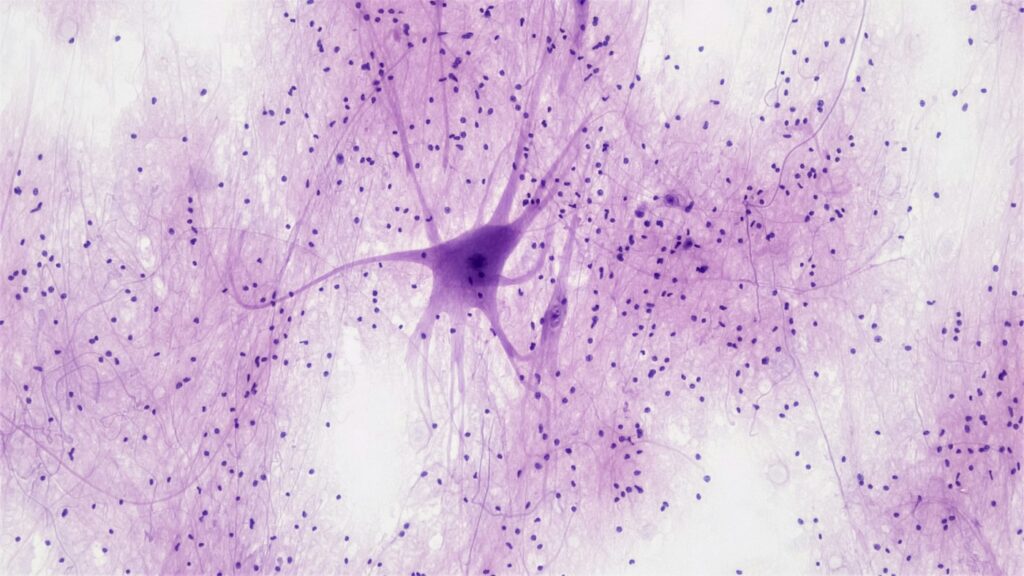
“Nootropic peptides” is a marketing phrase, not a scientific category. Behind it sits a mixed group of molecules with very different origins: two Russian drugs built from hormone fragments, an experimental compound from an Alzheimer’s laboratory in New York, a channel blocker designed in France, and a sleep peptide nobody fully understands.
This guide sorts them by what they are and how strong the evidence is, so you can tell a registered medicine from a mouse-study result at a glance.
The short answer
- Semax and Selank are Russian-developed seven-residue peptides, registered as medicines in Russia, studied mainly for BDNF signalling and anxiety respectively.
- P021 is a peptide derived from ciliary neurotrophic factor (CNTF) that increased BDNF and new-neuron formation in Alzheimer’s-model mice.
- PE-22-28 is a seven-residue analogue of spadin that blocks the TREK-1 potassium channel and showed antidepressant-like effects in mice.
- DSIP is a sleep-research peptide from 1977 whose gene and receptor are still unknown.
- None is approved in Canada, and for most of them the evidence comes from animal studies.
What “nootropic” really means
The word was coined in 1972 by the Romanian chemist Corneliu Giurgea to describe piracetam. It has no regulatory meaning: no agency uses “nootropic” as an approval category, and the compounds sold under the label differ in structure, target and quality of evidence. A more useful question for any of them is simple. What is it, what was actually measured, and in what?
Where the evidence stands
| Compound | Origin | Proposed mechanism | Strongest evidence |
|---|---|---|---|
| Semax | ACTH(4–7) plus Pro-Gly-Pro, Moscow | BDNF and TrkB signalling in rat hippocampus | Registered medicine in Russia; small Russian clinical studies |
| Selank | Tuftsin plus Pro-Gly-Pro, Moscow | GABA-related gene expression | Registered medicine in Russia; a 62-patient trial versus medazepam |
| DSIP | Rabbit blood during induced sleep, Basel | Unknown; no receptor identified | Small human studies, mostly 1980s, mixed results |
| P021 | CNTF epitope, New York | BDNF transcription and neurogenesis | Mouse and rat studies |
| PE-22-28 | Spadin analogue, France | TREK-1 potassium channel blockade | Mouse behavioural studies |
Semax and Selank
Both were developed at the Institute of Molecular Genetics in Moscow, both are seven residues long, and both end in the same stabilizing Pro-Gly-Pro tail. Semax is built from a fragment of ACTH and is studied mainly for neurotrophic signalling: in a 2006 rat study, a single application raised BDNF protein in the hippocampus about 1.4-fold. Selank is built from tuftsin, an immune peptide, and a 2016 rat study tied its effects to GABA-related gene expression. Both are registered medicines in Russia, but their human studies are small and mostly published in Russian. Our Semax vs Selank comparison covers both in depth.
P021
P021 came out of Khalid Iqbal’s laboratory at the New York State Institute for Basic Research in Developmental Disabilities. The team mapped the most active region of ciliary neurotrophic factor (CNTF), a large growth factor that cannot easily reach the brain, and built a small peptide from it. In studies of 3xTg-AD mice, a model of Alzheimer’s disease, P021 increased BDNF transcription, boosted the formation of new neurons and rescued synaptic markers and memory performance. A 2017 study started treatment before any visible pathology and reported that it prevented later deficits. All of that is animal work.
PE-22-28
PE-22-28 traces back to spadin, a peptide cut from the sortilin precursor that blocks TREK-1, a potassium channel linked to depression in mouse studies. In 2017, Jean Mazella, Marc Borsotto and colleagues in France reported shortened spadin analogues. PE-22-28, seven residues long, blocked TREK-1 far more potently than spadin, with an IC50 of 0.12 nM versus 40 to 60 nM, and its effect lasted up to 23 hours instead of 7. In mice it showed antidepressant-like effects in standard behavioural tests and increased neurogenesis after four days of treatment. No human trials have been registered.
Cognitive and neuro research peptides, each with a batch COA.
Browse the categoryDSIP, Pinealon and the blends
DSIP was isolated in 1977 from the blood of sleeping rabbits and named for the slow delta waves it produced, yet its gene and receptor remain unknown. Pinealon is a short peptide from the St. Petersburg bioregulator programme that also produced Epitalon, with little independent literature behind it. The Illumineuro blend combines Pinealon, N-acetyl Selank, N-acetyl Semax and PE-22-28 in one vial for multi-compound designs.
 SemaxACTH-fragment heptapeptideView product and COA
 SelankTuftsin-derived heptapeptideView product and COA
 Illumineuro blendPinealon, NA Selank, NA Semax, PE-22-28View product and COA
 DSIPDelta sleep-inducing peptideView product and COA
Also in the category: P21 (P021), PE-22-28, N-acetyl Semax and N-acetyl Selank.
Reasonably well established
- Semax and Selank are registered medicines in Russia.
- P021 and PE-22-28 produced consistent effects in published mouse studies.
- None of these compounds is approved in Canada or the US.
Open questions
- Whether rodent findings for P021 and PE-22-28 translate to humans.
- Independent, Western replication of the Russian clinical work.
- How the N-acetylated versions compare with the original peptides.
Sourcing cognitive research peptides in Canada
- Confirm the exact form. Plain and N-acetylated Semax or Selank have different masses, so the COA’s mass result tells you which one is in the vial. See HPLC vs mass spectrometry.
- For blends, ask what was tested. A multi-peptide vial needs each component identified, not just an overall purity figure. Our peptide blends list what each vial contains.
- Check the COA against your lot. How to read a certificate of analysis walks through it.
- Store cold, dry and dark. See our peptide storage guide.
Research use only. Cognitive and neuro research peptides from Pure Peptides Canada are laboratory reagents. They are not approved drugs, supplements or nootropic products, they are not for human or veterinary use, and nothing in this article is dosing or medical guidance.
Frequently asked questions
What are nootropic peptides?
“Nootropic peptides” is an informal label for peptides studied for effects on cognition, mood or neuroprotection, such as Semax, Selank, P021, PE-22-28 and DSIP. It is not a regulatory or scientific category, and the compounds differ widely in origin and evidence.
Are any nootropic peptides approved in Canada?
No. Semax and Selank are registered medicines in Russia, but none of these peptides is approved in Canada or the United States. Pure Peptides Canada sells them strictly as laboratory research reagents.
Which has the strongest evidence?
Semax and Selank have the most human data, through Russian clinical studies and registration there, though those studies are small. P021 and PE-22-28 rest on animal studies, and DSIP’s human data are small and mixed.
What is P021?
P021 is a small peptide derived from the most active region of ciliary neurotrophic factor (CNTF), developed in Khalid Iqbal’s laboratory in New York. In Alzheimer’s-model mice it increased BDNF and neurogenesis and protected memory performance.
What is PE-22-28?
PE-22-28 is a seven-residue analogue of spadin that blocks the TREK-1 potassium channel. In 2017 mouse studies it showed antidepressant-like effects, increased neurogenesis and lasted longer than spadin. It has not been tested in humans.
Does Pure Peptides Canada ship these peptides across Canada?
Yes. Orders ship tracked and discreetly across Canada, usually arriving by Xpresspost in 3–7 days, or free in 4–12 days on orders over $299, with free shipping on orders over $299.
Cognitive and neuro research peptides, tested batch by batch
Semax, Selank, P021, PE-22-28, DSIP and blends, each with an independent COA, tracked delivery across Canada and pricing in Canadian dollars.
References
- Dolotov OV, et al. Semax, an analog of ACTH(4-10) with cognitive effects, regulates BDNF and trkB expression in the rat hippocampus. Brain Res. 2006;1117(1):54–60. PubMed
- Volkova A, et al. Selank administration affects the expression of some genes involved in GABAergic neurotransmission. Front Pharmacol. 2016;7:31. DOI
- Baazaoui N, Iqbal K. Prevention of dendritic and synaptic deficits and cognitive impairment with a neurotrophic compound. Alzheimers Res Ther. 2017;9:45. DOI
- Djillani A, et al. Shortened spadin analogs display better TREK-1 inhibition, in vivo stability and antidepressant activity. Front Pharmacol. 2017;8:643. DOI
- Schoenenberger GA, Monnier M. Characterization of a delta-electroencephalogram (-sleep)-inducing peptide. Proc Natl Acad Sci USA. 1977;74(3):1282–1286. PubMed
For laboratory research use only. Not for human or veterinary use. This article summarizes published research for educational purposes and is not medical advice. Nothing here is intended to diagnose, treat, cure or prevent any disease.