
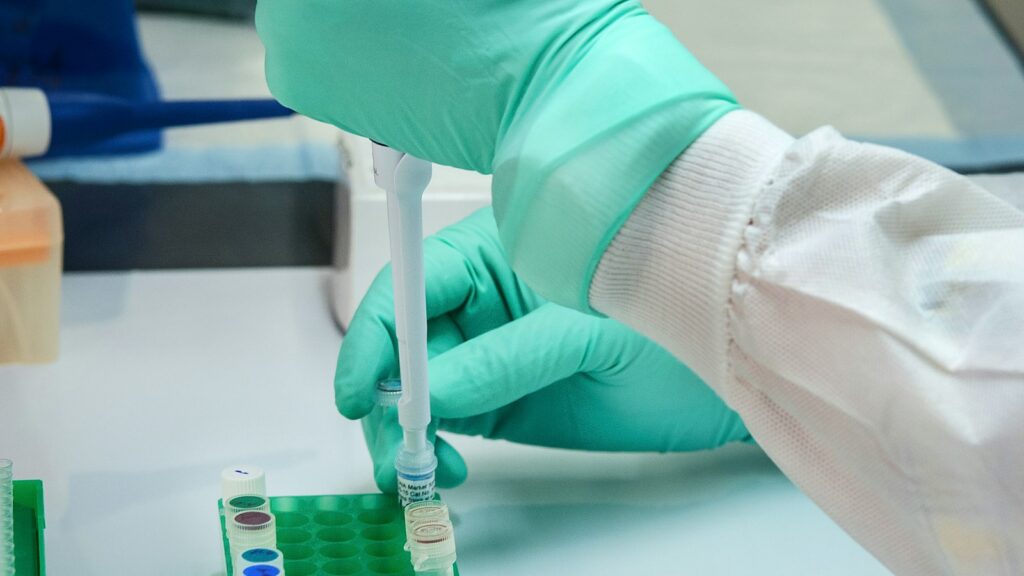
Almost every research peptide starts life the same way: as a growing chain anchored to a bead of resin smaller than a grain of sand, built one amino acid at a time. The method was invented in 1963, earned a Nobel Prize in 1984, and still decides what ends up in your vial, impurities included.
This guide explains how solid-phase peptide synthesis works, why small errors add up with every residue, where each kind of impurity comes from, and what all of that means when you read a certificate of analysis.
The short answer
- Most research peptides are made by solid-phase peptide synthesis (SPPS). The chain is built one amino acid at a time on tiny resin beads, then cut free, purified by HPLC and freeze-dried.
- R. Bruce Merrifield invented the method at the Rockefeller Institute in New York and published it in 1963. It earned him the 1984 Nobel Prize in Chemistry.
- Small inefficiencies compound. If every coupling step is 99% complete, only about three in four chains of a 29-residue peptide come out full length before purification.
- Every impurity has a source: missing residues, chains that stopped early, rearranged aspartic acid, oxidized residues, leftover protecting groups and trifluoroacetic acid (TFA) from the final cleavage.
- Purification removes most of them, and the COA shows how well it worked. HPLC measures what is left, and mass spectrometry catches most, but not all, of the wrong molecules.
From one bead to a finished peptide
Before 1963, chemists built peptides in solution and had to purify the product after every single step, which made anything longer than a few residues slow and wasteful. Merrifield’s idea was to tether the first amino acid to an insoluble polymer bead. Each new amino acid could then be added in excess to drive the reaction to completion, and everything left over simply washed away while the growing chain stayed attached.
Synthesis runs backwards compared with biology. Ribosomes build proteins from the N-terminus; SPPS starts with the C-terminal amino acid on the resin and adds residues toward the N-terminus. Every incoming amino acid carries two kinds of protection: a temporary group on its backbone amine, removed at the start of each cycle, and permanent groups on reactive side chains, which stay on until the very end.
Fmoc or Boc: two chemistries
Merrifield’s original method protected the backbone amine with a Boc group. In 1970, Louis Carpino and Grace Han introduced the Fmoc group, which comes off with a mild base instead of acid. Fmoc chemistry has since become the standard for research peptides.
| Fmoc/tBu chemistry | Boc/Bzl chemistry | |
|---|---|---|
| Temporary amine protection | Fmoc, removed by a mild base such as piperidine | Boc, removed by trifluoroacetic acid |
| Final cleavage | Trifluoroacetic acid with scavengers | Hydrogen fluoride |
| Use today | The dominant method for research peptides | Specialist use, such as some difficult sequences |
| Main drawback | Base-driven side reactions such as aspartimide formation | Hazardous hydrogen fluoride handling |
Why length matters: the arithmetic of errors
Coupling reactions are very efficient, but never perfect. If a small fraction of chains misses a residue at every step, the share of perfect, full-length chains falls with each cycle. The arithmetic is simple: the fraction of full-length product is the step efficiency multiplied by itself once per coupling.
| Peptide (length) | 98% per step | 99% per step | 99.5% per step |
|---|---|---|---|
| Epitalon (4 residues) | 94.1% | 97.0% | 98.5% |
| BPC-157 (15 residues) | 75.4% | 86.9% | 93.2% |
| Sermorelin (29 residues) | 56.8% | 75.5% | 86.9% |
| Thymosin beta-4 (43 residues) | 42.8% | 65.6% | 81.0% |
These figures are illustrative: they assume the same efficiency at every coupling, one fewer coupling than the number of residues, and no purification. Real efficiency varies by residue and sequence, and chemists often cap unreacted chains so that failures become short truncations rather than near-identical deletions.
The lesson holds anyway. Long peptides are harder to make pure, crude purity says little about the finished product, and a purity claim for a 43-residue protein deserves more scrutiny than the same claim for a tetrapeptide.
Where impurities come from
- Deletion sequences. When a coupling fails on some chains and the next one succeeds, those chains end up missing a single residue. Deletions are close to the target in size and behaviour, which makes them among the hardest impurities to remove.
- Truncated sequences. Chains that stop growing early, often because chemists deliberately cap unreacted chains. Truncations are usually easier to separate.
- Aspartimide products. Under repeated base treatment, aspartic acid can fold into a ring, especially when the next residue is glycine. The ring reopens to give normal α-aspartyl and abnormal β-aspartyl chains with identical mass. Epitalon (Ala-Glu-Asp-Gly) contains exactly this Asp-Gly pair, and for DSIP the β-aspartyl form was inactive in the original experiments.
- Racemization. Some residues, notably cysteine and histidine, can flip to their mirror-image D-form during activation. The mass doesn’t change.
- Oxidation. Methionine, cysteine and tryptophan oxidize easily; methionine sulfoxide adds 16 g/mol. Full-length thymosin beta-4 contains a methionine, one reason the BPC-157 vs TB-500 page suggests checking for it.
- Incomplete deprotection. Side-chain protecting groups that survive cleavage add characteristic masses.
- Counter-ions. TFA from cleavage and purification leaves most peptides as TFA salts unless they are exchanged, often for acetate. That changes net peptide content, not purity.
What mass spectrometry can and can’t see
Many synthesis errors change a peptide’s mass in predictable ways, which is why mass spectrometry is such a useful identity check.
| Problem | Mass change | Seen by mass spectrometry? |
|---|---|---|
| Missing residue | Minus that residue, for example about 97 for proline or 57 for glycine | Yes |
| Oxidized methionine | Plus 16 | Yes |
| tBu group left on | Plus 56 | Yes |
| Trt group left on | Plus 242 | Yes |
| Pbf group left on arginine | Plus 252 | Yes |
| β-aspartyl isomer or D-amino acid | None | No: needs HPLC separation |
Same-mass isomers are the reason a good COA pairs mass spectrometry with HPLC. One confirms the molecule’s identity; the other shows whether near-identical impurities are present.
Every batch is tested by HPLC and mass spectrometry, with the report matched to your lot.
See our lab testingPurification, salts and freeze-drying
After cleavage, the crude mixture is purified by preparative reversed-phase HPLC, usually on C18 columns with water and acetonitrile containing a little TFA. Fractions are collected as they leave the column, analyzed, and those meeting the purity target are pooled. Our HPLC testing guide explains how the same technique is used to measure the result.
The pooled solution is then freeze-dried (lyophilized), removing water under vacuum to leave the fluffy powder in a research vial. Lyophilized peptides are far more stable than peptides in solution, which is why storage advice centres on keeping that powder cold, dry and dark. See our peptide storage guide.
Beyond SPPS: very long peptides and lipidated drugs
Stepwise SPPS becomes impractical beyond roughly 50 residues, because the error arithmetic above catches up. Two workarounds dominate. In native chemical ligation, introduced in 1994 by a team that included Ian Clark-Lewis of the University of British Columbia, unprotected peptide segments are joined chemically into a longer chain. Recombinant expression, which has produced human insulin in microorganisms since the early 1980s, makes long sequences in cells instead.
Modern peptide drugs often combine approaches. Fatty-acid side chains, like those on semaglutide or cagrilintide, can be attached to a specific lysine during synthesis using an extra, independently removable protecting group. Our guide to peptide half-life engineering explains why those side chains are there.
Reading a COA with synthesis in mind
Knowing how peptides are made tells you what a certificate of analysis should show:
- An HPLC chromatogram with its method, not just a purity number. Deletions and isomers show up as nearby peaks.
- A mass that matches the sequence, with no unexplained signals at telltale offsets such as plus 16 or minus a residue.
- Extra care for isomer-prone sequences. Peptides containing Asp-Gly, cysteine or histidine depend on HPLC separation, because their likeliest impurities have the same mass.
- The salt form and net peptide content, since TFA and acetate change how much of the powder is peptide.
- A lot number that matches your vial. Our COA guide walks through every field, and how to spot fake or underdosed peptides covers the red flags.
 BPC-15715 residues, 14 couplingsView product and COA
 EpitalonContains an Asp-Gly pairView product and COA
 DSIPWhere the β-aspartyl isomer mattersView product and COA
 TB-500 (thymosin beta-4)43 residues in full-length formView product and COA
Research use only. Peptides from Pure Peptides Canada are laboratory reagents for in-vitro research. They are not approved drugs or supplements, they are not for human or veterinary use, and nothing in this article is dosing or medical guidance.
Frequently asked questions
How are research peptides made?
Most are made by solid-phase peptide synthesis: the chain is assembled one amino acid at a time on insoluble resin beads, then cleaved off with trifluoroacetic acid, purified by HPLC and freeze-dried into a powder.
Who invented solid-phase peptide synthesis?
R. Bruce Merrifield, working at the Rockefeller Institute in New York, published the method in 1963. He received the 1984 Nobel Prize in Chemistry for it.
Why are long peptides harder to make pure?
Each coupling step is slightly incomplete, and the losses multiply. At 99% efficiency per step, about 75% of chains in a 29-residue synthesis are full length before purification, compared with about 97% for a four-residue peptide.
What is a deletion sequence?
A deletion sequence is a peptide missing one amino acid because a coupling step failed on some chains. Deletions are similar to the target in size and behaviour, which makes them among the hardest impurities to remove.
Can mass spectrometry detect every impurity?
No. It detects impurities with a different mass, such as deletions, oxidation and leftover protecting groups, but not isomers with the same mass, such as β-aspartyl or D-amino-acid forms. Those need HPLC to separate them.
Why do synthetic peptides contain TFA?
Trifluoroacetic acid is used to cleave the peptide from the resin and in most HPLC purification buffers, so peptides are often isolated as TFA salts. Many are exchanged to acetate. The salt affects net peptide content, not purity.
Tested for what synthesis can leave behind
Independent HPLC and mass spectrometry on every batch, with the report matched to your lot and tracked delivery across Canada.
References
- Merrifield RB. Solid phase peptide synthesis. I. The synthesis of a tetrapeptide. J Am Chem Soc. 1963;85(14):2149–2154.
- The Nobel Prize in Chemistry 1984: Robert Bruce Merrifield. NobelPrize.org
- Carpino LA, Han GY. 9-Fluorenylmethoxycarbonyl function, a new base-sensitive amino-protecting group. J Am Chem Soc. 1970;92(19):5748–5749.
- Behrendt R, White P, Offer J. Advances in Fmoc solid-phase peptide synthesis. J Pept Sci. 2016;22(1):4–27.
- Dawson PE, Muir TW, Clark-Lewis I, Kent SB. Synthesis of proteins by native chemical ligation. Science. 1994;266(5186):776–779.
For laboratory research use only. Not for human or veterinary use. This article explains laboratory science for educational purposes and is not medical advice.