
Description
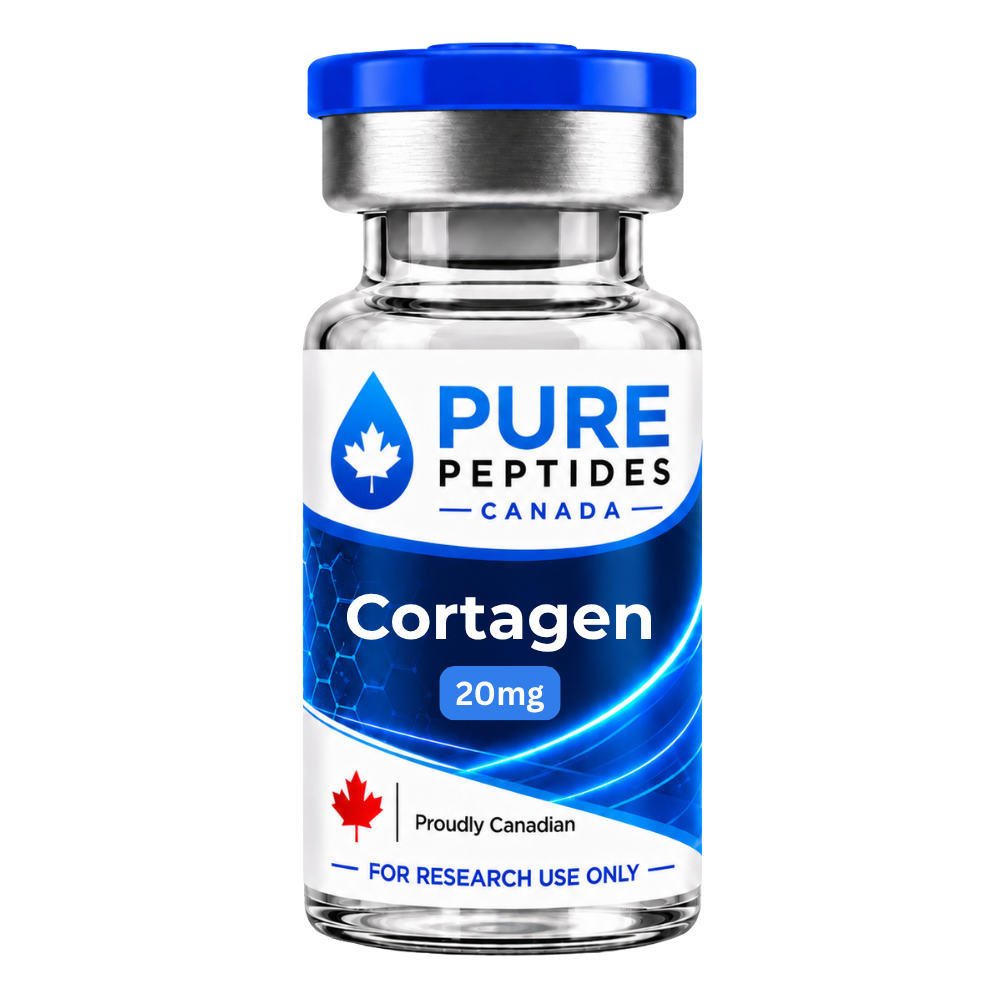
Cortagen is the synthetic tetrapeptide Ala-Glu-Asp-Pro (AEDP), designed by its St. Petersburg developers from an amino-acid analysis of the brain-cortex preparation Cortexin and studied mainly in rat nerve regeneration and in gene-expression and chromatin experiments. Pure Peptides Canada supplies it as a lyophilized research reagent in 20 mg vials, with an independent Janoshik HPLC and mass-spectrometry report, CAD pricing and tracked shipping from inside Canada.
Cortagen at a glance
- What it is: L-alanyl-L-glutamyl-L-aspartyl-L-proline (AEDP), a synthetic tetrapeptide from Vladimir Khavinson’s bioregulator programme, modelled on cortex-extract research.
- What researchers study: sciatic-nerve regeneration in rats, gene expression in mouse heart tissue, chromatin in lymphocytes from older donors, and what the C-terminal proline changes within the AED set.
- Evidence level: a small literature, mostly from the early 2000s and largely from the developers’ network: rodent and cell studies, plus a passing statement by the developers about human observations after nerve injury that gives no methods or data; we found no peer-reviewed controlled trial in people.
- Supplied as: sealed lyophilized powder, 20 mg, single vial or box of 10.
- Delivery: ships from inside Canada by tracked Xpresspost in 3–7 days ($25 CAD), or free in 4–12 days on orders over $299.
Cortagen
Ala-Glu-Asp-Pro · AEDP tetrapeptide · cortical bioregulator
- A
- E
- D
- P
Black: the Ala-Glu-Asp core shared with Cardiogen, Bronchogen, Cartalax and Epithalon. Blue: the proline that distinguishes Cortagen.
- Length
- 4 amino acids
- Molecular formula
- C17H26N4O9
- Molecular weight
- ≈ 430.4 g/mol
- Family
- Khavinson short-peptide bioregulators
- Form
- Lyophilized powder, sealed vial
- Sizes
- 20 mg (single or box of 10)
- SKU
- PP-CORTAGEN
Where the evidence stands
- Cell studies
- Animal models
- Controlled human trials
- Approved medicine
Published work comes mainly from the group that developed it. Cortagen is not an approved medicine.
What is Cortagen?
Cortagen is four residues long: alanine, glutamic acid, aspartic acid and proline (AEDP). According to its developers, it was made by directed synthesis after an amino-acid analysis of Cortexin, a mixture of polypeptides extracted from animal brain cortex. Cortexin is a heterogeneous extract and Cortagen is one defined molecule, so results obtained with one do not carry over to the other.
In the catalogue, Cortagen belongs to the AED set with Cardiogen (AEDR), Bronchogen (AEDL) and Epithalon (AEDG). Its distinguishing residue is the C-terminal proline, whose ring-shaped side chain restricts the flexibility of the peptide backbone in a way the glycine, leucine and arginine of its siblings do not. Remove the alanine and you have Crystagen (EDP), a separate tripeptide in the family. Pinealon (EDR) is also linked to Cortexin by the developers, although the two share only the central Glu-Asp pair.
The Cortagen literature is small and mostly dates from 2000 to 2004. The studies below all include the developers among their authors, and independent replication is limited.
What published studies report
- Sciatic-nerve regeneration in rats. Turchaninova and colleagues (Bulletin of Experimental Biology and Medicine, 2000) cut and sutured the sciatic nerve in rats. In animals that received Cortagen, regenerating fibres grew about 27% faster and conducted impulses about 40% faster than in controls. It is a single study from the developers’ circle.
- Gene expression in mouse heart. Anisimov, Khavinson and Anisimov (Neuroendocrinology Letters, 2004) screened 15,247 transcripts in the hearts of mice that received Cortagen. Of these, 234 clones (1.53%), matching 110 known genes, changed significantly, from 5.4-fold up to 2.9-fold down. Compared with earlier arrays for Vilon, Epithalon and melatonin, the changes were partly shared and partly specific to Cortagen. Brain tissue was not part of this analysis.
- Chromatin in cells from older donors. Khavinson, Lezhava and Malinin (Bulletin of Experimental Biology and Medicine, 2004) cultured lymphocytes from people aged 75 to 88 with five bioregulators. All five, Cortagen included, were reported to activate ribosomal genes and loosen densely packed chromatin. Only Epithalon, Livagen and Prostamax were reported to decondense the structural heterochromatin beside the chromosome 1 centromere, so Cortagen’s reported effect was narrower than theirs.
- A modelled DNA site. In the developers’ 2016 docking survey of 19 bioregulators (Bulletin of Experimental Biology and Medicine), AEDP was rated a strong binder with a predicted preference for the sequence AACC, one category below Cardiogen and Pinealon. The prediction was not tested experimentally.
Reported in studies
- Faster fibre regrowth and conduction after sciatic-nerve repair in rats.
- Expression changes in about 1.5% of screened heart transcripts in mice.
- Chromatin loosening in cultured lymphocytes from older donors.
- A predicted DNA-binding preference (modelling only).
Not established
- Any effect on the cerebral cortex, the tissue its name refers to.
- Whether Cortagen accounts for any activity of Cortexin.
- Independent replication of the nerve-regeneration result.
- Any human data from controlled trials.
Regulatory status: Cortagen is not an authorized drug in Canada. We sell it strictly as a laboratory reagent for in-vitro research.
Why researchers order Cortagen from Pure Peptides Canada
Add a 20 mg vial or a box of 10 above. Orders over $299 ship free across Canada.
See lab resultsCortagen FAQ
Where can I buy Cortagen in Canada?
Pure Peptides Canada stocks Cortagen as a lyophilized research reagent in 20 mg vials and ships it from inside Canada by tracked Xpresspost in 3–7 days ($25 CAD), or free in 4–12 days on orders over $299.
Is Cortagen the same as Cortexin?
No. Cortexin is a mixture of polypeptides extracted from animal brain cortex. Cortagen is a single synthetic tetrapeptide, Ala-Glu-Asp-Pro, that its developers designed from an amino-acid analysis of Cortexin.
How is Cortagen related to Pinealon?
Both are linked by their developers to Cortexin, but they are different molecules. Pinealon is the tripeptide Glu-Asp-Arg; Cortagen is the tetrapeptide Ala-Glu-Asp-Pro and belongs to the AED set with Cardiogen, Bronchogen and Epithalon.
What experiments have used Cortagen?
Rats after sciatic-nerve repair, gene-expression profiling of mouse heart tissue, and cultured lymphocytes from donors aged 75 to 88, plus a computer docking survey. Most of this work dates from 2000 to 2004 and involves the developers.
Can Cortagen be used in people or animals?
No. This product is for in-vitro laboratory research only and is not a drug, supplement or food. We do not provide dosing or administration information.
References
- Turchaninova LN, Kolosova LI, Malinin VV, et al. Effect of tetrapeptide cortagen on regeneration of sciatic nerve. Bull Exp Biol Med. 2000;130(12):1172–1174. doi:10.1007/BF02682018
- Anisimov SV, Khavinson VKh, Anisimov VN. Elucidation of the effect of brain cortex tetrapeptide Cortagen on gene expression in mouse heart by microarray. Neuro Endocrinol Lett. 2004;25(1-2):87–93. Europe PMC 15159690
- Khavinson VKh, Lezhava TA, Malinin VV. Effects of short peptides on lymphocyte chromatin in senile subjects. Bull Exp Biol Med. 2004;137(1):78–81. doi:10.1023/B:BEBM.0000024393.40560.05
- Khavinson VKh, Lin’kova NS, Tarnovskaya SI. Short peptides regulate gene expression. Bull Exp Biol Med. 2016;162(2):288–292. doi:10.1007/s10517-016-3596-7
- Khavinson V, Linkova N, Kozhevnikova E, Trofimova S. EDR peptide: possible mechanism of gene expression and protein synthesis regulation involved in the pathogenesis of Alzheimer’s disease. Molecules. 2021;26(1):159. doi:10.3390/molecules26010159
For laboratory research use only. Not a drug, supplement, food or cosmetic, not for human or veterinary use, and not intended to diagnose, treat, cure or prevent any disease.


Reviews
There are no reviews yet.