
Description
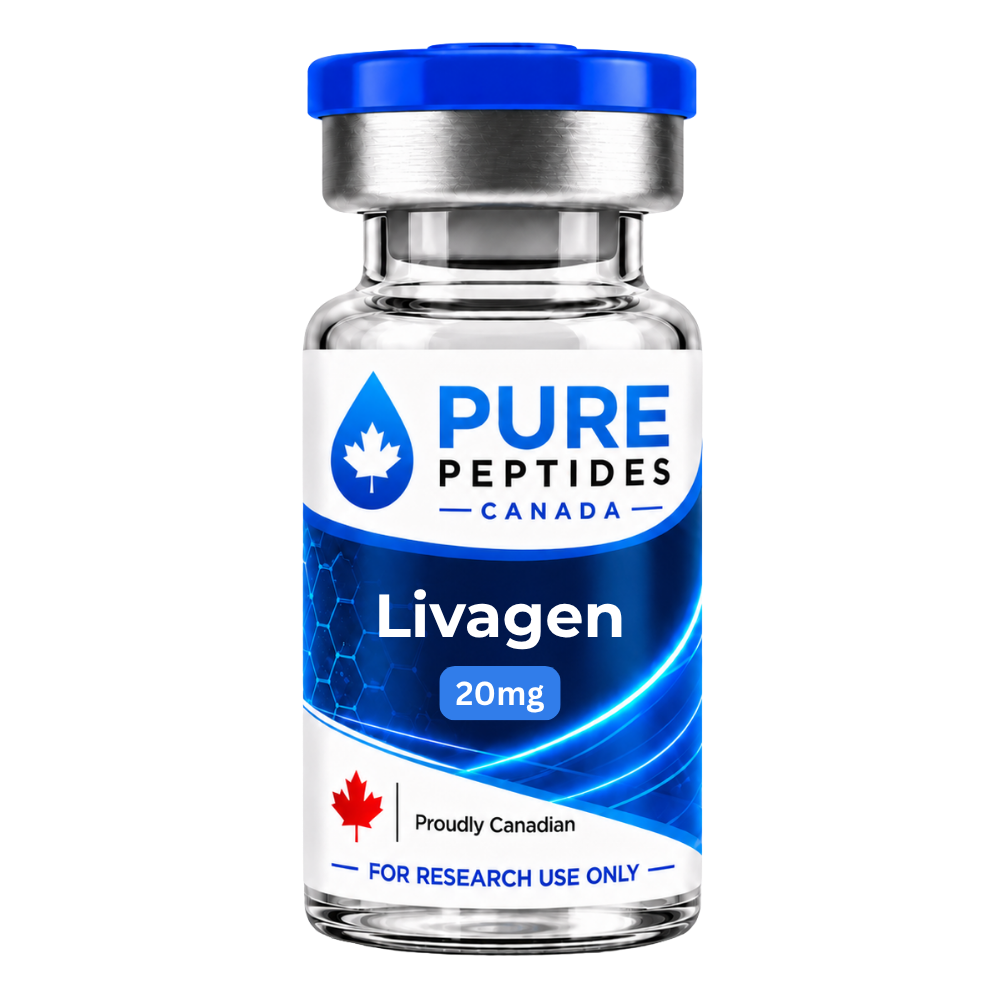
Livagen is the synthetic tetrapeptide Lys-Glu-Asp-Ala (KEDA), which Vladimir Khavinson’s group in St. Petersburg assigns to liver function and has studied mainly for its effects on chromatin in cultured lymphocytes from older donors. Pure Peptides Canada supplies it as a lyophilized research reagent in 20 mg vials, priced in CAD and shipped tracked from inside Canada.
Livagen at a glance
- What it is: the tetrapeptide KEDA, linked to liver tissue in the Khavinson group’s literature.
- What researchers study: heterochromatin condensation and ribosomal-gene activity in lymphocytes from donors aged 75 and over, growth of rat liver explants in organotypic culture, and modelled binding of KEDA to DNA.
- Evidence level: cell and tissue-culture studies from the developers and a collaborating chromosome laboratory, mostly published between 2001 and 2007, plus molecular modelling; the developers’ 2006 US patent also describes rat experiments that have not been peer-reviewed. Not an approved medicine.
- Supplied as: sealed lyophilized powder, 20 mg, single vial or box of 10.
- Delivery: Xpresspost in 3–7 days ($25 CAD), or free shipping in 4–12 days on orders over $299.
Livagen
Lys-Glu-Asp-Ala · KEDA · bioregulator tetrapeptide
- K
- E
- D
- A
One-letter code, N-terminus to C-terminus.
- Length
- 4 amino acids
- Molecular formula
- C18H31N5O9
- Molecular weight
- ≈ 461.5 g/mol
- Form
- Lyophilized powder, sealed vial
- Sizes
- 20 mg (single or box of 10)
- SKU
- PP-LIVAGEN
Where the evidence stands
- Cell studies
- Animal models
- Controlled human trials
- Approved medicine
Most published work comes from the Khavinson research network, and independent replication is limited.
What is Livagen?
Livagen is L-lysyl-L-glutamyl-L-aspartyl-L-alanine, a tetrapeptide from the St. Petersburg Institute of Bioregulation and Gerontology. Khavinson’s 2014 overview of the institute’s synthetic peptides assigns it to liver function, a designation it shares with Ovagen (Glu-Asp-Leu) even though the two sequences are unrelated. Like the other tissue names in the range, the label records the programme’s origins in tissue extracts; it is not evidence of a liver-specific action.
By sequence, its nearest relative is Vesugen (Lys-Glu-Asp), which Livagen extends by one alanine. The same Lys-Glu-Asp opening is shared with Testagen (KEDG), Prostamax (KEDP) and Pancragen (KEDW), and its first two residues make up Vilon (Lys-Glu).
What sets Livagen apart is its chromatin literature. Several papers from Teimuraz Lezhava’s group, some co-authored with Khavinson, tested it on cultured lymphocytes from people aged roughly 75 to 91, and in a five-peptide comparison it was one of two, with Epithalon, reported to change structural heterochromatin on both chromosome 1 and chromosome 9. Nearly all of this work comes from the developers and that collaborating group, uses cultured cells or tissue explants, and has not been repeated by unrelated laboratories that we could find.
What published studies report
- Chromatin in lymphocytes from older donors: Khavinson and colleagues (Bulletin of Experimental Biology and Medicine, 2002) reported that Livagen activated ribosomal genes, decondensed pericentromeric structural heterochromatin and released genes silenced by age-related condensation in cultured lymphocytes from old people. The readouts were chromosome staining and heterochromatin denaturation measures.
- Five-peptide comparison: in lymphocytes from donors aged 75–88, Vilon, Epithalon, Livagen, Prostamax and Cortagen all activated ribosomal genes, but only Epithalon, Livagen and Prostamax decondensed structural heterochromatin on chromosome 1, and only Epithalon and Livagen also changed chromosome 9 (Khavinson, Lezhava and Malinin, Bulletin of Experimental Biology and Medicine, 2004).
- Chromosome damage: Lezhava and Jokhadze (Annals of the New York Academy of Sciences, 2007) compared lymphocytes from donors aged 80–91 with donors aged 18–30. Livagen was reported to reactivate heterochromatinized regions in the older cells and to reduce chromosome aberrations caused by cobalt chloride, and cobalt alone and cobalt with Livagen targeted different chromosome regions for sister-chromatid exchange.
- Liver explants: in organotypic culture, Livagen stimulated growth of rat liver explants, while Cortagen, Epithalon and Vilon stimulated brain cortex, subcortical and thymus explants respectively (Khavinson, Bulletin of Experimental Biology and Medicine, 2001). The abstract of this two-page report gives no animal ages or concentrations.
- DNA modelling: in the group’s 2016 docking study of 19 short peptides, KEDA was assigned the TCCT sequence with very strong predicted binding. This is a modelling result, not a measured interaction.
Reported in studies
- Ribosomal-gene activation and heterochromatin decondensation in lymphocytes from older donors
- Fewer cobalt-induced chromosome aberrations in cells from donors over 80
- Growth of rat liver explants in organotypic culture
- A modelled DNA binding site (TCCT)
Not established
- That Livagen acts selectively on liver tissue
- Whether the chromatin changes alter gene expression or cell function
- Replication by laboratories outside the developers’ network
- Any controlled study in people
Regulatory status: Livagen is not an authorized drug in Canada, and Health Canada regulates injectable peptides as prescription drugs. We sell it strictly as a laboratory reagent for in-vitro research.
Ordering Livagen from Pure Peptides Canada
Choose a single vial or a box of 10 above.
Livagen FAQ
What is the sequence of Livagen?
Livagen is the tetrapeptide Lys-Glu-Asp-Ala, written KEDA in one-letter code, with a molecular weight of about 461.5 g/mol.
Where can I buy Livagen in Canada?
Pure Peptides Canada stocks Livagen as a lyophilized research reagent in 20 mg vials and ships it tracked from inside Canada, by Xpresspost in 3–7 days or free in 4–12 days on orders over $299.
How strong is the evidence on Livagen?
Modest. The core papers are a 2002 study of lymphocyte chromatin from older donors, a 2004 five-peptide comparison, a 2007 chromosome-damage study and a two-page 2001 explant report, all from the developers and a collaborating group. We found no independent replication and no controlled human trials.
How does Livagen differ from Vesugen and Ovagen?
Vesugen is Lys-Glu-Asp, so Livagen is Vesugen with one alanine added. Ovagen (Glu-Asp-Leu) shares Livagen’s liver designation in the developers’ 2014 overview but has an unrelated sequence. We found no study comparing the three directly.
How do I get the certificate of analysis?
Ask for the report for your batch when you order, or check the Lab Testing page. Our COA guide explains how to read it.
Can Livagen be used in people or animals?
No. This product is for in-vitro laboratory research only and is not a drug, supplement or food. We do not provide dosing or administration information.
References
- Khavinson VKh. Tissue-specific effects of peptides. Bull Exp Biol Med. 2001;132(2):807–808. DOI
- Khavinson VKh, Lezhava TA, Monaselidze JG, Dzhokhadze TA, Dvalishvili NA, Bablishvili NK, Ryadnova IYu. Effects of Livagen peptide on chromatin activation in lymphocytes from old people. Bull Exp Biol Med. 2002;134(4):389–392. DOI
- Khavinson VKh, Lezhava TA, Malinin VV. Effects of short peptides on lymphocyte chromatin in senile subjects. Bull Exp Biol Med. 2004;137(1):78–81. DOI
- Lezhava T, Jokhadze T. Activation of pericentromeric and telomeric heterochromatin in cultured lymphocytes from old individuals. Ann N Y Acad Sci. 2007;1100:387–399. DOI
- Khavinson VKh. Peptides, genome, aging. Adv Gerontol. 2014;4(4):337–345. DOI
- Khavinson VKh, Lin’kova NS, Tarnovskaya SI. Short peptides regulate gene expression. Bull Exp Biol Med. 2016;162(2):288–292. DOI
For laboratory research use only. Not a drug, supplement, food or cosmetic, not for human or veterinary use, and not intended to diagnose, treat, cure or prevent any disease.


Avery Gagnon –
Good bioregulator. happy with the product. highly recommend