What are peptides in skincare? They are short chains of amino acids used as cosmetic ingredients, and the one word covers a whole family of molecules designed for different jobs, listed under coded names such as palmitoyl pentapeptide-4 or copper tripeptide-1. Knowing the main types, and how Canadian labels list them, makes a peptide serum or cream far easier to judge before you buy.
This guide covers the four types, how to read peptides on a Canadian label, what published studies measured, peptides vs retinol, and what to check before you order.
The short answer
- Peptides are short chains of amino acids. Typically 2 to 50 amino acids long, they are used in skincare as cosmetic ingredients, many of them designed by ingredient makers.
- There are four main types. Reviews group them by design as signal, carrier, neurotransmitter-inhibiting and enzyme-inhibiting peptides.
- Labels use INCI names, not trade names. Look for palmitoyl pentapeptide-4 (Matrixyl), palmitoyl tripeptide-1 and palmitoyl tetrapeptide-7 (Matrixyl 3000), acetyl hexapeptide-8 (Argireline), acetyl octapeptide-3 (SNAP-8) or copper tripeptide-1 (GHK-Cu).
- On a Canadian label, a peptide’s position says little. Ingredients above 1% are listed by weight, largest first; those at 1% or less may follow in any order, and peptides can be used at parts-per-million levels.
- The evidence is small and often sponsored. Studies mostly measure appearance, such as wrinkle depth, in about 10 to 100 people over one to three months, and many come from the companies behind the ingredient or product.
- Peptides are not a retinol substitute. Retinol, a form of vitamin A, has a larger and more independent evidence base; the two are not interchangeable.
- Patch test anything new. The American Academy of Dermatology suggests a small test spot twice a day for 7 to 10 days.
Peptides in skincare
Cosmetic peptides · skincare peptides · topical peptides
- What they are
- Short amino-acid chains (typically 2 to 50) used as cosmetic ingredients
- Main types
- Signal, carrier, neurotransmitter-inhibiting, enzyme-inhibiting
- Amounts used
- As low as parts per million (3 ppm in a 2005 cream study)
- Label order in Canada
- Above 1%: by weight, largest first; 1% or less: any order
- What studies measure
- Appearance, such as wrinkle depth and roughness
Where the evidence stands
- Lab studies
- Small sponsored studies of visible effects
- Independent controlled studies
- Consensus
Lab work and small, often maker-run studies exist; a 2026 systematic review found only two topical peptide trials that met its criteria.
What are peptides in skincare?
A peptide is a short chain of amino acids joined by peptide bonds. A US government genetics glossary puts the usual length at 2 to 50 amino acids; longer chains are polypeptides, the material proteins are made from. In skincare, a peptide cream, serum or toner is simply a product whose ingredient list includes one or more peptides.
Many cosmetic peptides are synthetic sequences designed by ingredient makers, some modelled on fragments of the skin’s structural proteins and others on part of a protein that nerve cells use to send signals. Many carry a small group on one end, such as palmitoyl (a fatty, lipophilic chain) or acetyl; reviews describe the palmitoyl group as a way to help a peptide into the skin and make it more stable. That matters because a 2017 review gives the usual guideline that a peptide should be under about 500 daltons to penetrate the skin, while noting that larger molecules can cross, especially in dry or aged skin.
In Canada, the Food and Drugs Act defines a cosmetic as a product for cleansing, improving or altering the complexion, skin, hair or teeth, so cosmetic peptide claims, ours included, describe how skin looks and feels rather than promising medical results.
The four types of peptides in skincare
A 2009 review by University of California, San Francisco dermatologists sorted cosmetic peptides into four groups by what each is designed to do; a 2020 review uses three, and a 2017 review adds a fifth. Think of the types as a filing system, not proof that a product works.
| Type | What it is designed to do | Label (INCI) examples | Trade names |
|---|---|---|---|
| Signal peptides | Act as messages to skin cells; many mimic fragments of the skin’s structural matrix | Palmitoyl pentapeptide-4; palmitoyl tripeptide-1; palmitoyl tetrapeptide-7 | Matrixyl; Matrixyl 3000 (the last two together) |
| Carrier peptides | Deliver or hold trace metals such as copper and manganese | Copper tripeptide-1; manganese tripeptide-1 | GHK-Cu is the common name of the copper form |
| Neurotransmitter-inhibiting peptides | Many imitate part of SNAP-25, a protein nerve cells use to signal muscles to contract, to soften the look of expression lines | Acetyl hexapeptide-8; acetyl octapeptide-3; pentapeptide-18 | Argireline; SNAP-8; Leuphasyl |
| Enzyme-inhibiting peptides | Slow skin enzymes; very few or no studies in people (2017 review) | Peptides from soy, rice or silk | Vary by supplier |
Copper tripeptide-1 is GHK-Cu, the amino acids glycine, histidine and lysine bound to copper, and it is the carrier peptide in our GHK-Cu peptide skincare line. Watch for one naming quirk: Argireline’s supplier lists it as acetyl hexapeptide-8, but the 2017 and 2020 reviews call it acetyl hexapeptide-3. In the 2002 paper that introduced Argireline, it reduced neurotransmitter release in lab tests, with much lower efficacy than botulinum toxin.
How to read peptides on a Canadian label
Decoding a peptide’s INCI name
Ingredient lists use INCI names (International Nomenclature of Cosmetic Ingredients), which Canada’s Cosmetic Regulations tie to the dictionary published by the Personal Care Products Council. Its conventions make peptide names readable:
- The prefix counts amino acids. Di- to deca- cover 2 to 10; chains of 11 to 100 are oligopeptides, and longer ones polypeptides.
- The number after the hyphen is arbitrary. It is a catalogue number, not a strength: pentapeptide-18 is a different molecule from pentapeptide-3, not a stronger one.
- A word in front names a group on the start of the chain, such as palmitoyl, myristoyl or acetyl; a group on the other end, such as an amide, comes after the name.
Trade names don’t belong in the ingredient list, because Canadian labels must list each ingredient only by its INCI name; Matrixyl 3000, for example, appears as palmitoyl tripeptide-1 and palmitoyl tetrapeptide-7.
A percentage needs context. Peptide trade ingredients are often sold as solutions: Argireline’s supplier lists its solution as water, acetyl hexapeptide-8 and caprylyl glycol, and SNAP-8 comes in a similar water-based solution. A front-label “10% Argireline” may describe the solution rather than the pure peptide, so ask the brand which it means.
What the order of ingredients means in Canada
Canada’s Cosmetic Regulations require the ingredient list on the outer label or, for a container too small for it, on an attached tag, tape or card or a website named on the label. Label information must be in English and French, but INCI names are exempt, so the list itself is not translated.
Ingredients present at more than 1% must be listed in descending order by weight. Ingredients at 1% or less, and all colouring agents, may then follow in any order. Peptides can be used in tiny amounts: the 2005 palmitoyl pentapeptide-4 study tested a moisturizer containing 3 parts per million (0.0003%), and the 2025 peptide serum described below contained 0.002%. At those levels a peptide sits far below the 1% line, so the common advice to look for peptides “near the top of the list” tells you little.
Every product in our GHK-Cu skincare line names copper tripeptide-1 on its label, and we will send the full ingredient list before you order.
Browse peptide skincareWhat the studies actually measured
Here is what five published studies of skincare peptides actually did, as their papers report it.
| Study | Who ran it | People and length | What was measured | Reported finding |
|---|---|---|---|---|
| Argireline (2002) | Spanish university scientists with Lipotec, the company behind the peptide | 10 women (per a 2017 review); 30 days | Wrinkle depth, by skin topography | Depth reduced by up to 30% |
| Palmitoyl pentapeptide-4 (2005) | Scientists at Procter & Gamble | 93 women aged 35 to 55; 12 weeks; split-face against a placebo | Wrinkles and fine lines, by image analysis and expert graders | Significant reduction compared with placebo; well tolerated |
| Argireline (2013) | A university hospital in Xi’an, China | 60 people, three on the peptide for every one on placebo; 4 weeks | Eye-area wrinkles, by silicone skin replicas and visual grading | Roughness fell with the peptide but not with placebo; 48.9% vs 0% rated effective |
| Cyclized hexapeptide-9 vs retinol (2025) | Authors affiliated with the peptide’s developer | 96 people in three groups; 56 days | Wrinkle number, area and roughness by imaging, plus elasticity and hydration | Peptide reported ahead of a low-strength retinol serum |
| Systematic review (2026) | Review authors pooling published trials | 19 randomized trials, 1,341 people | Hydration, elasticity, wrinkles and brightness | Only 2 of the 19 trials tested peptides on skin; the wrinkle result came mainly from oral peptide trials |
Three patterns stand out: what gets measured is appearance, the studies are small and short, and many test complete formulas, so they cannot isolate the peptide. The 2017 review noted that some results are sparse or unpublished, some studies had very few participants, and several did not separate the peptide’s role from other actives. None of this shows that peptides do nothing, only that the evidence is thinner than marketing suggests.
Peptides vs retinol: different ingredients, different evidence
Retinol is a form of vitamin A and a precursor of retinoic acid (tretinoin), which a 2006 review described as the most widely investigated retinoid for photoaging, skin changes caused by sun exposure. Peptides are not a gentler retinol; they are a different ingredient category with a much smaller evidence base.
| Question | Peptides | Retinol |
|---|---|---|
| What it is | Short amino-acid chains, many designed by ingredient makers | A form of vitamin A and a precursor of retinoic acid |
| Size of the evidence | Small, short studies, many run by makers; only 2 topical trials met a 2026 review’s criteria | Larger, including university trials with public funding |
| Common complaints | Few adverse events reported, but the trials are small and short | Irritant reactions such as burning and scaling; retinol is milder than tretinoin |
The retinol side includes trials with no commercial sponsor. In a 2007 University of Michigan study with US government funding, staff applied retinol lotion to one arm and an inactive lotion to the other in 36 adults with an average age of 87; after 24 weeks, fine wrinkling had improved significantly more on the retinol side. The trade-off is irritation, such as burning or scaling, although the 2006 review rates retinol considerably less irritating than tretinoin.
The 2025 trial in the table reported a new peptide, cyclized hexapeptide-9, ahead of retinol over 56 days, but its authors were affiliated with the peptide’s developer and acknowledged that the 0.002% retinol serum was a low concentration. Whether peptides and retinol can share a routine depends on the products, so follow each label; our GHK-Cu product pages, such as the GHK-Cu Facial Serum, advise keeping retinoids to a separate routine from copper peptides.
How to choose a peptide product
Peptide cream, serum, toner or cleanser?
Format decides how long a peptide stays on skin. A serum, toner or peptide cream is left on, while a cleanser is rinsed off after brief contact, so a leave-on format is the usual first choice:
- Serum: the lightest leave-on layer, before moisturizer, like our GHK-Cu Facial Serum.
- Peptide cream: a moisturizer to finish the routine, like our GHK-Cu Face Cream.
- Toner: a light first layer after cleansing, like our GHK-Cu Facial Toner.
- Cleanser: a gentle rinse-off first step, like our GHK-Cu Facial Cleanser.
Read the label and the claims
Find the peptide by its INCI name, check what any stated percentage refers to, and follow the storage directions; our GHK-Cu product pages, for example, ask you to keep containers tightly closed, away from heat and direct sunlight. Cosmetic claims describe how skin looks and feels; promises of medical results go beyond what a cosmetic is for.
Patch test first
The American Academy of Dermatology (AAD) suggests applying a new product to a quarter-sized spot that won’t be rubbed or washed away, such as the inner arm, twice a day for 7 to 10 days; for a rinse-off product, leave it on for about five minutes, or as long as its directions say, before rinsing. Our product pages suggest a shorter patch test, 24 to 48 hours before first use; the AAD’s 7 to 10 day method is the more cautious option. If a reaction develops, wash the product off and don’t use it again.
What’s established and what isn’t
Reasonably well established
- Reviews group cosmetic peptides by design: signal, carrier, neurotransmitter-inhibiting and enzyme-inhibiting.
- Canadian labels list ingredients above 1% by weight, largest first; those at 1% or less may follow in any order.
- Several peptides have small placebo-controlled studies that measured changes in the look of wrinkles or roughness.
- Retinol’s evidence base is larger, and more of it is independent, than that of any single cosmetic peptide.
Open questions
- How much of a given peptide reaches its intended target in everyday use.
- Whether results from one formula carry over to another with a different concentration or base.
- How peptides compare with retinol in independent, adequately sized head-to-head trials.
- Whether enzyme-inhibiting peptides have measurable effects on skin; few or no studies in people exist.
- What happens with use beyond the one to three months most studies cover.
Buying peptide skincare in Canada
Whichever brand you choose, check for:
- the full INCI list with the peptide named, on the label or available before you buy;
- a label in English and French, apart from the INCI names;
- the net size, to compare price per millilitre or gram;
- where the order ships from, and the delivery time and cost to your province or territory;
- a clear returns policy, and claims about look and feel rather than medical results.
Our GHK-Cu skincare line is built around copper tripeptide-1, with humectants such as hyaluronic acid, glycerin and panthenol. Each label lists the full ingredients by INCI name, and we will send the complete list before you order if you contact us. See shipping across Canada for delivery details, read our shipping and returns policy, or learn more about Pure Peptides Canada.
Leave-on products from our GHK-Cu line
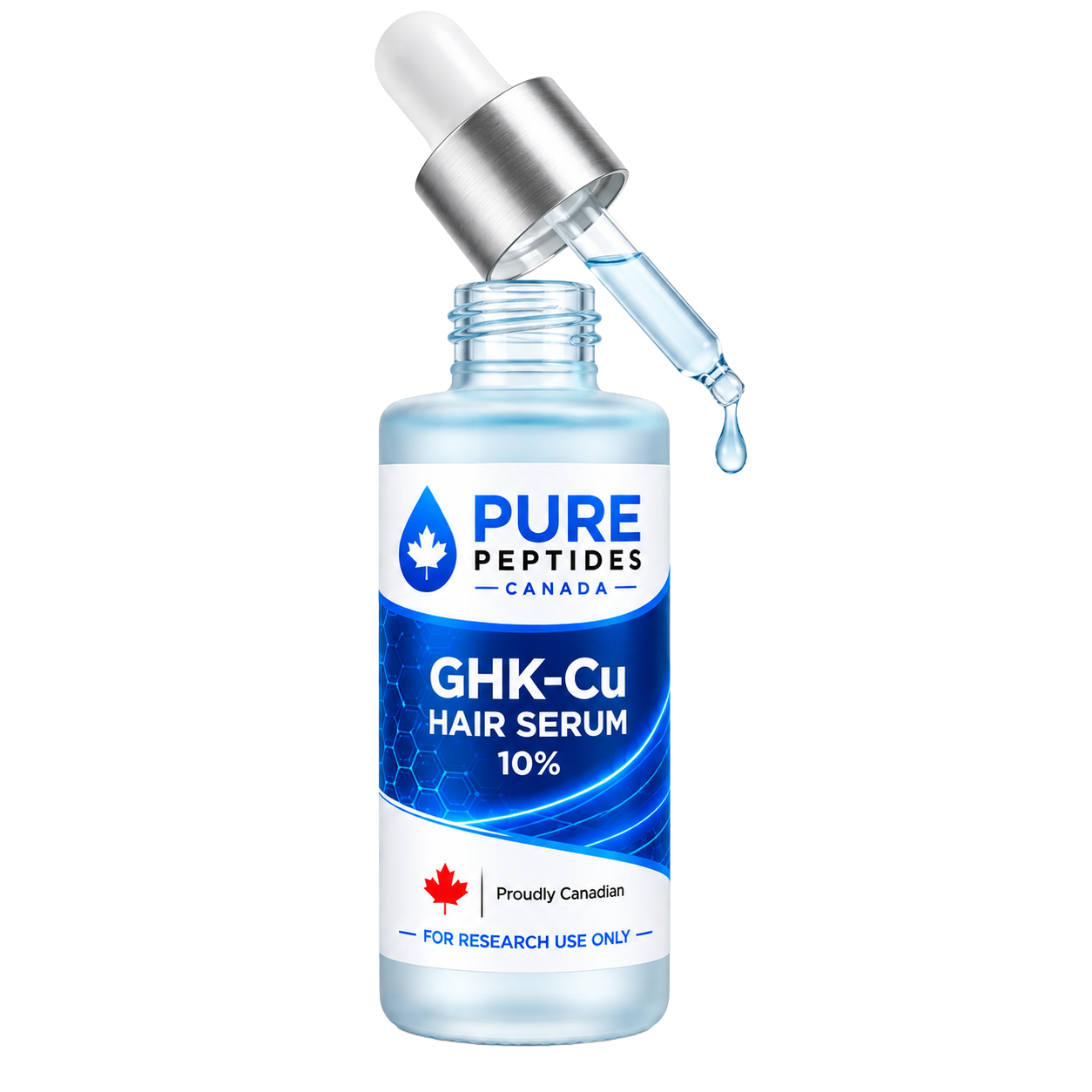 GHK-Cu Facial SerumA lightweight leave-on serum: copper tripeptide-1 with hyaluronic acid, glycerin, aloe vera, cucumber and panthenolView product
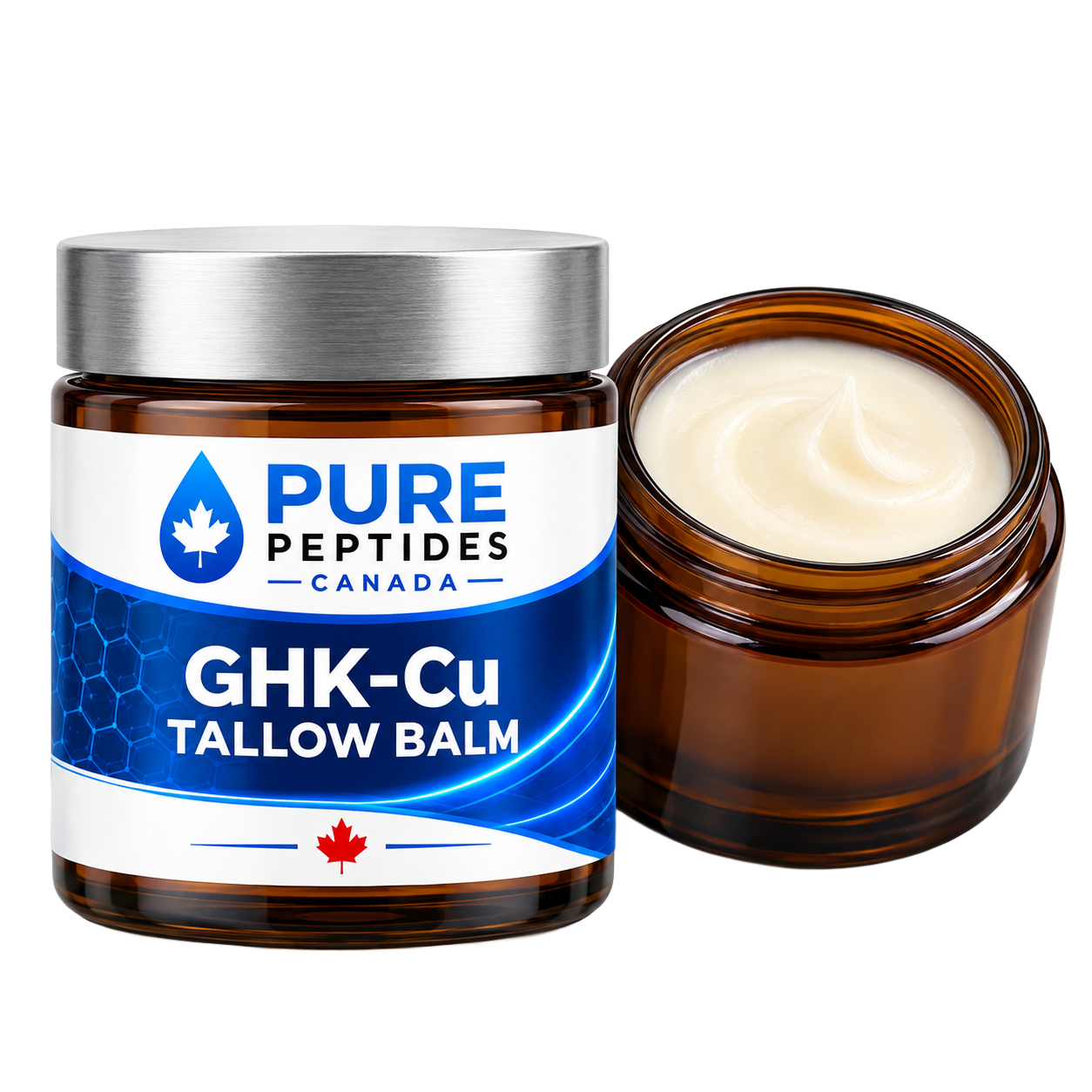 GHK-Cu Face CreamA light, fast-absorbing daily face cream: copper tripeptide-1 with hyaluronic acid, glycerin, aloe vera, panthenol and allantoinView product
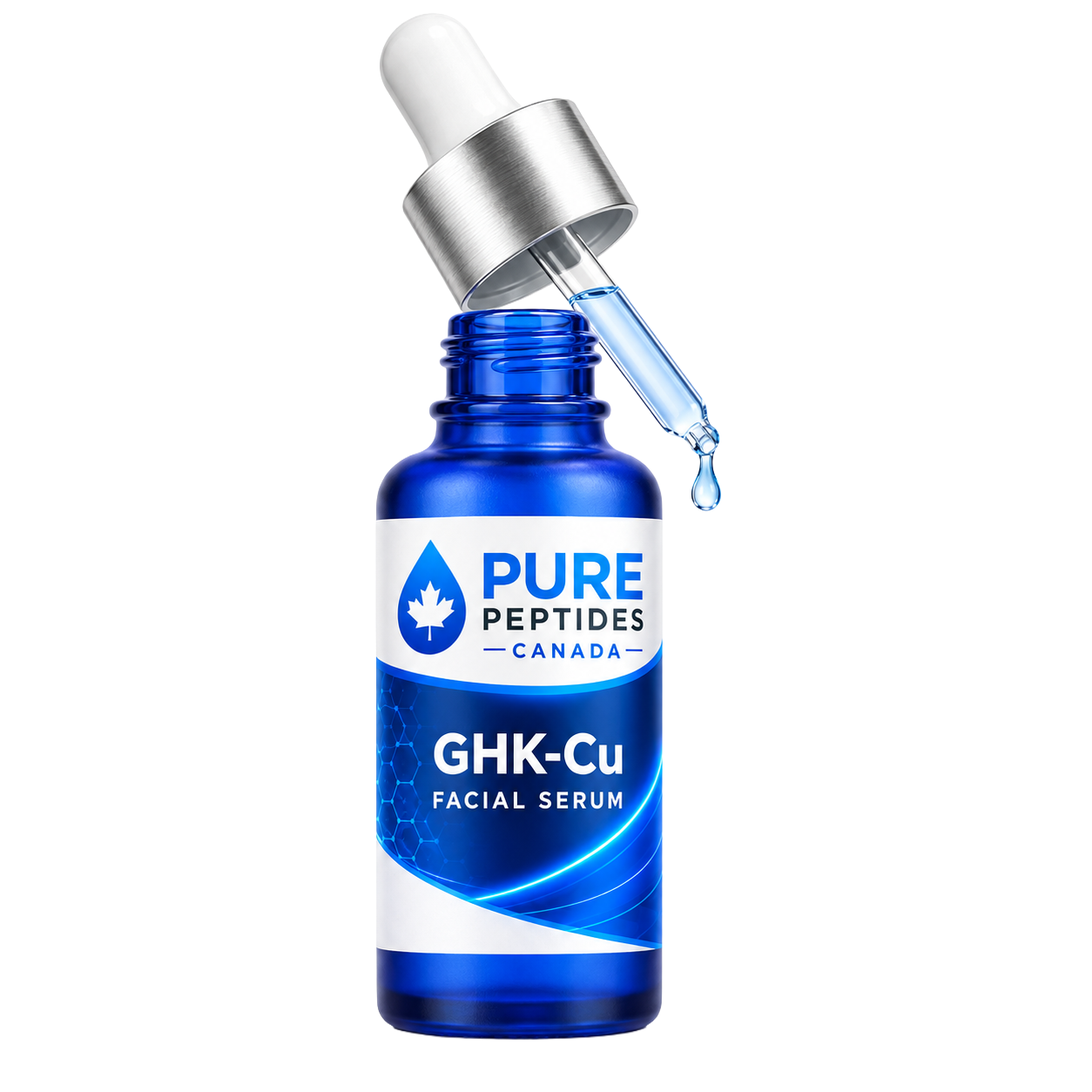 GHK-Cu Facial TonerA refreshing leave-on toner: copper tripeptide-1 with aloe vera, cucumber, panthenol, glycerin and sodium hyaluronateView product
Buying from Pure Peptides Canada
- Products
- Cosmetics for external use, formulated in Canada
- Prices
- In Canadian dollars
- Shipping
- From inside Canada by tracked Canada Post Xpresspost in 3–7 days ($25 CAD), or free in 4–12 days on orders over $299
- Payment
- Credit or debit card, Interac e-Transfer or crypto
Good to know. Our skincare is for external use only. Patch test each new product first, avoid the eye area and broken or irritated skin, stop using a product if irritation develops, and keep skincare out of reach of children.
Frequently asked questions
What are peptides in skincare?
Peptides in skincare are short chains of amino acids, typically 2 to 50 long, used as cosmetic ingredients to improve how skin looks and feels. On a label they appear under INCI names such as palmitoyl pentapeptide-4 or copper tripeptide-1.
What are the four types of peptides in skincare?
Reviews group them as signal peptides, such as palmitoyl pentapeptide-4; carrier peptides, such as copper tripeptide-1; neurotransmitter-inhibiting peptides, such as acetyl hexapeptide-8; and enzyme-inhibiting peptides, designed to slow skin enzymes. Some reviews use three or five groups instead.
How can I tell if a skincare product contains peptides?
Read the ingredient list for INCI names containing “peptide”, such as acetyl hexapeptide-8 or palmitoyl tripeptide-1. Trade names such as Matrixyl or Argireline don’t belong in the list, because Canadian labels must list each ingredient by its INCI name.
Why are peptides listed so far down the ingredient list?
Often because they are used in tiny amounts. In Canada, ingredients above 1% are listed by weight, largest first, but those at 1% or less may follow in any order. Published studies have tested peptides at levels as low as 3 parts per million, so their position says little about how much is present.
Are peptides better than retinol?
Not in any simple sense. Retinol, a form of vitamin A, has a larger and more independent evidence base, while peptide studies are smaller, shorter and often run by the ingredient’s maker. Retinoids can cause irritation such as burning and scaling, though retinol is milder than tretinoin. They are different ingredients, not substitutes.
Can you use peptides and retinol together?
It depends on the products, so follow each label’s directions. Pure Peptides Canada’s GHK-Cu product pages, for example, advise keeping retinoids to a separate routine from copper peptides.
Where can I buy peptide skincare in Canada?
Pure Peptides Canada sells a GHK-Cu skincare line online, priced in Canadian dollars: a facial serum, face cream, toner, cleanser and hair serum built around copper tripeptide-1. Orders ship from inside Canada by tracked Canada Post Xpresspost in 3–7 days ($25 CAD), or free in 4–12 days on orders over $299.
Copper peptide skincare, formulated in Canada
Five GHK-Cu products built around copper tripeptide-1, priced in CAD and shipped from inside Canada.
References
- National Human Genome Research Institute. Peptide. Talking Glossary of Genomic and Genetic Terms. genome.gov
- Gorouhi F, Maibach HI. Role of topical peptides in preventing or treating aged skin. Int J Cosmet Sci. 2009;31(5):327–345. DOI
- Schagen SK. Topical peptide treatments with effective anti-aging results. Cosmetics. 2017;4(2):16. DOI
- Errante F, Ledwoń P, Latajka R, Rovero P, Papini AM. Cosmeceutical peptides in the framework of sustainable wellness economy. Front Chem. 2020;8:572923. DOI
- Personal Care Products Council. INCI Nomenclature Conventions, January 2022 edition, Convention 61 (synthetic and recombinant peptides). PDF
- Cosmetic Regulations, C.R.C., c. 869: definitions in s. 2(1) and labelling in s. 18 (part 1); list of ingredients in ss. 21.2, 21.4 and 21.5 (part 2). Justice Laws Website, Government of Canada.
- Food and Drugs Act, R.S.C. 1985, c. F-27, s. 2, definition of “cosmetic”. Justice Laws Website, Government of Canada. laws-lois.justice.gc.ca
- Lubrizol. Argireline peptide solution C: product data, including INCI names. lubrizol.com
- SpecialChem. SNAP-8 peptide solution C by Lubrizol: technical datasheet, including INCI names. specialchem.com
- Blanes-Mira C, Clemente J, Jodas G, et al. A synthetic hexapeptide (Argireline) with antiwrinkle activity. Int J Cosmet Sci. 2002;24(5):303–310. DOI
- Robinson LR, Fitzgerald NC, Doughty DG, Dawes NC, Berge CA, Bissett DL. Topical palmitoyl pentapeptide provides improvement in photoaged human facial skin. Int J Cosmet Sci. 2005;27(3):155–160. DOI
- Wang Y, Wang M, Xiao S, Pan P, Li P, Huo J. The anti-wrinkle efficacy of argireline, a synthetic hexapeptide, in Chinese subjects: a randomized, placebo-controlled study. Am J Clin Dermatol. 2013;14(2):147–153. DOI
- Chang H, Tao K, Yang Y, et al. Novel cyclized hexapeptide-9 outperforms retinol against skin aging: a randomized, double-blinded, active- and vehicle-controlled clinical trial. J Cosmet Dermatol. 2025;24(7):e70290. DOI
- Nukaly HY, Halawani IR, Irtaza HM, et al. Oral and topical peptides for skin aging: systematic review and meta-analysis of randomized controlled trials. Front Med (Lausanne). 2026;13:1618306. DOI
- Kafi R, Kwak HS, Schumacher WE, et al. Improvement of naturally aged skin with vitamin A (retinol). Arch Dermatol. 2007;143(5):606–612. DOI
- Mukherjee S, Date A, Patravale V, Korting HC, Roeder A, Weindl G. Retinoids in the treatment of skin aging: an overview of clinical efficacy and safety. Clin Interv Aging. 2006;1(4):327–348. DOI
- American Academy of Dermatology. How to test skin care products. AAD public education page, last updated August 10, 2021. aad.org