
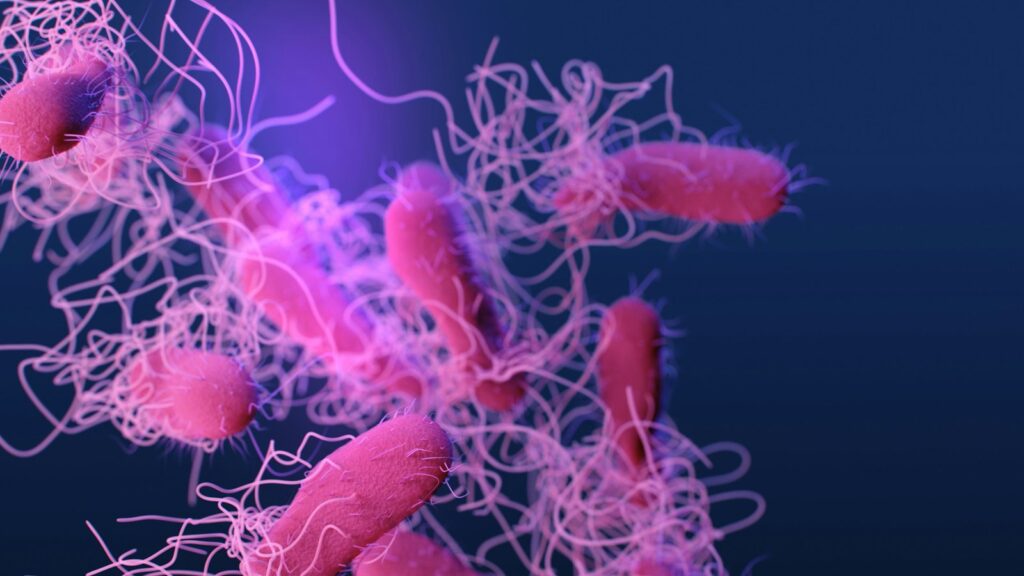
Long before people invented antibiotics, every plant and animal already had its own. Antimicrobial peptides are short, usually positively charged molecules that punch holes in bacteria, fungi and some viruses, and that also act as messengers for the immune system. Humans make dozens of them: in tears, sweat, saliva, skin and the white blood cells that respond first to infection.
This guide explains what antimicrobial peptides are, the main human families, how they kill microbes, why they matter beyond killing, and why so few have become medicines.
The short answer
- Antimicrobial peptides (AMPs), also called host-defence peptides, are part of the innate immune system in virtually all forms of life. Thousands have been catalogued.
- Most are short, roughly 12 to 50 amino acids, positively charged and amphipathic, which lets them bind and disrupt the negatively charged membranes of microbes.
- The two main human families are the defensins and the cathelicidins, of which humans make just one: LL-37.
- Many AMPs also steer the immune response, a role mapped in part by researchers at the University of British Columbia.
- Some peptide-based antibiotics are in clinical use, but most natural AMPs have struggled in drug development because of toxicity, instability and cost.
The human AMP families
| Family | Examples | Where they are made | Notes |
|---|---|---|---|
| Alpha-defensins | HNP1–4; HD5 and HD6 | Neutrophils; Paneth cells in the small intestine | Three internal disulfide bridges hold a compact shape |
| Beta-defensins | hBD1–4 | Skin and the linings of airways, gut and urinary tract | Some are switched on by infection or inflammation |
| Cathelicidins | LL-37, the only human member | Neutrophils and barrier tissues | Cut from the precursor hCAP18; switched on by vitamin D |
| Others | Histatins; dermcidin | Saliva; sweat glands | Specialized defences at particular surfaces |
For the full story of the human cathelicidin, from its vitamin D switch to its role in wound repair, see our LL-37 research guide.
How they kill microbes
The key is charge. Bacterial membranes carry many negatively charged lipids on their outer surface, while the outer surface of human cell membranes is close to neutral and stiffened by cholesterol. Positively charged AMPs are drawn to the bacterial surface, where their oily face slips into the membrane. Researchers describe several ways this goes wrong for the microbe: peptides lining up to form pores, curving the membrane into a toroidal pore, or carpeting the surface until it breaks apart like a detergent.
Not every AMP works by breaking membranes. Some slip inside the microbe and interfere with its DNA, protein production or cell-wall building. Because many hit something as basic as membrane structure, bacteria tend to find it harder to evolve resistance to them than to many conventional antibiotics, though resistance does happen.
Research-grade LL-37, the human cathelicidin, with a batch-matched COA.
View LL-37More than antibiotics
At the concentrations found in many tissues, some AMPs kill microbes weakly, yet they are still important. They act as immune signals: recruiting white blood cells, adjusting inflammation, neutralizing bacterial toxins and promoting wound repair. That is why researchers increasingly prefer the term host-defence peptides. Robert Hancock’s laboratory at the University of British Columbia helped establish this view, showing in 2002 that LL-37 acts as a multifunctional modulator of innate immune responses.
A short history
- 1981Hans Boman’s group in Sweden characterizes cecropins, antibacterial peptides from silk moth pupae.
- 1985Tomas Ganz, Robert Lehrer and colleagues describe the defensins of human neutrophils as natural peptide antibiotics.
- 1987Michael Zasloff discovers the magainins in the skin of the African clawed frog, which stays free of infection after surgery in non-sterile water.
- 2002The UBC team characterizes LL-37’s immune-signalling roles, and Zasloff’s review in Nature frames AMPs as a defence shared across multicellular life.
- 2015A transferable colistin-resistance gene, mcr-1, is reported, a reminder that peptide antibiotics are not immune to resistance.
Peptide antibiotics in the clinic
Several antibiotics in use today are peptides, though most come from microbes rather than from human immune cells. The polymyxins, including colistin, are last-resort drugs against resistant Gram-negative bacteria. Daptomycin, a lipopeptide, treats serious Gram-positive infections. Vancomycin is a glycopeptide. Nisin, made by bacteria, is used as a food preservative.
Natural host-defence peptides have had a harder road. Many lose activity in the salt and protein of real body fluids, are broken down quickly, can damage human cells at higher concentrations and are expensive to make at scale. Pexiganan, a cream based on the frog peptide magainin, was tested for infected diabetic foot ulcers but did not reach approval. Researchers are now designing shorter, more stable synthetic AMPs, often using tools such as D-amino acids; see our guide to D-amino acids.
What is established and what is open
Reasonably well established
- AMPs are an ancient, near-universal part of innate immunity.
- Most disrupt microbial membranes, favoured by charge differences.
- Human defensins and LL-37 also act as immune signals.
Open questions
- How to keep activity in body fluids without toxicity.
- Whether synthetic AMPs can become broadly useful medicines.
- How fast resistance emerges under widespread use.
 LL-37The human cathelicidinView product and COA
 Thymosin alpha-1Thymic immune peptideView product and COA
 KPVInflammation-research tripeptideView product and COA
Research use only. Pure Peptides Canada products are laboratory reagents, not antibiotics or medicines, and are not for human or veterinary use. This article is general scientific education and is not medical guidance.
Frequently asked questions
What are antimicrobial peptides?
Antimicrobial peptides, or host-defence peptides, are short, usually positively charged peptides made by almost all living things as part of innate immunity. They kill bacteria, fungi and some viruses, and many also signal to the immune system.
How do antimicrobial peptides kill bacteria?
Most are drawn to the negatively charged surface of bacterial membranes, insert into them and form pores or break them apart. Some instead enter the cell and interfere with DNA, protein production or cell-wall building.
What are defensins?
Defensins are small antimicrobial peptides held in shape by three internal disulfide bridges. In humans, alpha-defensins are made by neutrophils and intestinal Paneth cells, and beta-defensins by skin and the linings of the airways and gut.
What is a cathelicidin?
Cathelicidins are antimicrobial peptides released from precursor proteins that share a cathelin-like domain. Humans make only one, the precursor hCAP18, which is cut to release the active peptide LL-37.
Can bacteria become resistant to antimicrobial peptides?
Yes, though often more slowly than to many conventional antibiotics. A transferable resistance gene against colistin, a peptide antibiotic, was reported in 2015.
Are any antimicrobial peptides used as drugs?
Several peptide antibiotics are used in medicine, including polymyxins such as colistin, daptomycin and vancomycin, and nisin is used as a food preservative. Natural human host-defence peptides have not yet become approved medicines.
Immune research peptides, tested batch by batch
LL-37, thymosin alpha-1 and KPV, each with an independent COA, priced in Canadian dollars and shipped tracked across Canada.
References
- Zasloff M. Antimicrobial peptides of multicellular organisms. Nature. 2002;415:389–395.
- Ganz T. Defensins: antimicrobial peptides of innate immunity. Nat Rev Immunol. 2003;3:710–720.
- Hancock REW, Sahl HG. Antimicrobial and host-defense peptides as new anti-infective therapeutic strategies. Nat Biotechnol. 2006;24:1551–1557.
- Zasloff M. Magainins, a class of antimicrobial peptides from Xenopus skin. Proc Natl Acad Sci USA. 1987;84:5449–5453.
For laboratory research use only. Not for human or veterinary use. This article is educational and is not medical advice.