
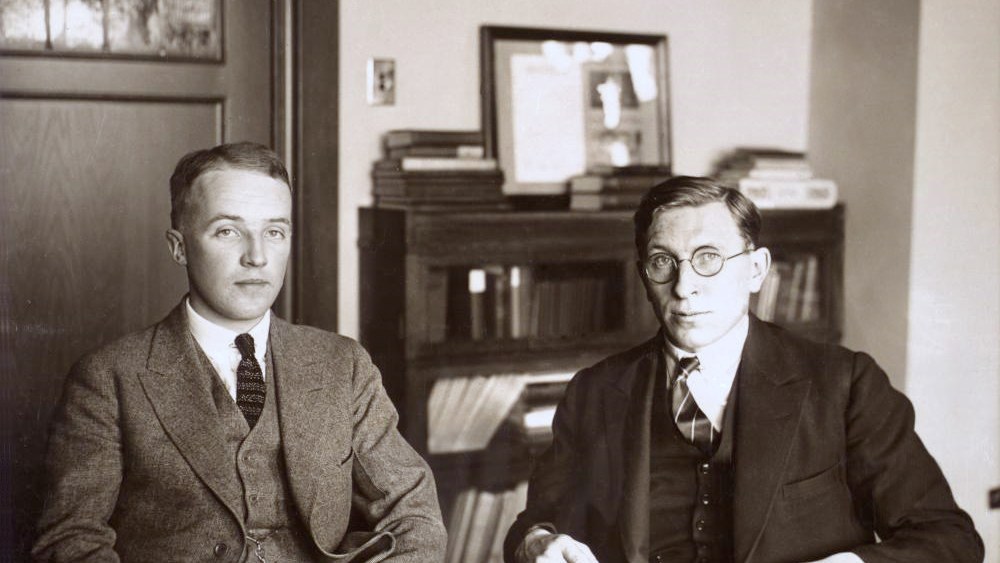
The first peptide hormone ever used as a medicine was purified in Toronto. A century later, Canadian laboratories are still behind a remarkable share of peptide science, from the hormones that regulate calcium to the GLP-1 biology behind today’s metabolic drugs.
This is that story, told through the discoveries, the people and the places, and connected to research peptides on the shelf today.
The short answer
- Insulin, a 51-amino-acid peptide hormone, was discovered at the University of Toronto in 1921–22 by Frederick Banting, Charles Best, James Collip and J.J.R. Macleod. Banting and Macleod received the 1923 Nobel Prize.
- Calcium’s hormones have Canadian roots too. In 1925 Collip, at the University of Alberta, made the first active extract of parathyroid hormone, and in 1961 Harold Copp at UBC discovered calcitonin.
- Both winners of the 1977 Nobel Prize for the brain’s peptide hormones trained in Montreal: Roger Guillemin at the Université de Montréal and Andrew Schally at McGill.
- Toronto’s Daniel Drucker helped establish GLP-1 and GLP-2 biology, the science underneath today’s GLP-1 medicines.
- Modern research peptides with Canadian roots include tesamorelin and CJC-1295, both developed in Montreal, and SS-31, co-developed at Montreal’s IRCM, alongside landmark research on LL-37 at UBC and cagrilintide in Calgary.
1921: insulin and the first peptide medicine
In 1921, Frederick Banting, a young surgeon from Alliston, Ontario, persuaded J.J.R. Macleod to lend him laboratory space at the University of Toronto. Working with student Charles Best, he prepared a pancreatic extract that lowered blood sugar in diabetic dogs. Biochemist James Collip then purified it enough to give to a person. In January 1922, 14-year-old Leonard Thompson, dying of diabetes at Toronto General Hospital, became the first person treated with insulin, and he recovered.
The 1923 Nobel Prize in Physiology or Medicine went to Banting and Macleod. Banting shared his prize money with Best, and Macleod shared his with Collip. The discoverers then sold the patent to the University of Toronto for a nominal sum so that insulin could be made widely available.
Insulin is a peptide: two chains of 21 and 30 amino acids joined by disulfide bridges. Its discovery showed that a peptide taken from tissue could be purified, standardized and used as a medicine, the template every peptide drug since has followed.
The calcium hormones: Edmonton and Vancouver
Collip returned from Toronto to the University of Alberta, where in 1925 he became the first to extract the active principle of the parathyroid glands, a hormone he named parathormone. The first injection of purified parathyroid hormone took place in the university’s Medical Building in Edmonton. Parathyroid hormone raises blood calcium, and modified fragments of it are still studied in bone research today.
Thirty-six years later, Harold Copp, the first head of physiology at the University of British Columbia, found the opposite signal. In 1961 his experiments revealed a previously unknown hormone that lowers blood calcium, which he named calcitonin. Calcitonin later became a treatment for bone diseases. It also founded a peptide family that includes amylin, which is why cagrilintide, a modern amylin analogue, acts partly on the calcitonin receptor.
Montreal’s hormone hunters
In the 1940s and 1950s, Hans Selye’s stress research made Montreal a magnet for endocrinologists. Roger Guillemin earned his PhD at the Université de Montréal in 1953 under Selye, and Andrew Schally completed his at McGill University in 1957. Both then moved to the United States and spent years in a fierce race to isolate the tiny peptide hormones the brain uses to control the pituitary.
They found them: TRH, then GnRH, and in Guillemin’s laboratory somatostatin. The 1977 Nobel Prize in Physiology or Medicine went to Guillemin and Schally for their discoveries concerning the peptide hormone production of the brain, shared with Rosalyn Yalow. In 1982 Guillemin’s team characterized growth hormone-releasing hormone (GHRH). Quebec-born Paul Brazeau, an author on both the somatostatin and GHRH papers, went on to co-found Montreal’s Theratechnologies, which developed the GHRH analogue tesamorelin. Our growth hormone peptides map follows that lineage to today’s research compounds.
Research peptides with Canadian roots, each with a batch-matched COA.
View tesamorelinToronto and the GLP-1 era
In 1987, Daniel Drucker, then working in Joel Habener’s laboratory in Boston, co-authored a study showing that glucagon-like peptide-1 stimulates insulin gene expression in pancreatic cells. Back in Toronto, his laboratory showed in 1996 that the related hormone GLP-2 makes the intestinal lining grow, work that led to a medicine for short bowel syndrome. Drucker’s research at the Lunenfeld-Tanenbaum Research Institute helped lay the groundwork for the GLP-1 drugs that now dominate metabolic medicine.
The story has a 2026 coda: in April, Canada became the first G7 country to authorize a generic version of semaglutide, a GLP-1 medicine. Our GLP-1 research map covers where every compound in that class stands.
Research peptides with Canadian roots
- Tesamorelin, developed by Montreal’s Theratechnologies, was approved in the US in 2010 and by Health Canada in 2014 as Egrifta.
- CJC-1295 came from Montreal’s ConjuChem, whose Drug Affinity Complex technology bonds peptides to albumin. See peptide half-life engineering.
- SS-31 is one of the Szeto-Schiller peptides, co-developed by Peter W. Schiller of Montreal’s Institut de recherches cliniques. As elamipretide, it received US accelerated approval for Barth syndrome in 2025.
- LL-37 was recast as an immune modulator, not just a natural antibiotic, by Robert Hancock’s laboratory at UBC in 2002.
- Cagrilintide‘s 2021 phase 2 trial was led by David Lau of the University of Calgary.
- Peptide chemistry itself owes a debt to Ian Clark-Lewis of UBC, a co-author of the 1994 paper introducing native chemical ligation. See how research peptides are made.
 TesamorelinA Montreal-developed GHRH analogueView product and COA
 SS-31Co-developed at Montreal’s IRCMView product and COA
 LL-37Reframed at UBC in 2002View product and COA
 CagrilintidePhase 2 led from CalgaryView product and COA
A century at a glance
- 1921–22: insulin, TorontoBanting, Best, Collip and Macleod; the first patient is treated in January 1922.
- 1925: parathyroid hormone, EdmontonCollip makes the first active extract at the University of Alberta.
- 1950s: Montreal trains two future laureatesGuillemin (Université de Montréal, 1953) and Schally (McGill, 1957).
- 1961: calcitonin, VancouverHarold Copp discovers a calcium-lowering hormone at UBC.
- 1977: Nobel Prize for brain peptidesGuillemin and Schally share the prize with Rosalyn Yalow.
- 1987 and 1996: GLP-1 and GLP-2Drucker’s work on insulin gene expression and intestinal growth.
- 2002: LL-37 as immune modulatorHancock’s laboratory at UBC.
- 2010 and 2014: tesamorelin approvedTheratechnologies’ GHRH analogue reaches patients in the US, then Canada.
- 2021: cagrilintide phase 2Led by David Lau at the University of Calgary.
- 2026: generic semaglutideCanada becomes the first G7 country to authorize one.
Research use only. Research peptides from Pure Peptides Canada are laboratory reagents for in-vitro research. They are not the approved medicines mentioned in this history, they are not for human or veterinary use, and nothing here is dosing or medical guidance.
Frequently asked questions
Was insulin discovered in Canada?
Yes. Insulin was discovered at the University of Toronto in 1921 and 1922 by Frederick Banting, Charles Best, James Collip and J.J.R. Macleod. In January 1922, Leonard Thompson became the first person treated with it, at Toronto General Hospital.
Who won the Nobel Prize for insulin?
Frederick Banting and J.J.R. Macleod received the 1923 Nobel Prize in Physiology or Medicine. Banting shared his prize money with Charles Best, and Macleod shared his with James Collip.
Who discovered calcitonin?
Harold Copp, the first head of physiology at the University of British Columbia, discovered calcitonin in 1961. It is a peptide hormone that lowers blood calcium.
What is Canada’s connection to GLP-1?
Daniel Drucker co-authored a key 1987 study showing GLP-1 stimulates insulin gene expression, and his Toronto laboratory later showed that the related hormone GLP-2 promotes intestinal growth. His work helped lay the groundwork for today’s GLP-1 medicines.
Which research peptides have Canadian origins?
Tesamorelin was developed by Montreal’s Theratechnologies, CJC-1295 by Montreal’s ConjuChem, and SS-31 was co-developed by Peter Schiller at Montreal’s Institut de recherches cliniques. Canadian researchers also shaped work on LL-37 and cagrilintide.
Did Canadians win the Nobel Prize for brain peptide hormones?
The 1977 Nobel Prize went to Roger Guillemin and Andrew Schally, with Rosalyn Yalow, for discoveries about the brain’s peptide hormones. Guillemin earned his PhD at the Université de Montréal and Schally his at McGill University.
A Canadian supplier for Canadian research
Research peptides with independent, batch-matched COAs, tracked delivery across Canada and pricing in Canadian dollars.
References
- Banting FG, Best CH, Collip JB, Campbell WR, Fletcher AA. Pancreatic extracts in the treatment of diabetes mellitus. Can Med Assoc J. 1922;12(3):141–146.
- The Nobel Prize in Physiology or Medicine 1923. NobelPrize.org
- Collip JB. The extraction of a parathyroid hormone which will prevent or control parathyroid tetany and which regulates the level of blood calcium. J Biol Chem. 1925;63:395–438.
- Copp DH, Cameron EC, Cheney BA, Davidson AGF, Henze KG. Evidence for calcitonin: a new hormone from the parathyroid that lowers blood-calcium. Endocrinology. 1962;70:638–649.
- University of British Columbia Archives. Douglas Harold Copp fonds. UBC Archives
- The Nobel Prize in Physiology or Medicine 1977. NobelPrize.org
- Guillemin R, Brazeau P, Böhlen P, Esch F, Ling N, Wehrenberg WB. Growth hormone-releasing factor from a human pancreatic tumor that caused acromegaly. Science. 1982;218(4572):585–587.
- Drucker DJ, Philippe J, Mojsov S, Chick WL, Habener JF. Glucagon-like peptide I stimulates insulin gene expression and increases cyclic AMP levels in a rat islet cell line. Proc Natl Acad Sci USA. 1987;84(10):3434–3438.
- Drucker DJ, Erlich P, Asa SL, Brubaker PL. Induction of intestinal epithelial proliferation by glucagon-like peptide 2. Proc Natl Acad Sci USA. 1996;93(15):7911–7916.
For laboratory research use only. Not for human or veterinary use. This article is a history of peptide science for educational purposes and is not medical advice.