
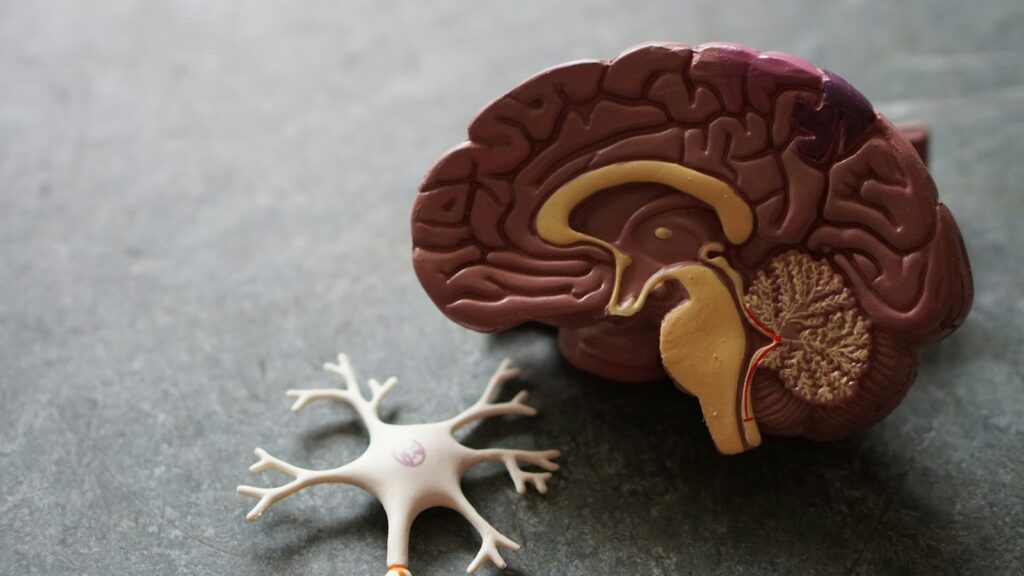
Semax and Selank are sibling peptides. Both were developed at the Institute of Molecular Genetics of the Russian Academy of Sciences, both are seven amino acids long, and both end in the same stabilizing Pro-Gly-Pro tail. What separates them is where their first four residues come from, and that changes what researchers study them for.
This guide compares the two side by side: their origins, the key rat and clinical studies, what “NA” means on a label, the limits of the evidence, and what to check when sourcing them in Canada.
The short answer
- Semax (Met-Glu-His-Phe-Pro-Gly-Pro) is built from a fragment of the hormone ACTH and is studied mainly for neurotrophic signalling such as BDNF.
- Selank (Thr-Lys-Pro-Arg-Pro-Gly-Pro) is built from tuftsin, an immune-system peptide, and is studied mainly for anxiety-related and GABA-linked signalling.
- Both are registered medicines in Russia. Neither has US FDA approval, and most human data come from small Russian studies.
- In Canada, both are available only as laboratory research reagents.
Semax
ACTH (4–7) fragment with a Pro-Gly-Pro tail (highlighted)
- M
- E
- H
- F
- P
- G
- P
- Parent molecule
- ACTH (4–10), a fragment of adrenocorticotropic hormone
- Mass
- 813.9 g/mol
- Developed
- Institute of Molecular Genetics, Moscow
- Status
- Registered in Russia; not FDA-approved
Furthest stage of research
- Cell studies
- Animal studies
- Small human studies
- Controlled efficacy trials
Clinical studies are mostly small and published in Russian.
Selank
Tuftsin with the same Pro-Gly-Pro tail (highlighted)
- T
- K
- P
- R
- P
- G
- P
- Parent molecule
- Tuftsin, a fragment of immunoglobulin G
- Mass
- 751.9 g/mol
- Developed
- Institute of Molecular Genetics, Moscow
- Status
- Registered in Russia (2009); not FDA-approved
Furthest stage of research
- Cell studies
- Animal studies
- Small human studies
- Controlled efficacy trials
The key human study compared 62 patients on Selank or medazepam (Russia, 2008).
Same lab, same tail
Short natural peptides tend to be broken down within minutes, which makes them hard to study. The Moscow group’s solution was to add a three-residue tail, proline–glycine–proline, that slows that breakdown. They applied it to two different starting fragments. Semax borrows its first four residues from ACTH, the pituitary hormone that controls cortisol release. Selank takes all four residues of tuftsin, a small peptide cut from immunoglobulin G antibodies.
Semax: an ACTH fragment without the hormone
ACTH normally tells the adrenal glands to release cortisol. Its 4–10 fragment, Met-Glu-His-Phe-Arg-Trp-Gly, was known to act on the brain without that hormonal role. Semax keeps the first four residues of the fragment and replaces the last three with Pro-Gly-Pro, giving a peptide described in the research literature as devoid of ACTH’s hormonal activity.
The most-cited mechanistic study, published in 2006, gave rats a single intranasal application of Semax and then measured the hippocampus, a brain region central to memory. BDNF protein, a growth factor involved in learning and neuron survival, rose about 1.4-fold. Activation of its receptor, TrkB, rose about 1.6-fold, and the treated rats made more conditioned avoidance responses in a learning task. Other Russian studies have examined Semax in models of reduced blood flow to the brain.
Semax is registered in Russia and appears on the country’s list of vital and essential medicines. Its exact mechanism is still debated; proposals include interactions with melanocortin receptors and effects on enzymes that break down other neuropeptides.
Selank: tuftsin with a stabilizing tail
Tuftsin is a four-residue peptide, Thr-Lys-Pro-Arg, released from the heavy chain of immunoglobulin G and known for immune-modulating activity. Selank extends it with the same Pro-Gly-Pro tail used in Semax.
In a 2016 rat study, researchers tracked 84 genes involved in GABA signalling in the frontal cortex after giving Selank or GABA itself. Expression of dozens of those genes shifted within hours, and the pattern after Selank correlated with the pattern after GABA. That supports the idea that Selank works partly through GABA-related signalling, the same system benzodiazepines act on.
The most-cited clinical comparison, published in 2008, followed 62 patients with generalized anxiety disorder or neurasthenia: 30 received Selank and 32 received the benzodiazepine medazepam. The authors reported similar anxiety-reducing effects in both groups. Selank was registered in Russia in 2009.
Side-by-side comparison
| Feature | Semax | Selank |
|---|---|---|
| Sequence | Met-Glu-His-Phe-Pro-Gly-Pro | Thr-Lys-Pro-Arg-Pro-Gly-Pro |
| Parent molecule | ACTH (4–10), a hormone fragment | Tuftsin, an antibody fragment |
| Main research themes | Neurotrophic signalling (BDNF and TrkB), reduced blood-flow models | Anxiety-related behaviour, GABA-related gene expression, immune modulation |
| Key study | Rat hippocampus, 2006 | Rat frontal cortex, 2016; 62-patient comparison, 2008 |
| Mass | 813.9 g/mol | 751.9 g/mol |
| Regulatory status | Registered in Russia; not FDA-approved | Registered in Russia (2009); not FDA-approved |
What NA and amidate mean on a label
Many suppliers also sell modified versions. “NA” stands for N-acetyl, a small acetyl cap on the first amino acid; “amidate” means the final carboxyl group has been converted to an amide. Both changes are meant to slow breakdown by enzymes that trim peptides from their ends.
Most of the published research summarized here used unmodified Semax and Selank, so results don’t automatically carry over to the modified forms. Treat NA versions as related but distinct compounds, and expect a different mass on the COA: acetylation adds about 42 g/mol.
 SemaxThe unmodified heptapeptide used in most published studies.View product and COA
 NA SemaxN-acetylated Semax for stability-focused work.View product and COA
 SelankThe unmodified tuftsin-derived heptapeptide.View product and COA
 NA SelankN-acetylated Selank for stability-focused work.View product and COA
For multi-compound designs, the Illumineuro blend combines NA Semax and NA Selank with Pinealon and PE-22-28 in one vial.
Limits of the evidence
- One country, one lineage. Development, most studies and both approvals come from Russia, and independent replication elsewhere is limited.
- Small studies. The human trials are small by modern standards, and many are published only in Russian-language journals.
- Animal-to-human gap. Rat gene-expression and behaviour results don’t predict human outcomes on their own.
- Unsettled mechanisms. Neither peptide has a single confirmed receptor target.
Cognitive and neuro research reagents, each with a batch COA.
Browse the categorySourcing Semax and Selank in Canada
Pure Peptides Canada is a Canadian-owned supplier of laboratory research peptides, established in 2023. Whichever supplier you use, check:
- Which form you’re getting. Plain, NA and amidated versions have different masses, and mass spectrometry tells them apart: 813.9 g/mol for Semax and 751.9 g/mol for Selank in their unmodified forms.
- A batch-specific COA. The lot number should match your vial. See our COA guide.
- Purity and identity both. HPLC shows purity; mass spectrometry confirms identity. Here’s how they differ.
- Cold, dry storage. Short peptides are sensitive to moisture. Our storage guide covers the basics.
Regulatory status in 2026
At its July 23–24, 2026 meeting, an advisory committee to the US FDA voted 8 to 5 to recommend adding Semax to the list of substances US pharmacies may compound, overriding FDA staff, who had recommended against it. Selank was not part of that review. The vote is advisory only: Semax has not been added to the list and is not an FDA-approved drug. In Canada, Health Canada’s April 2026 advisory on unauthorized injectable peptides did not name either peptide, but it warned that many other unauthorized peptide drugs exist and that “For Research Use Only” labelling does not make such products legal or exempt from regulatory requirements.
Independently testedEvery batch verified by Janoshik Analytical.
Batch-matched COALinked from each product page.
Tracked across CanadaDiscreet delivery by Xpresspost in 3–7 days, or free in 4–12 days on orders over $299.
Free shipping over $299Plus discounts on bulk orders.
Frequently asked questions
What is the difference between Semax and Selank?
Both are seven-residue peptides ending in Pro-Gly-Pro, developed at the Institute of Molecular Genetics in Moscow. Semax is built from a fragment of the hormone ACTH and is studied mainly for neurotrophic signalling such as BDNF. Selank is built from tuftsin, an immune peptide, and is studied mainly for anxiety-related and GABA-linked signalling.
Why do Semax and Selank both end in Pro-Gly-Pro?
Short natural peptides are broken down within minutes. The Pro-Gly-Pro tail was added to both to slow that breakdown and make the active fragments last long enough to study.
What does NA Semax or NA Selank mean?
NA stands for N-acetyl, a small cap on the first amino acid intended to improve stability. Most published research used the unmodified peptides, so NA versions should be treated as related but distinct compounds.
Are Semax and Selank approved in Canada?
No. Both are registered medicines in Russia, but neither has been approved by Health Canada or the US FDA. A July 2026 FDA advisory committee vote recommending Semax for the US compounding list is not an approval. In Canada they are sold only as laboratory research reagents, not for human use.
Is there human research on Semax and Selank?
Yes, but it is limited. Human studies are mostly small and Russian, including a 2008 comparison of Selank with the benzodiazepine medazepam in 62 patients. Most mechanistic data come from rat studies.
Does Pure Peptides Canada ship Semax and Selank across Canada?
Yes. Orders ship tracked and discreetly across Canada, usually arriving by Xpresspost in 3–7 days, or free in 4–12 days on orders over $299, with free shipping on orders over $299.
Semax and Selank, batch-tested
Plain and N-acetylated forms, each with a certificate of analysis matched to your vial’s lot number.
References
- Dolotov OV, et al. Semax, an analog of ACTH(4-10) with cognitive effects, regulates BDNF and trkB expression in the rat hippocampus. Brain Res. 2006;1117(1):54-60. PubMed
- Volkova A, et al. Selank administration affects the expression of some genes involved in GABAergic neurotransmission. Front Pharmacol. 2016;7:31. DOI
- Zozulia AA, et al. Efficacy and possible mechanisms of action of a new peptide anxiolytic selank in the therapy of generalized anxiety disorders and neurasthenia. Zh Nevrol Psikhiatr Im S S Korsakova. 2008.
Prepared by Pure Peptides Canada. Sources checked October 2026. For laboratory research use only; not for human or veterinary use. This article summarizes published research for education and is not medical advice. Nothing here is intended to diagnose, treat, cure or prevent any disease.