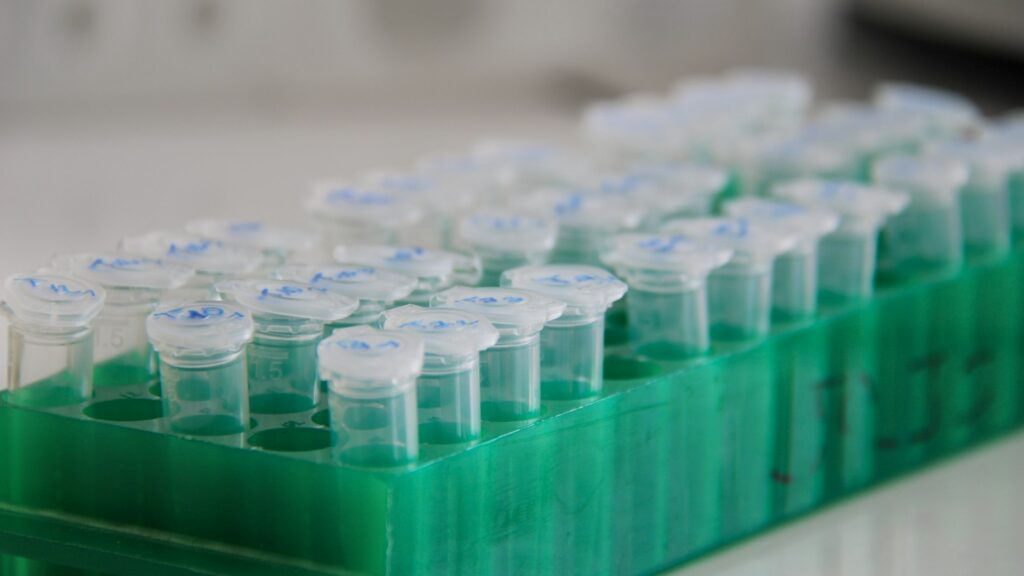
Two vials on the same catalogue page, priced differently, with names that differ by one word: TB-500 and TB-500 Fragment. Most suppliers, ours included until recently, have written about them as though the difference were a matter of packaging. It is not. On the evidence of the United States Food and Drug Administration’s own substance register, the two names refer to molecules that differ roughly five and a half fold in mass, and almost the entire research literature attaches to only one of them.
This article sets out what each name actually denotes, what the published work supports for each, and the single analytical test that tells you which one is in a vial. It is deliberately blunt about where the evidence stops, because this is a case where the marketing and the chemistry have drifted apart.
The short answer
- Thymosin beta-4 is a 43-residue peptide, encoded as a 44-residue precursor whose initiator methionine is removed. UniProt records both numbers, which is why sources appear to disagree.
- The FDA registers “TB-500” as a seven-residue fragment, Ac-LKKTETQ, described in its own synonym list as the “N-terminal acetylated 17-23 fragment of thymosin beta 4”.
- So the two names are not synonyms. Full-length acetylated thymosin beta-4 computes to roughly 4,960 Da; the acetylated heptapeptide to roughly 889 Da.
- The trade uses the label both ways. A 2026 peer-reviewed scoping review says plainly that use of the term “varies across commercial, regulatory, and research contexts”.
- LKKTETQ is a motif, not the whole actin-binding site. Mutating residues outside the motif severely impairs actin binding, so the fragment is not demonstrated to reproduce actin sequestration.
- No head-to-head study compares them. We could find no published study directly comparing full-length thymosin beta-4 with the short fragment.
- Human trial data belongs to the full-length molecule, and the one Phase III result we could read did not meet its primary endpoint.
- A purity percentage cannot tell them apart. Only a measured mass can.
Thymosin beta-4 and the fragment sold as TB-500
T beta-4 · Fx · TMSB4X gene product · UniProt P62328
- Full-length peptide
- 43 residues mature, encoded as a 44-residue precursor; UniProt annotates the initiator methionine as removed
- Native modification
- N-acetylserine at the mature N-terminus, so the natural molecule is itself acetylated
- Established function
- Binds actin monomers and inhibits actin polymerization; a member of the beta-thymosin family
- The motif
- LKKTETQ, at precursor positions 18–24, equivalently mature positions 17–23
- FDA-registered “TB-500”
- Ac-LKKTETQ-OH; UNII QHK6Z47GTG; CAS 885340-08-9
- Mass separation
- Roughly 4,960 Da against roughly 889 Da — about a 5.6-fold difference
- Head-to-head evidence
- None located
Where the evidence stands
- Structural and sequence data
- Cell and animal work on full-length Tb4
- Human trials of full-length Tb4
- Human data for the heptapeptide
The structural biology is solid. The equivalence of the fragment to the parent peptide is not established, and no human data for the fragment could be located.
What thymosin beta-4 is
Thymosin beta-4 is the product of the human TMSB4X gene. UniProt’s reviewed entry, accession P62328, records the molecule twice over: the record header reads 44 AA, while the feature table annotates INIT_MET 1 as removed and the mature CHAIN 2..44 as thymosin beta-4 itself. Those two facts are the reason some sources call it a 44-residue protein and others a 43-residue peptide. Both are defensible if you say which you mean. The precise form is that the mature peptide is 43 residues, encoded as a 44-residue precursor.
The same record notes that the mature peptide carries an N-acetylserine at its new N-terminus. The naturally occurring molecule is therefore already acetylated, which matters when reading a certificate: an acetyl group on a thymosin beta-4 product is not a modification someone has added for stability, it is the native state.
Functionally, UniProt describes it as organising the cytoskeleton by binding actin monomers and inhibiting actin polymerization. It belongs to the beta-thymosin family. One further point worth holding onto, because secondary sources blur it: thymosin beta-4 yields more than one named fragment. Residues 2 to 5 form the hemoregulatory peptide Ac-SDKP, which is annotated separately in the UniProt record and is a different molecule from the one at issue here. Thymosin beta-4 is also unrelated to thymosin alpha-1 despite the shared family name, a confusion we have unpicked separately.
What “TB-500” denotes
This is the part that resolves the question, and it rests on a regulator rather than on commentary. The FDA’s Global Substance Registration System holds a record for the substance named TB-500. That record gives a single protein subunit of length 7 with the sequence LKKTETQ, marked as a complete sequence. Its registered synonyms include the systematic name for the acetylated heptapeptide and, in plain words, “N-terminal acetylated 17-23 fragment of thymosin beta 4”. It carries UNII QHK6Z47GTG and CAS 885340-08-9.
So in the register that assigns substance identifiers, TB-500 is Ac-LKKTETQ-OH: a seven-residue fragment, not the 43-residue parent.
Commerce has not followed suit. A 2026 scoping review in Applied Sciences treats TB-500 as “a commercially used designation for synthetic peptide products marketed as related to TB4”, states that “use of the term varies across commercial, regulatory, and research contexts”, and warns of “products marketed as TB-500, which may not be interchangeable” given what it calls “limited direct equivalence data”. The same review notes that the mechanistic literature it surveyed pertains to thymosin beta-4 or its fragments rather than to TB-500 as a commercial article.
The practical consequence. You cannot infer which molecule you are buying from the product name alone, from any supplier. The name is ambiguous in the market even though it is unambiguous in the FDA register. What resolves it is a measured mass on the batch’s certificate, and nothing else on the label does.
The LKKTETQ motif, and what it does not do
LKKTETQ is the conserved beta-thymosin actin-binding motif. Reading the UniProt sequence directly, it sits at precursor positions 18 to 24, which is mature positions 17 to 23 — exactly the span the FDA synonym names.
It is routinely described as “the actin-binding site”. That overstates it. The site was mapped by mutational analysis in a 1996 EMBO Journal paper by Van Troys and colleagues, whose abstract reports that the N-terminal region must form an alpha-helix to bind, with hydrophobic residues on that helix plus electrostatic contacts. UniProt’s own mutagenesis annotations tell the same story from a different angle: changing lysine 12 to proline gives “very weak actin binding; no inhibition of actin polymerization”, and changing serine 16 to alanine leaves the peptide binding actin 2.5-fold less well than wild type. Both residues lie outside LKKTETQ. The record also annotates helices spanning residues 6 to 11 and 15 to 17, structure that the heptapeptide simply does not contain.
For actin sequestration, then, the motif alone is not demonstrated to be sufficient. There is a separate finding that pulls the other way on a different endpoint: a 2003 FASEB Journal paper by Philp and colleagues reported that the seven-residue motif was essential for angiogenic activity, that peptides lacking part of it were inactive, and that the motif alone matched full-length thymosin beta-4 in that assay at around 50 nM. That figure is an in-vitro potency, not a dose, and we read it at abstract level only. It is a within-study comparison on one endpoint in one assay system, which is not the same thing as establishing that the fragment substitutes for the parent peptide generally.
Masses, and why identity needs one
The two molecules are far apart in mass, which makes them trivially separable by mass spectrometry and completely inseparable by a purity figure. The values below are computed from the sequences in the UniProt record and the FDA synonym; as a check on the method, the computed average mass for the 44-residue precursor comes to 5,052.66 Da against UniProt’s stated 5,053, agreeing to under a dalton.
| Species | Formula | Monoisotopic | Average |
|---|---|---|---|
| Precursor, 44 residues | C215H357N57O78S2 | 5049.52 | 5052.66 |
| Mature Tb4, 43 residues, free N-terminus | C210H348N56O77S | 4918.48 | 4921.47 |
| Mature Tb4, N-acetylated (native form) | C212H350N56O78S | 4960.49 | 4963.51 |
| LKKTETQ, free N-terminus | C36H66N10O13 | 846.48 | 846.98 |
| Ac-LKKTETQ-OH (FDA “TB-500”) | C38H68N10O14 | 888.49 | 889.02 |
These are computed values rather than publisher-sourced ones, and we say so rather than dressing them up. The point they make does not depend on the third decimal place: a mass determination near 4.96 kDa indicates full-length acetylated thymosin beta-4, and one near 889 Da indicates the acetylated heptapeptide. There is no ambiguity in between.
The reading rule follows directly. A certificate that reports only “HPLC purity 98 per cent” with no measured mass has not told you which molecule is in the vial, because a purity percentage is a relative measure of detected material and will read high for either. Our guides to reading a mass spectrum and calculating a peptide’s molecular weight from its sequence cover the arithmetic if you want to check a report yourself.
What human data exists, and for which molecule
There is published human trial work, and it belongs to the full-length molecule. A 2023 paper in International Journal of Molecular Sciences reports SEER-1, a multicentre, randomised, placebo-controlled, double-masked Phase III study of RGN-259 in neurotrophic keratopathy, whose active drug substance the authors describe as the synthetic version of thymosin beta-4. The trial was terminated early for slow recruitment: 18 subjects completed, 10 on active treatment and 8 on placebo, against 46 planned. On the primary endpoint, complete healing at day 29 in the intention-to-treat population, 6 of 10 healed on active against 1 of 8 on placebo, giving a Fisher’s exact p of 0.0656 — not statistically significant. A day-43 comparison reached p = 0.0359.
That is worth stating carefully, because the trial is often cited as though it were a positive result. It was underpowered by its own early termination and it missed its primary endpoint. No fragment was tested in it.
For the heptapeptide, we could find no human interventional data at all. We also could find no published study directly comparing full-length thymosin beta-4 with the short fragment on any endpoint, which is the single most important sentence in this article: the equivalence that the shared trade name implies has not been demonstrated.
What’s established and what isn’t
Reasonably well established
- Thymosin beta-4 is the TMSB4X product: 43 residues mature, 44 as encoded, natively N-acetylated at the mature N-terminus.
- It binds actin monomers and inhibits actin polymerization.
- LKKTETQ is the conserved beta-thymosin motif, at mature positions 17 to 23.
- The FDA registers the substance named TB-500 as the acetylated heptapeptide Ac-LKKTETQ, UNII QHK6Z47GTG.
- Residues outside the motif, including lysine 12 and serine 16, contribute materially to actin binding.
- A measured mass separates the two molecules unambiguously; a purity percentage does not.
Open questions
- Whether the heptapeptide reproduces any activity of the parent peptide beyond the single angiogenesis endpoint reported at abstract level in 2003.
- Whether the two are interchangeable at all. No head-to-head study was located, and a 2026 review calls the equivalence data limited.
- What the fragment does in a whole animal or in a person. No human interventional data for it could be located.
- Whether full-length thymosin beta-4 has a clinical effect in neurotrophic keratopathy. The Phase III result did not reach its primary endpoint at an interim sample size.
- Which molecule any given supplier’s “TB-500” contains, absent a mass measurement on the batch certificate.
Sourcing either form in Canada
If you are ordering either product for laboratory work, the documentation question is narrower than usual and unusually decisive: you are not checking how pure the material is so much as which molecule it is.
- Look for a measured mass, not just a purity figure. Roughly 4.96 kDa indicates the full-length acetylated peptide; roughly 889 Da indicates the heptapeptide. Our COA guide covers what else a useful certificate contains.
- Match the batch number on the certificate to the one on your vial. A report about different material is a document about different material.
- Treat the name as a label, not a specification. Our TB-500 research guide sets out the naming problem at length, and BPC-157 versus TB-500 compares the two repair-research compounds.
- Do not carry the full-length literature across to a fragment, or the reverse. The MAPK pathway article works through a related case where signalling claims were transferred between the two without evidence.
Research peptides with published test reports
Both forms are in the catalogue as separate products, along with the two blends that contain them. Janoshik test reports are listed by batch on our Lab Testing page.
 TB-500 (Thymosin Beta-4)Listed as the full-length thymosin beta-4 formView product
 TB-500 FragmentThe short fragment form, listed separatelyView product
 BPC-157 + TB-500 BlendCo-formulated with BPC-157View product
 BPC-157 + TB-500 Fragment BlendThe fragment form, co-formulated with BPC-157View product
Research use only. Pure Peptides Canada products are laboratory reagents for in-vitro research, not for human or veterinary use. This article explains published research for education; it is not medical, dietary or dosing guidance.
Frequently asked questions
Is TB-500 the same thing as thymosin beta-4?
Not according to the register that assigns substance identifiers. The FDA’s Global Substance Registration System records the substance named TB-500 as a single seven-residue protein subunit with the sequence LKKTETQ, and its registered synonyms include the phrase N-terminal acetylated 17-23 fragment of thymosin beta 4. Full-length mature thymosin beta-4 is 43 residues. The two differ about 5.6-fold in mass. In commerce, however, the name is used both ways, so the label alone does not tell you which molecule you have.
How many amino acids does thymosin beta-4 have, 43 or 44?
Both numbers appear in the same UniProt record and refer to different things. Accession P62328 is headed 44 amino acids, which is the encoded precursor, and its feature table marks the initiator methionine as removed, leaving a mature chain of residues 2 to 44. That mature peptide is 43 residues. The precise way to say it is that thymosin beta-4 is a 43-residue peptide encoded as a 44-residue precursor.
What is the LKKTETQ motif?
It is the conserved actin-binding motif of the beta-thymosin family, sitting at mature positions 17 to 23 of thymosin beta-4. It is often called the actin-binding site, which overstates what has been shown. Mutational mapping published in 1996 found that the N-terminal region has to form an alpha-helix to bind actin, and UniProt records that altering lysine 12 or serine 16, both outside the motif, substantially impairs actin binding. The heptapeptide does not contain those residues or that helix.
Does the fragment do the same thing as the full-length peptide?
That is not established. For actin sequestration the evidence points away from it, because residues outside the motif contribute to binding. For one angiogenesis endpoint, a 2003 paper reported at abstract level that the motif alone matched full-length thymosin beta-4 in that assay system, at a potency of around 50 nanomolar, which is an in-vitro potency figure and not a dose. That is a single endpoint in a single assay. We could find no published study directly comparing the two molecules.
Is there human trial data for TB-500?
We could find none for the heptapeptide. There is published human work on full-length thymosin beta-4: a Phase III study of RGN-259 in neurotrophic keratopathy, reported in 2023, which was terminated early for slow recruitment with 18 of 46 planned subjects completing. Its primary endpoint, complete healing at day 29, gave a Fisher’s exact p of 0.0656 and so was not statistically significant. No fragment was tested in that trial.
How can I tell which molecule is in a vial?
By a measured mass on the batch certificate, and realistically by nothing else. A mass determination near 4,960 daltons indicates full-length acetylated thymosin beta-4; one near 889 daltons indicates the acetylated heptapeptide. A purity percentage cannot distinguish them, because it is a relative measure of the material detected and will read high for either molecule. Retention time differs as well, but it depends on the method and so corroborates rather than decides.
Why is a thymosin beta-4 product already acetylated?
Because the natural molecule is. UniProt annotates an N-acetylserine at the mature N-terminus of thymosin beta-4, so acetylation there is the native state rather than something added to improve stability. This is different from peptides sold in both plain and N-acetyl versions, where the acetyl group is a deliberate synthetic modification.
Both forms, listed separately and documented by batch
The full-length peptide and the fragment are separate products in the catalogue, priced in Canadian dollars and shipped tracked from inside Canada.
References
- UniProt Consortium. UniProtKB entry P62328 (TYB4_HUMAN), thymosin beta-4, Homo sapiens. Reviewed entry; sequence, initiator-methionine removal, N-acetylserine modification, mutagenesis and helix annotations. Record
- US Food and Drug Administration. Global Substance Registration System, substance “TB-500”, UNII QHK6Z47GTG, CAS 885340-08-9; protein subunit of length 7, sequence LKKTETQ; registered synonym “N-terminal acetylated 17-23 fragment of thymosin beta 4”. Record
- McGuire F, Hughes E, Maak T, Cushman DM. Thymosin Beta-4 and TB-500 in Tissue Healing, Regeneration, and Musculoskeletal Repair: A Scoping Review. Applied Sciences. 2026;16(12):6202. DOI
- Van Troys M, Dewitte D, Goethals M, Carlier MF, Vandekerckhove J, Ampe C. The actin binding site of thymosin beta 4 mapped by mutational analysis. EMBO J. 1996;15(2):201–210. Abstract consulted. DOI
- Philp D, Huff T, Gho YS, Hannappel E, Kleinman HK. The actin binding site on thymosin beta-4 promotes angiogenesis. FASEB J. 2003;17(14):1–13. Abstract consulted. DOI
- Sosne G, Kleinman HK, Springs C, Gross RH, Sung J, Kang S. A Phase III, Multicenter, Randomized, Placebo-Controlled, Double-Masked Clinical Trial of RGN-259 in Neurotrophic Keratopathy. Int J Mol Sci. 2023;24(1):554. DOI
For laboratory research use only. Not for human or veterinary use. This article summarizes published research for educational purposes and is not medical advice.