
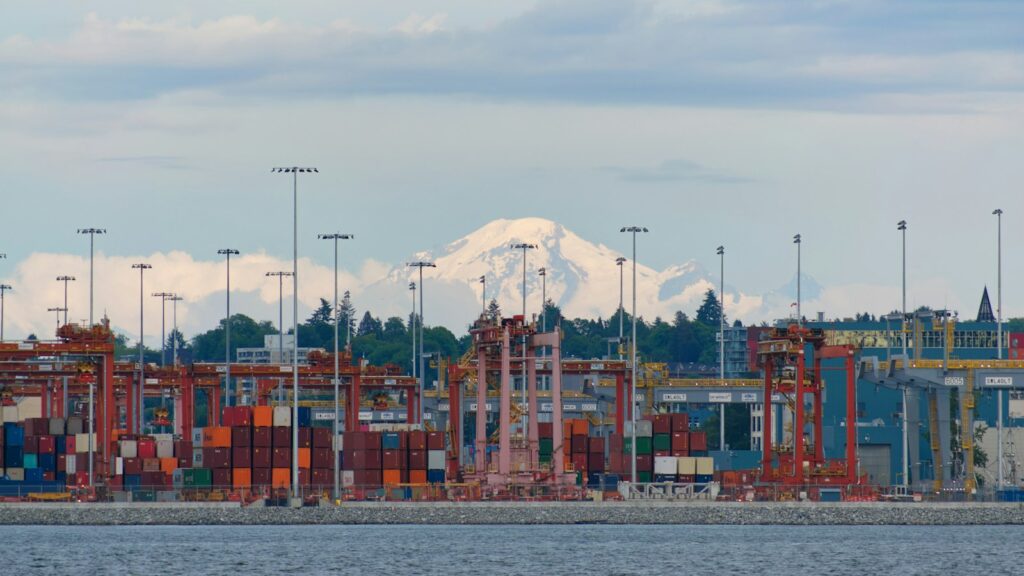
Where are research peptides made? For a synthetic peptide, the honest answer starts with the manufacturer that ran the synthesis, not the company whose name is on the vial — and the material may pass through purification, freeze-drying, testing, labelling and distribution, in different hands, before it reaches a bench. That is why an origin claim deserves a close reading, and why it can never replace the documents that come with a lot.
This article follows a peptide through that chain, lists the records that should travel with each lot, and explains what the Competition Bureau’s “Product of Canada” and “Made in Canada” tests measure under its guidelines of March 7, 2025 — and why “Canadian-owned”, “shipped from Canada”, “tested” and “formulated” are different claims.
The short answer
- A synthetic peptide is made in stages. It is usually assembled by solid-phase synthesis, generally purified by chromatography and commonly freeze-dried; testing, labelling and distribution can each happen somewhere else.
- The seller is not necessarily the manufacturer. ICH Q7, a pharmaceutical manufacturing guide, has a whole section for “any party other than the original manufacturer” that trades, repacks, relabels or distributes material.
- Origin travels on paper. ICH Q7 expects those parties to keep the original manufacturer’s identity, its batch number and “All authentic Certificates of Analysis, including those of the original manufacturer”.
- “Product of Canada” is the stricter claim. The Competition Bureau generally will not challenge it if the last substantial transformation occurred in Canada and at least 98% of total direct costs were incurred in Canada.
- “Made in Canada” needs a qualifier. The same transformation test applies, with at least 51% of direct costs incurred in Canada and a qualifying statement such as “Made in Canada with imported parts”.
- Ownership, shipping and quality are separate questions. “Canadian-owned” and “shipped from Canada” describe the seller, not where the molecule was made, and no origin claim says anything about identity or purity.
“Product of Canada” and “Made in Canada”
Origin claims · where a good was made
- What they are
- Statements about where a good was made, judged by a transformation test and a cost test
- Guidance
- Competition Bureau enforcement guidelines dated March 7, 2025
- Laws
- Competition Act, Consumer Packaging and Labelling Act, Textile Labelling Act (non-food products)
- Product of Canada
- Last substantial transformation in Canada; at least 98% of total direct costs incurred in Canada
- Made in Canada
- The same transformation test; at least 51% of direct costs; a qualifying statement
- Substantial transformation
- A “fundamental change in form, appearance or nature” that yields new and different goods
- Direct costs
- The producer’s materials and labour; general overhead is usually excluded
- What they are not
- Approvals or certifications, or statements about quality
What an accurate origin claim can tell you
- Where the last substantial transformation took place
- That a set share of direct costs was incurred in Canada
- Who synthesized, tested or relabelled the lot
- The identity or purity of what is in your vial
An origin claim is a statement about places and costs. Everything about the material itself has to come from the lot’s own documents.
The links in a peptide supply chain
A synthetic research peptide is built, not extracted. In solid-phase synthesis the sequence is “built up on a solid support”, in the words of the European Medicines Agency’s 2025 guideline on synthetic peptides; our explainer on how solid-phase synthesis works covers the chemistry. Five more links follow, and each can sit in a different company or country:
- Purification. The crude peptide is cleaved from the resin and, as the EMA guideline puts it, “generally purified using chromatographic techniques”.
- Isolation. The guideline calls freeze-drying (lyophilization) “common practice”, while precipitation, crystallization and spray drying are also used.
- Testing. A sample is analyzed and a report is issued for that lot.
- Filling and labelling. Vials receive a lot number, and material can later be repacked or relabelled by someone other than the maker.
- Distribution. The product moves to a seller, then to your lab.
An origin claim compresses that sequence of places into a word or two.
Where research peptides are made, and by whom
The chemistry at the start of the chain is specialist work, spread across the pharmaceutical industry and contract organizations that make peptides for others. A 2019 perspective in The Journal of Organic Chemistry on peptide synthesis and purification addresses that mix, encouraging synergies between academia, “the pharmaceutical industry, and contract research organizations/contract manufacturing organizations.”
Even one manufacturer may buy in parts of a molecule. For peptide medicines, the EMA asks for “the name and address of all starting material manufacturers” and notes that for conjugated peptides the linkers and conjugation moiety are, in many cases, made by a different manufacturer than the peptide. Those are medicine rules, cited only to show how many hands one molecule can pass through.
As for geography, we looked for an independent, published breakdown of where research-grade peptides are synthesized and found none; the commercial market-research reports we found estimate market size rather than document manufacturing sites. Origin therefore has to be established lot by lot, from what a seller can document, not assumed from where the seller is based.
Want to know more about who we are and how we work?
About usWhat should travel with a lot
When several companies handle a peptide, paperwork holds the story together. The clearest description is in ICH Q7, the international good manufacturing practice guide for active pharmaceutical ingredients. Its section 17 covers “any party other than the original manufacturer” that trades, repacks, relabels, distributes or stores material, and says such parties “should maintain complete traceability”, keeping among other records:
- the original manufacturer’s identity and address;
- the manufacturer’s batch number;
- purchase, transport, receipt and distribution records;
- “All authentic Certificates of Analysis, including those of the original manufacturer”;
- the retest or expiry date.
When a certificate is reissued along the way, ICH Q7 says it should name “the laboratory that performed the analysis” and refer to the original manufacturer and to “the original batch Certificate, a copy of which should be attached.” The supplier should also give its customer “the name of the original API or intermediate manufacturer and the batch number(s) supplied”. The World Health Organization’s 2018 model certificate of analysis agrees: “A copy of the CoA generated by the original manufacturer should be attached.”
These are drug frameworks, and this article makes no claim about which rules apply to a laboratory reagent; they serve as a yardstick for complete documentation. For a research purchase, a practical minimum is a lot number that matches the certificate, a certificate that names the laboratory that did the work, and a way to trace any relabelled lot back to the original. Our guide to lot numbers and traceability explains what a matching number can and cannot prove.
What “Product of Canada” and “Made in Canada” mean
Origin claims on non-food products fall to the Competition Bureau, whose current enforcement guidelines, dated March 7, 2025, relate to the Competition Act, the Consumer Packaging and Labelling Act and the Textile Labelling Act. (Food origin labelling is a matter for the Canadian Food Inspection Agency.) The guidelines are not a licensing scheme — “we do not approve or certify such claims,” the Bureau says — but a statement of when it will generally not challenge one.
Both claims require that the last substantial transformation occurred in Canada. Goods are substantially transformed, the guidelines say, when they “undergo a fundamental change in form, appearance or nature such that the goods existing after the change are new and different goods”. The claims then differ on cost:
- “Product of Canada”: “all or virtually all (at least 98%)” of the total direct costs of producing or manufacturing the good incurred in Canada.
- “Made in Canada”: at least 51% of those costs incurred in Canada, plus a qualifying statement such as “Made in Canada with imported parts” or “Made in Canada with domestic and imported parts”.
How a claim is read matters as much as the arithmetic. The Bureau weighs “the general impression conveyed by a representation, as well as its literal meaning”, the rules cover every medium including the internet, and no one has to have been misled in fact. Misleading representations can be pursued criminally when made knowingly or recklessly (section 52 of the Competition Act) or as civil reviewable conduct (section 74.01).
Qualifiers are enforced. In December 2016 the Bureau resolved concerns over the parka maker Moose Knuckles’ “Made in Canada” advertising: the company agreed to make it clearer that certain parkas “are in fact made with Canadian and imported components” and to donate $750,000 over five years to charities in Canada.
The guidelines say nothing about chemicals or peptides, and this article applies them to no product. What the transformation test does make clear is the question to ask of any Canadian origin claim: which steps, from synthesis on, actually happened in Canada?
Canadian-owned, shipped from Canada, tested, formulated: different claims
Much Canadian wording is not, on its face, an origin claim; it describes the business, the warehouse or one process. Where a product meets neither test, the Bureau “recommends the use of a more specific term that more accurately reflects the limited production or manufacturing activity that took place in Canada”, and it accepts process claims such as “Designed in Canada” if they are accurate and understood as referring to that process.
| Wording | What it describes | What the Bureau’s guidelines say | What it does not tell you |
|---|---|---|---|
| Product of Canada | Where the good was made | Last substantial transformation in Canada; at least 98% of direct costs in Canada | The identity or purity of any lot |
| Made in Canada with imported parts | Where the good was made, with foreign inputs | Same transformation test; at least 51% of direct costs; a qualifying statement | Which inputs were imported, or from where |
| Manufactured or produced in Canada | Where the good was made | Likely read as “Made in Canada”, so the same conditions apply | Anything a “Made in Canada” claim would not |
| Designed, assembled or formulated in Canada | One process | Accepted if accurate and clearly about that process; “formulated” is not mentioned | Where the peptide itself was synthesized |
| Tested or lab tested | That a sample was analyzed | Not addressed; a statement about analysis, not origin | Where it was made, or whether the report matches your lot |
| Shipped from Canada | Where the parcel starts out | Not addressed; a fact about logistics | Where the contents were made |
| Canadian-owned | Who owns the business | Not addressed; a fact about ownership | Where any product was made |
| Maple leaf or flag imagery | Nothing explicit | May “be just as forceful as an explicit ‘Made in Canada’ written representation” | Anything, unless an accurate claim stands behind it |
Two rows can both be true of a business whose products are made abroad. “Shipped from Canada” says where the parcel begins its trip — our page on how orders ship within Canada describes ours — and nothing about the contents. “Canadian-owned” says who owns the company. The risk is context: the Bureau reads implied claims through “the overall general impression” of an advertisement, label or other promotional material, so a maple leaf beside “Canadian-owned” can say more than the words do.
Questions to ask any supplier about origin
Each of these needs more than a slogan:
- “What does your Canadian wording refer to?” Ownership, shipping, one process or manufacture. A good answer names the step.
- “Were synthesis, purification and freeze-drying done by one manufacturer?” If not, ask how your lot number connects to the original batch.
- “Has this material been repacked or relabelled?” If so, the documents should still lead back to the original batch.
- “Who tested this lot, and does the report carry my vial’s lot number?” A certificate is evidence about the lot it names, and nothing more.
- “If you reissued the certificate, does it name the testing laboratory?” ICH Q7 and the WHO model both expect that.
If a supplier declines to name its manufacturer, the documentation for your lot has to carry more of the weight. We are a supplier too, so put the same questions to us; our guide to choosing a Canadian supplier turns them into a wider checklist.
What’s established and what isn’t
Established, and citable
- The Bureau’s current origin-claim guidelines are dated March 7, 2025 (Competition Bureau).
- “Product of Canada”: last substantial transformation in Canada plus at least 98% of direct costs (Competition Bureau).
- “Made in Canada”: the same test, at least 51% of direct costs and a qualifying statement (Competition Bureau).
- A flag or maple leaf can amount to an implied “Made in Canada” claim (Bureau guidelines, 3.2.4).
- Synthetic peptides are generally purified by chromatography, and lyophilization is common practice (EMA, 2025).
- Drug-quality guidance says a reissued certificate should name the testing laboratory and come with the original manufacturer’s certificate (ICH Q7; WHO, 2018).
Open, or outside what an origin claim can show
- Where research-grade peptides are mostly synthesized: we found no independent, published data.
- How the guidelines would apply to any particular reagent; they do not mention peptides.
- Which steps of a given lot’s journey happened in which country, unless the seller documents it.
- How your institution interprets “Canadian suppliers” or “Canadian content”.
- Anything about identity, purity or suitability for an experiment.
Origin and sourcing questions in Canada
Origin is now a practical question for Canadian labs. The Tri-agency Guide on Financial Administration, in effect from April 1, 2026, says institutions and grant recipients “are strongly encouraged to take reasonable steps to prioritize Canadian suppliers, services, material and content wherever possible.” Supplier and material are different words there, and the federal government keeps them apart in its own buying: its Buy Canadian materials policy for large construction and defence purchases says “materials must be made in Canada, not simply sold by Canadian companies”. How your institution reads that wording is its decision, not a supplier’s.
Our own facts: Pure Peptides Canada is a Canadian-owned online supplier of research peptides and laboratory reagents, established in 2023 and based in Toronto. We price in Canadian dollars and ship tracked from inside Canada to every province and territory. As our guide to research peptides in Canada states, our research peptides are made “by specialist peptide manufacturers overseas”.
For anything specific to a product or lot — the question no origin label can answer — ask us directly.
Our research peptides and their batch documents
Janoshik test reports for the research peptides below are listed on our Lab Testing page. If you need more detail about a particular lot before you order, ask us through the Contact page.
 BPC-15715-amino-acid research peptideView product
 GHK-CuCopper tripeptideView product
 TB-500Thymosin beta-4 research peptideView product
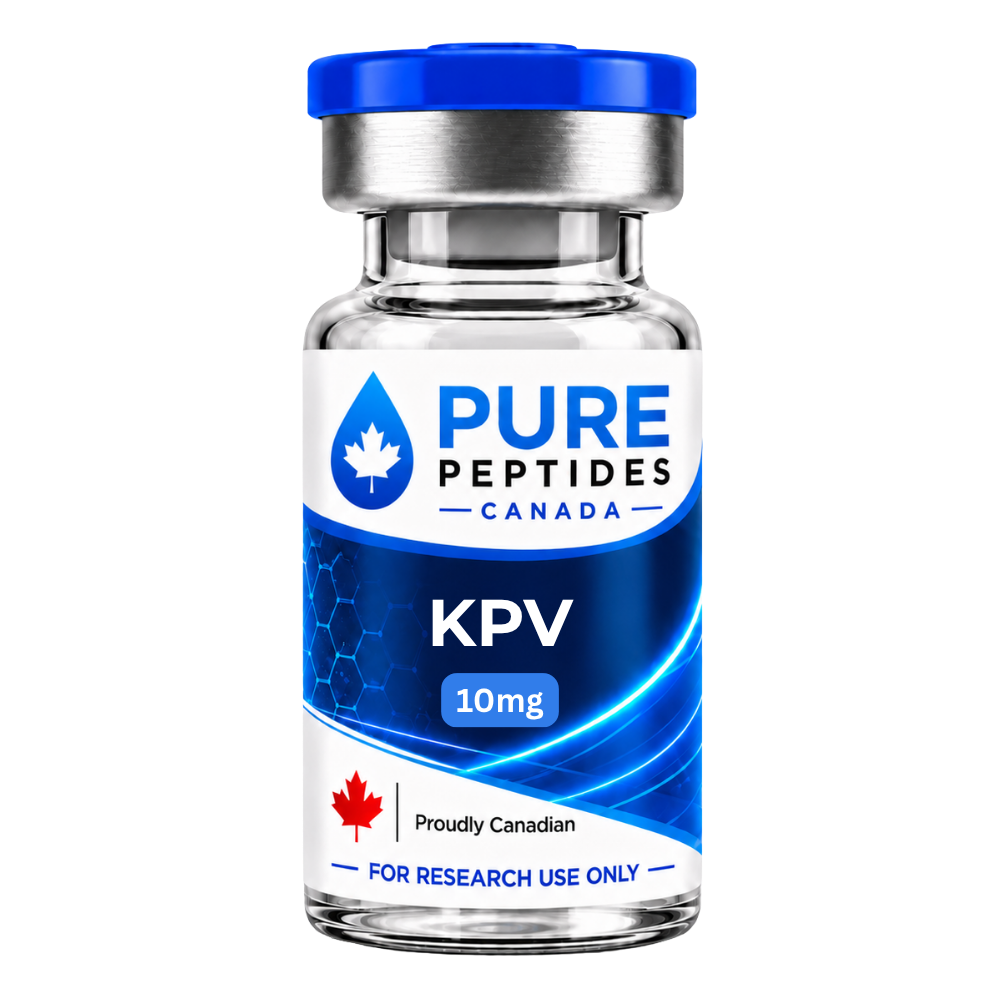 KPVLys-Pro-Val tripeptideView product
Research use only. Pure Peptides Canada products are laboratory reagents for in-vitro research, not for human or veterinary use. This article explains supply chains and origin claims for education; it is not medical, dietary or dosing guidance, and it is not legal or regulatory advice.
Frequently asked questions
Where are research peptides made?
By peptide manufacturers, typically through solid-phase synthesis, chromatographic purification and freeze-drying; testing, labelling and distribution may happen elsewhere. We found no independent, published breakdown of where research-grade peptides are synthesized, so ask the seller what it can document for your lot.
What does Made in Canada mean on a product?
Under its guidelines dated March 7, 2025, the Competition Bureau generally will not challenge a Made in Canada claim on a non-food product if the last substantial transformation happened in Canada, at least 51% of total direct costs were incurred in Canada, and the claim carries a qualifier such as Made in Canada with imported parts.
What is the difference between Product of Canada and Made in Canada?
Both require the last substantial transformation of the good to have happened in Canada. Product of Canada also needs at least 98% of total direct costs incurred in Canada, while Made in Canada needs at least 51% plus a qualifying statement. Product of Canada is the stricter claim.
If a peptide supplier is Canadian, are its peptides made in Canada?
Not necessarily. Canadian-owned describes who owns the business and shipped from Canada describes where the parcel starts its journey; neither says where a peptide was synthesized. Ask the supplier which steps, if any, took place in Canada.
What should I ask a supplier about where a peptide was made?
Ask what its Canadian wording refers to, whether one manufacturer did the synthesis, purification and freeze-drying, and whether the material was repacked or relabelled. Then ask who tested the lot, and check that the report carries the same lot number as your vial.
Does country of origin tell you anything about peptide quality?
Not by itself. Origin tests look at where a product was transformed and where its costs were incurred, not at identity or purity. Evidence about quality has to come from documents for the specific lot, such as a certificate of analysis that matches your vial’s lot number.
Ask where a product comes from
Ask us about a product’s documentation, and see the certificates on our Lab Testing page.
References
- Competition Bureau Canada. “Product of Canada” and “Made in Canada” Claims. Enforcement guidelines, March 7, 2025 (page modified 2025-03-17). Competition Bureau Canada
- Competition Bureau Canada. Made in Canada claims. Competition Bureau Canada
- Government of Canada. Competition Act (R.S.C., 1985, c. C-34), section 52. Current to 2026-09-30. Justice Laws Website
- Government of Canada. Competition Act (R.S.C., 1985, c. C-34), section 74.01. Current to 2026-09-30. Justice Laws Website
- Competition Bureau Canada. Competition Bureau resolves Made in Canada advertising concerns with Moose Knuckles. News release, December 7, 2016. Government of Canada
- International Council for Harmonisation. ICH Q7: Good Manufacturing Practice Guide for Active Pharmaceutical Ingredients (CPMP/ICH/4106/00), November 2000. Sections 11.4 and 17. European Medicines Agency
- World Health Organization. Model certificate of analysis. WHO Technical Report Series, No. 1010, Annex 4, 2018. World Health Organization
- European Medicines Agency. Guideline on the development and manufacture of synthetic peptides. EMA/CHMP/CVMP/QWP/367182/2025, in effect from June 1, 2026. European Medicines Agency
- Isidro-Llobet A, Kenworthy MN, Mukherjee S, Kopach ME, Wegner K, Gallou F, Smith AG, Roschangar F. Sustainability challenges in peptide synthesis and purification: from R&D to production. The Journal of Organic Chemistry, 2019;84(8):4615–4628. doi:10.1021/acs.joc.8b03001. American Chemical Society
- Natural Sciences and Engineering Research Council of Canada, Social Sciences and Humanities Research Council and Canadian Institutes of Health Research. Tri-agency Guide on Financial Administration, effective April 1, 2026: Goods and services expenditures. NSERC
- Public Services and Procurement Canada. Buy Canadian (page modified 2026-07-06). Government of Canada
For laboratory research use only. Not for human or veterinary use. This article summarizes published regulatory, standards and scientific material for educational purposes and is not medical, legal or regulatory advice.