
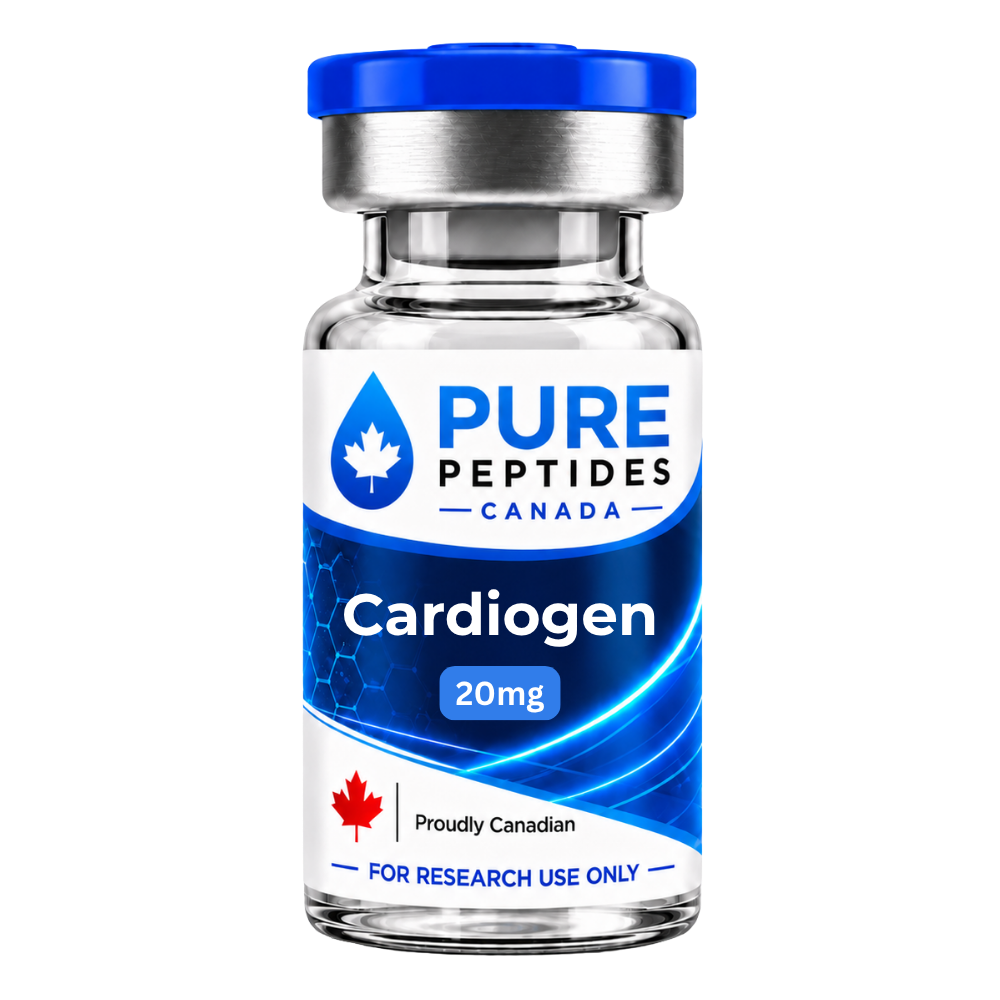
Description
Cardiogen is the synthetic tetrapeptide Ala-Glu-Asp-Arg (AEDR), a St. Petersburg bioregulator whose sequence its developers report finding in a peptide complex from heart tissue; most published work on it concerns DNA binding, with a few rat studies. Pure Peptides Canada supplies it as a lyophilized research reagent in 20 mg vials, with an independent Janoshik HPLC and mass-spectrometry report, CAD pricing and tracked shipping from inside Canada.
Cardiogen at a glance
- What it is: L-alanyl-L-glutamyl-L-aspartyl-L-arginine (AEDR), a synthetic tetrapeptide from Vladimir Khavinson’s bioregulator programme.
- What researchers study: DNA and histone binding in cell-free assays, predicted DNA-binding sites, tumour growth in old rats, and how swapping the fourth residue changes behaviour within the AED set.
- Evidence level: thin. A few biochemical and rat studies, some known mainly through the developers’ own reviews, and little work in cultured heart cells. We found no peer-reviewed controlled trial in people.
- Supplied as: sealed lyophilized powder, 20 mg, single vial or box of 10.
- Delivery: ships from inside Canada by tracked Xpresspost in 3–7 days ($25 CAD), or free in 4–12 days on orders over $299.
Cardiogen
Ala-Glu-Asp-Arg · AEDR tetrapeptide · cardiac bioregulator
- A
- E
- D
- R
Black: the Ala-Glu-Asp core shared with Cartalax, Cortagen, Bronchogen and Epithalon. Blue: the arginine that distinguishes Cardiogen.
- Length
- 4 amino acids
- Molecular formula
- C18H31N7O9
- Molecular weight
- ≈ 489.5 g/mol
- Family
- Khavinson short-peptide bioregulators
- Form
- Lyophilized powder, sealed vial
- Sizes
- 20 mg (single or box of 10)
- SKU
- PP-CARDIOGEN
Where the evidence stands
- Cell studies
- Animal models
- Controlled human trials
- Approved medicine
Published work comes mainly from the group that developed it. Cardiogen is not an approved medicine.
What is Cardiogen?
Cardiogen is four residues long: alanine, glutamic acid, aspartic acid and arginine (AEDR). Its developers report that the AEDR sequence was detected, by chromatography–mass spectrometry, in a polypeptide complex prepared from heart tissue (Khavinson and colleagues, Cells, 2023). That is the origin of the name and of the cardiac association. The synthetic peptide is a single defined molecule, not the extract.
Structurally, Cardiogen sits at a junction in the catalogue. It shares its Ala-Glu-Asp opening with Epithalon (AEDG), Cortagen (AEDP) and Bronchogen (AEDL), and the AED tripeptide on its own is sold as Cartalax. Read from the other end, it is Pinealon (EDR) with one alanine added at the front. The two have been compared directly, and that single residue made a large difference to how strongly they bound DNA.
Despite the name, the published record contains little work in cultured heart cells. Most of what is known comes from cell-free binding assays, computer modelling and a few rat studies, and the heart-specific findings are known mainly through the developers’ own summaries.
What published studies report
- Strong DNA binding in a six-peptide comparison. Fedoreyeva and colleagues (Biochemistry (Moscow), 2011) measured how six bioregulators quench fluorescent DNA probes. In the ethidium-bromide and phage-DNA assay, Cardiogen’s binding constants were roughly 1.5 to 6 times those of the others, including Epithalon and Pinealon, and the authors suggested it may slip between the base pairs of double-stranded DNA. It bound probes containing TGA or TCA motifs but not a GC-rich probe. These are test-tube measurements, not cell data.
- A predicted DNA site. In the developers’ 2016 docking survey of 19 bioregulators (Khavinson, Lin’kova and Tarnovskaya, Bulletin of Experimental Biology and Medicine), AEDR was rated a very strong binder, with a predicted preference for the four-base sequence AGTC. No laboratory validation was reported.
- Histones and nucleases. The developers’ 2021 systematic review (Molecules) lists AEDR among six short peptides reported to bind fluorescently labelled wheat histones H1, H2B, H3 and H4, and among peptides that inhibit or stimulate cleavage of phage DNA by wheat endonucleases depending on DNA methylation.
- Tumour growth in old rats. Levdik and Knyazkin (Bulletin of Experimental Biology and Medicine, 2009) studied senescent rats carrying transplanted M-1 sarcoma. Tumours in the Cardiogen groups grew more slowly and showed more apoptosis and haemorrhagic necrosis. Because proliferation measures did not point to a direct cytostatic effect on tumour cells, the authors proposed an effect on the tumour’s blood vessels. It is a single study.
- Heart injury and fibroblasts, as summarized by the developers. A 2023 review by Khavinson and colleagues (Cells) reports, from the group’s earlier work, about threefold lower mortality and smaller necrotic zones in rats after coronary-artery ligation, and increases of roughly two- to fivefold in actin, tubulin and vimentin, and two- to threefold in lamins A and C, in mouse embryonic fibroblast cultures. These are secondary summaries rather than primary data we could examine.
Reported in studies
- Strong DNA binding in cell-free assays, well above Pinealon’s.
- A predicted preference for the DNA motif AGTC (modelling only).
- Slower tumour growth and more apoptosis in one rat sarcoma study.
- Developer-reported lower mortality after experimental heart injury in rats.
Not established
- Any effect on human heart cells or on heart function.
- Whether AEDR reaches DNA inside living cells.
- Independent replication of the rat findings.
- Whether the synthetic peptide reproduces any activity of the heart extract.
Regulatory status: Cardiogen is not an authorized drug in Canada. We sell it strictly as a laboratory reagent for in-vitro research.
Why researchers order Cardiogen from Pure Peptides Canada
Add a 20 mg vial or a box of 10 above. Orders over $299 ship free across Canada.
See lab resultsCardiogen FAQ
Where can I buy Cardiogen in Canada?
Pure Peptides Canada stocks Cardiogen as a lyophilized research reagent in 20 mg vials and ships it from inside Canada by tracked Xpresspost in 3–7 days ($25 CAD), or free in 4–12 days on orders over $299.
How is Cardiogen related to Epithalon?
Both share the Ala-Glu-Asp core. Epithalon ends in glycine (AEDG) and Cardiogen in arginine (AEDR). They come from the same research programme but are associated with different tissues.
How does Cardiogen differ from Pinealon?
Cardiogen is Pinealon’s sequence with one alanine added at the front: Pinealon is Glu-Asp-Arg (EDR) and Cardiogen is Ala-Glu-Asp-Arg (AEDR). In a 2011 fluorescence assay, Cardiogen bound DNA roughly 2.5 to 4.5 times more strongly than Pinealon.
Is Cardiogen extracted from heart tissue?
No. It is a synthetic tetrapeptide. Its developers report detecting the AEDR sequence in a polypeptide complex from heart tissue, which is where the name comes from.
Can Cardiogen be used in people or animals?
No. This product is for in-vitro laboratory research only and is not a drug, supplement or food. We do not provide dosing or administration information.
References
- Fedoreyeva LI, Kireev II, Khavinson VKh, Vanyushin BF. Penetration of short fluorescence-labeled peptides into the nucleus in HeLa cells and in vitro specific interaction of the peptides with deoxyribooligonucleotides and DNA. Biochemistry (Mosc). 2011;76(11):1210–1219. doi:10.1134/S0006297911110022
- Khavinson VKh, Lin’kova NS, Tarnovskaya SI. Short peptides regulate gene expression. Bull Exp Biol Med. 2016;162(2):288–292. doi:10.1007/s10517-016-3596-7
- Khavinson VK, Popovich IG, Linkova NS, Mironova ES, Ilina AR. Peptide regulation of gene expression: a systematic review. Molecules. 2021;26(22):7053. doi:10.3390/molecules26227053
- Levdik NV, Knyazkin IV. Tumor-modifying effect of Cardiogen peptide on M-1 sarcoma in senescent rats. Bull Exp Biol Med. 2009;148(3):433–436. doi:10.1007/s10517-010-0730-9
- Khavinson V, Linkova N, Dyatlova A, et al. Senescence-associated secretory phenotype of cardiovascular system cells and inflammaging: perspectives of peptide regulation. Cells. 2023;12(1):106. doi:10.3390/cells12010106
For laboratory research use only. Not a drug, supplement, food or cosmetic, not for human or veterinary use, and not intended to diagnose, treat, cure or prevent any disease.


Reviews
There are no reviews yet.